Showing posts with label Hepworth Wakefield. Show all posts

Wednesday, 24 June 2015

The Silver Ticket - Barbara Hepworth

My invitation has arrived for the special private view of the major Barbara Hepworth retrospective at Tate Britain.

It's the first major retrospective in London of the sculptor's work in 50 years.  And I'm going!!

I was at the Hepworth Wakefield the other week to see complementary exhibitions about her work, as a scene-setter for the Tate show.


The first was Hepworth in Yorkshire, about her early years in Wakefield, which sets the scene for her later working life.  It's interesting that Hepworth's very RP accent which you can hear in later documentaries and films doesn't betray anything of her Yorkshire roots - all part of her careful self-image and projection of herself as an international artist.

Here she is on holiday at Robin Hood's Bay in 1925 - as ever, her pose shows that she is very conscious of her artistic image, even early on.
Barbara Hepworth on holiday at Robin Hood's bay, 1925 Photo: BROWNES, HEPWORTH ESTATE

This is a recently discovered early portrait of Hepworth by Ethel Walker.

 
The second exhibition was A Greater Freedom, focussing on her prolific final decade (because artists don't retire), in which she explored new materials such as marble and bronze.  I have to say, I find that the more expensive and precious her materials became, the less connection I have with the work, finding it too sterile and uninteresting.  It looks coldly over-finished, over-processed, lacking in that warm, tactile, sensual quality.

Three Forms (Bronze, 1971)

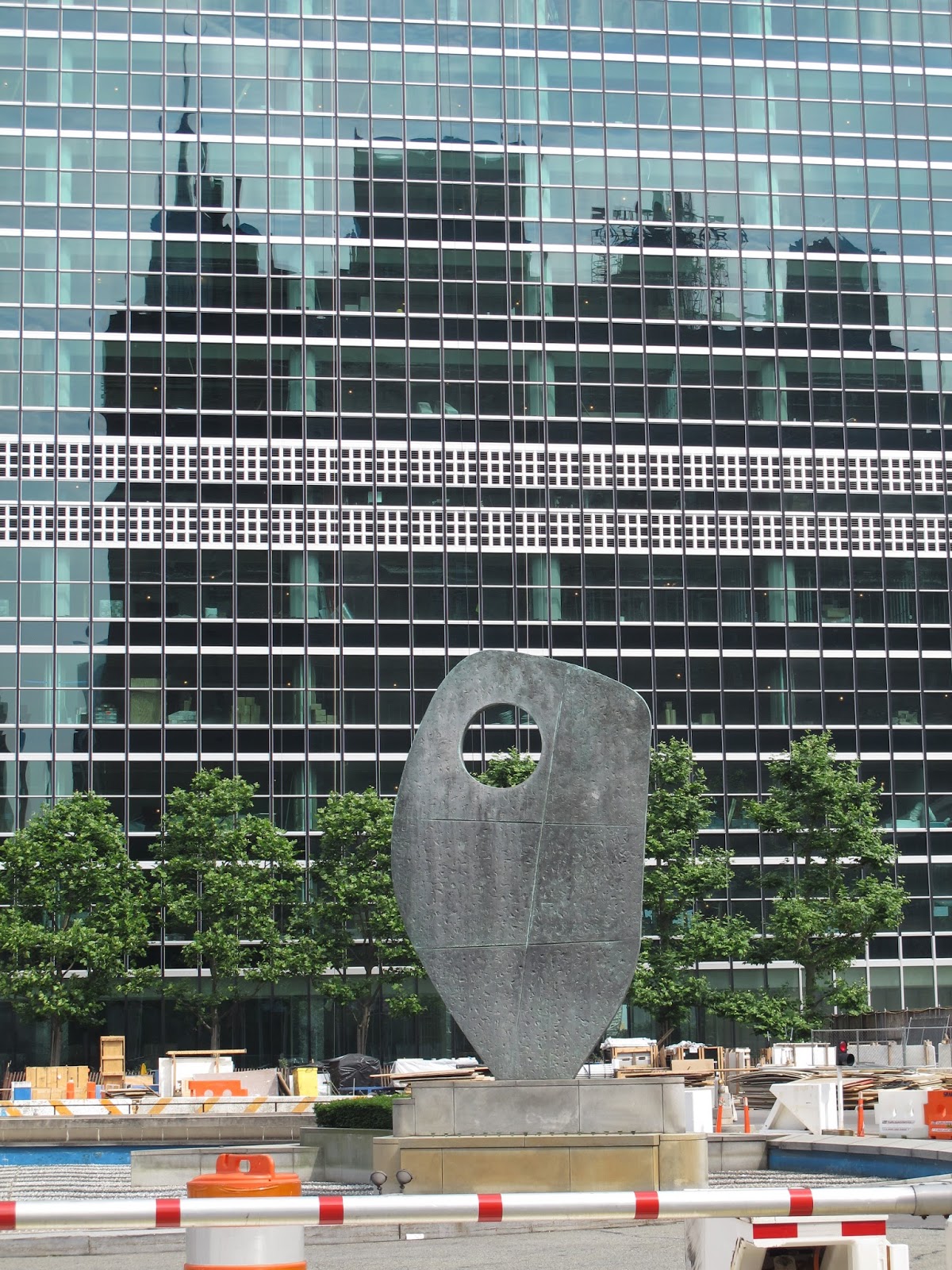
However, this decade also saw her purchasing the Palais de Danse in St Ives in 1961, the large space opposite her studio (which has, excitingly, just been purchased by Tate St Ives).  This large space allowed her to take on such monumental commission such as Single Form for the United Nations.

Here's the photo I took of Single Form last time I was in New York (amidst construction work at the UN).
 

There was also a great display of her printmaking, which showed that she was very interested in the simple, textural marks that you can get on the zinc lithography plate, and of gestural, fluid water-like marks that are possible in the print process.  This mark making has everything thing to do with an artist's interest in a print as means to an end, and as a source material for exploring mark-making possibilities, rather than a print-makers obsession with process.

As ever, it was a joy to look at her plasters, with their wonderful, warm surface textures and painted patinas (which in their watery, gestural sweeping brushmarks, are reminiscent of her prints).  They demanded to be touched.


Which sadly, you can't.  Here's the much much smaller plaster for the UN piece, in the main room of the Hepworth Wakefield.  It has an incised circle instead of the cut-through hole of the UN piece, a pitted surface texture like a natural stone or marble, and a lovely sweep of coloured washes in burnt sienna and Paynes grey, with a beautiful pink tinge of rose quinacridone at the bottom...

...and a beautiful tactile groove running up the back that you just want to run your finger down.  Which again, sadly, you can't.

There's also a wonderful display of how her plasters are created, with the armature


and the finished piece in plaster
 

which would then go on to be cast in bronze.  Here it is in Hepworth's garden at her studio in St Ives.  The bronzes in the garden are meant to be viewed in the context of the shapes of the plants and the sunlight and shadows of the garden.  You can often see how the shapes of the sculptures make reference to and play against, for example, the organic shapes of the cheeseplant or cacti in her greenhouse.
 

The Wakefield gallery is first rate at showing the tools of the trade, and explaining the processes.  Inspiring stuff.

Next week I'm off on a week long sculpture course, and as well as looking forward to the Tate show, I'll be taking a lot of what I saw in Wakefield to my sculpture class.

BARBARA HEPWORTH; SCULPTURE FOR THE MODERN WORLD OPENS TODAY AT TATE BRITAIN, LONDON.  Until 25 October 2015.

Friday, 25 January 2013

Barbara Hepworth: The Hospital Drawings

As I mentioned in a previous blog, despite Snowmageddon, I was down in Wakefield at the weekend to see the exhibition of Barbara Hepworth's little-seen Hospital Drawings before the show finishes at the beginning of February.

It doesn't sound very exciting, but in fact it turned out to be a really tremendous show.

Take a look at this photo of Hepworth.

Barbara Hepworth by Peter Keen
vintage bromide print, early 1950s (c) estate of Peter Keen / National Portrait Gallery, London

Look at any photo of her, and you'll see someone carefully controlling their image.  In this picture, there's something very knowing about the position of the hammer and chisel, the way she stares intensely into the distance.  She's a woman trying to make it in a man's world, and whilst she carved curvy feminine pieces all about motherhood, I bet she was as tough as the stone she's carving.  She had to be. 

But back to the show.  Best known as a sculptor, Hepworth was restricted in this in the 1940s because of childcare commitments - she had four children, including a set of triplets by Ben Nicholson.  Her daughter Sarah had to have an operation in hospital, and Hepworth struck up a friendship with the surgeon.  As a result of this, she was invited to attend a variety of surgical procedures at the hospital in Exeter and in London, and produced around 80 works.  These drawings, made during 1947-49, were on the cusp of the birth of the Health Service.  Thirty of them are in the exhibition.

This is 'Radial' made in 1947.  Have a think about the word 'drawing' and then a good long look at the image.


It's a very different way to make a drawing.  It's not drawn on to paper, it's scratched with a razor into a board covered in a white plaster-like ground - Hepworth talks about using the razor to draw in this way as having the feel of a 'bite' into the ground.  

It's no co-incidence that this way of working mirrors the work of the surgeon - Hepworth draws using a sharp blade, just as the surgeon inscribes the patient with a scalpel.  Hepworth is therefore saying that the work of the surgeon, the way he cuts into a patient, is also something beautiful, a work of art, with the patient as his canvas.  (Considering one of the patients was her daughter, its quite a detached, sang-froid approach, but then there is very little reference to the patient in any of the drawings.)

The gesso ground Hepworth used was made to a special recipe with enamel paint, white lead and chalk (as used by husband, artist Ben Nicholson).  Over the top of the white ground is a thin wash of oil paint, so that the white of the scratches shows up, then pencil lines are drawn on top of the oil and the white scratches.  

This sgraffito gives a sculptural, three-dimensional feel to the figures,  like the drawings of Henry Moore.


Henry Moore, Elephant Skull Plate XIX 1969( HMF Archive)

This is a drawing of an operation - and Hepworth's own daughter had recently gone through the trauma of an operation - and yet none of that sense is here.  This is a serene, calm scene, and as with the majority of the drawings, there is very little to do with the depiction of the patient. The patient is the reason for the surgeons to be there, and yet is strangely absent, usually reduced to a vulval-like opening from which the other components of the composition whirl out like a Catherine wheel.

The drawings are all about hands, cat-like eyes, masks, and the tools of the art of surgery.  The gowns render the bodies into genderless, timeless, simplified  shapes, with the sweeps of the lines of the surgical scrubs forming sensuous links between the concentration of hands and the eyes.  

The more you look, the more sensual and voyeuristic it becomes, as you are looking at something private, something usually unseen, something about the balance between life and death.


Barbara Hepworth, Concentration of Hands II, 1948, Private Collection 
© Bowness, Hepworth Estate., Image courtesy of Hazlitt Holland-Hibbert.

The figures are concentrated into a shallow dramatic space, literally an operating theatre, with an almost religious, ritualistic sense.  The surgeons are skilful, powerful, mysterious, other-worldy - like saints, almost.  Your life is in their hands - literally.  This, added to the fresco-like quality of the drawings and simplified shapes, reminded me of Giotto's frescoes in the Arena Chapel in Padua.


The surgeons are the centre of the drama, sometimes with acolytes of theatre sisters, or even, it has been suggested, the figure of Hepworth herself (with her characteristic high forehead).  Is that her on the left, observing?

Barbara Hepworth, Reconstruction (detail)  (1947)

Here, the emphasis is on the tools that the surgeons are using, which are very similar to those used by a sculptor.  There is a clear identification between Hepworth the sculptor and the art of the surgeons.  She, too, is part of this drama of construction, reconstruction, renewal and creation.

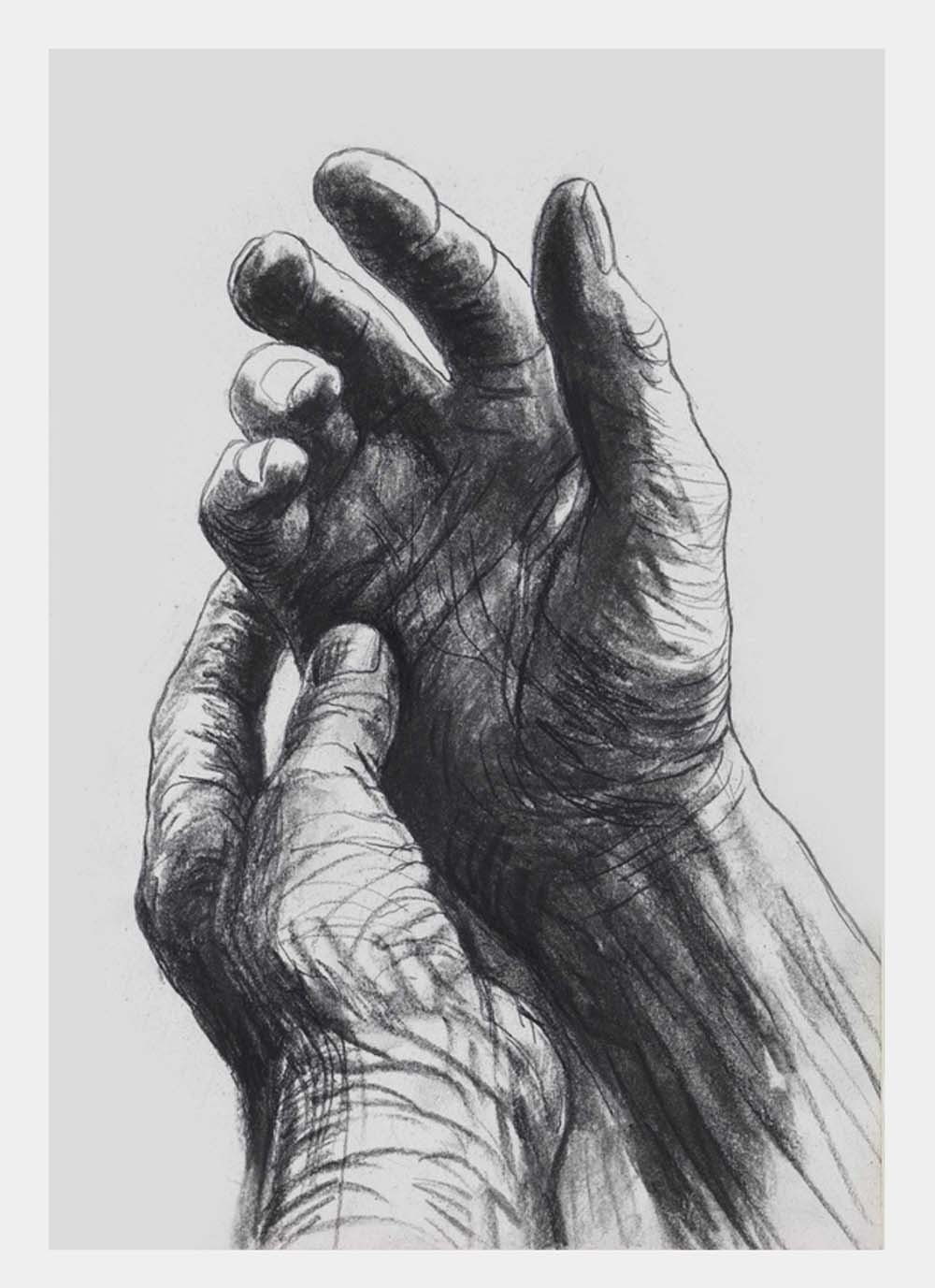
Hepworth made many studies of hands, and hands manipulating instruments are the focus of the compositions of the Hospital Drawings.


Barbara Hepworth, Study of Surgeon's Hands (pencil on gesso on board, 1947)
Fitzwilliam Museum, Cambridge

These are studies about tools as extensions of the hand.  There is a real empathy with the feeling of the tools in the hands, how they can be manipulated and what they can achieve, in the same way that a sculptor manipulates their materials.  In executing the drawings, Hepworth is sensing the surgeon's hands as they work in the same way she works, and puts that empathy into the drawings, which echo this by flowing across the surface like tactile waves.
  
Henry Moore similarly made studies of his own sculptor's hands quarter of a century later.  His look vulnerable.

Henry Moore, The Artist's Hands (1974, (c) HMF)

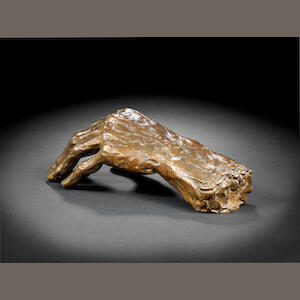
Hepworth made only one self-portrait of herself, but made several casts of her own hands, firm and purposeful.

 
Barbara Hepworth, The Artist's Hand (Bronze, 1943, Tate St Ives)

And this is a bronze of the hand of the surgeon who gave permission for her to attend the operating theatres, Norman Capener.

Barbara Hepworth, Hand II (Horizontal), Bronze, 1950

Capener and Hepworth became friends during the hospitalisation of Hepworth's daughter.  Capener was an amateur sculptor himself, and Hepworth gave him lessons as return for the favour of letting her observe the operations.
  
They corresponded about tools (Hepworth, apparently,  helping Capener to design surgery instruments based on her own sculpture tools), and also on the subject of hands.  Capener used slides in his lectures of Hepworth's hands sculpting.  Capener urged surgeons to observe their own hands in action so as to better understand the working of the hands that they were operating on.  
They also corresponded about the different characteristics of each hand, Capener assigning masculine qualities of dynamic power and decision to the right, and passive support and precise control to the feminine left.  No sexism there, then.

Meanwhile  Hepworth wrote, 'My left hand is my thinking hand.  The right is only a motor hand.'  So there.  Assistants would describe how she caressed her sculptures with the palms of her hands whilst carving, in a sensual dialogue with the materials.

So in observing the surgeons in these Hospital Drawings, Hepworth is actually observing herself at work.  She literally draws with a surgeon's scalpel.  With the surgeons at the centre of their own drama in the operating theatre, they in turn imbue sculptors with a similar heroic status.  And at no point is there any emotional identification with the patient.

Basically, for Hepworth and Capener, with their strong mutual admiration for each other, the roles of surgeon and sculptor were analogous.  Through this, the thrilling creativity of the artist also imbued the surgeon with an exciting artistic genius, whilst the studied skill and social status of a surgeon gave the artist a new level of respectability and gravitas.  And in a post-war society at the dawn of the health service, this was all part of the inclusivity and destratification of the new structure of society.

If you're in South Yorkshire this week, do try and get along to Wakefield to see this show.