I suppose there can be no real appreciation of the history of art without an appreciation of the work of Paul Cezanne. Fortunately, he's an artist who also happens to produce very very beautiful paintings.
This is Still Life with Apples and Oranges.
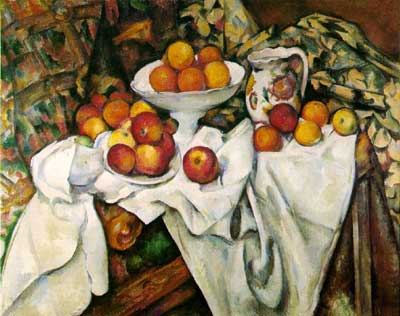
Paul Cezanne, Still Life with Apples and Oranges (c. 1895—1900,
Oil on canvas, 74 x 93 cm Musée
d'Orsay, Paris).
Even if you've seen this painting a million times before, have a really good look at it now. Just take a look at the whole painting.
How does it strike you? How would you describe the picture? What do you see? How does it make you feel? Does it make you happy?
The fruit seems scattered in quite a jolly, random way, the jug seems pretty and familiar; it's a pleasant, unthreatening domestic scene.
Take a closer look. Obviously, this being a reproduction, you can't see the canvas and the brushstrokes and the way that the paint is applied - if the real painting were in front of you, you'd look at all of these things - but have a look at the space. The nice fullsome round fruit, the jug and the bowl - are they really as round and full of volume as they seem?
The central apple is very real and round, but the fruit at the top left at the back - they seem almost flat. And the bowl seems tipped up and squint. What exactly is the whole arrangement sitting on? Is there a chair underneath? A table? It's unclear as to how it all works, which on further reflection, is a little unsettling. There seem to be a number of different answers to the questions, all of which are largely unresolved.
If you look at how the composition works, what appears at first quite random is in fact carefully orchestrated in a series of dynamic geometric shapes which underpin the whole painting.
If you join the corners of the painting by drawing a giant imaginary 'X' across the picture, then slap bang in the middle is the apple, like the fulcrum of a wheel.
Once you notice this, the whole composition turns with a forward motion like the spokes of a wheel (you can see something similar at wortk in Caravaggio's Crucifixtion of St Peter.)

Caravaggio Crucifixtion of St Peter (Oil, c1600)
If you divide the painting in half horizontally, then all the fruit is sitting above the line in the top half. All the fruit forms a rough pyramid shape, and there are pyramids of fruit within that shape that echo the pyramids of the folds of cloth.
The bowl is tipped up so that it appears more flattened than it should. The plate of apples is also tipped up. There is also an ambiguous area on the left hand of the stem of the bowl, where there is a shape that might be a piece of fruit in front of it, or the darkness of the fabric behind.

Cezanne Still Life with Apples and Oranges (detail)
It floats between being positive and negative space, in front or behind.
The cloth in the top right, with its shape, colouring and pattern, also look strangely reminiscent of one of Cezannes other favourite motifs....

Cezanne Still Life with Apples and Oranges (detail)

Cezanne, Mont St Victoire (Oil, 1890-94, National Gallery of Scotland, Edinburgh)
So is it a cloth or a mountain? Fabric or earth? Or just paint and pattern? Lines and colour on a two dimensional surface?
Paul Cezanne (1839-1906) was contemporary with the Impressionists, but paved the way for Picasso and Cubism, and all that is 'modern' art. He painted over 200 still lifes, with the aim of 'conquering Paris with an apple'. These still lifes were very carefully considered over a long time - so long that he would even use wax fruit as props, with wooden blocks to prop up plates to stage-set the arrangements.
These weren't just paintings about fruit - these were essays in the essential pattern of geometry that he perceived as underpinning nature itself - the “cylinder, sphere and the cone”. Hence referencing a mountain in a piece of cloth - the same principles govern the shapes of both.
He saw the pattern in forms and the rhythms of nature, and in the flattening of objects and his playing with perspectives he showed that the experience of looking is about the assimilation not just of one viewpoint - for no-one observes from only one fixed point - but from the experience of looking and of piecing together in your head many, many viewpoints.
Which of course leads to this...

Pablo Picasso Les Demoiselles d'Avignon (Oil, 1907)
...but that's a story for another day.


