Sunday, 21 June 2015

Some New Paintings from the Studio...

Thought you might like to see some new work from the studio.  I'm trying to pull a few things together before the summer break, and so the paintings reflect a few of the ideas I've been looking at and exploring over the last weeks.

There's a couple of Tower Bridge from Bermondsey (you can see the original photos and read the blog HERE) ...

Setting Sun, Tower Bridge from Bermondsey (Oil on linen, 16 x 16)


Tower Bridge at Dusk from Bermondsey (Oil on linen 12 x 12)

Then there is some work from my trip earlier in the year to Yorkshire, where I travelled up the coast from Spurn Point to Whitby.  Flamborough Head is sort of the half-way point!

Gorse at Flamborough Head (Oil on linen, 20 x 30)

Sandsend (Oil on linen, 16 x 16)

Finally, there are paintings exploring the seasonal theme of the flowers in my garden, which is always a rich source of material.

Bluebells (Oil on linen, 16 x 16)

Honesty and Yellow Poppies (Oil on linen, 12 x 12)

Sunday, 14 June 2015

Sargy Mann: How a Blind Painter Sees

There's a really fascinating essay HERE about the painter Sargy Mann, who unfortunately died two months ago.  

Mann was a painter despite having limited vision, and for the last 25 years of his life was registered blind.


I won't use the word 'inspirational', which perhaps has certain patronising overtones.  But as an artist I am acutely aware of my eyesight and the need to see and observe clearly.  His essay therefore gives a very powerful and moving account of what it is to 'look' as a painter, and of the different ways of looking and perceiving a world which you have a innate burning desire to create and record visually, but cannot see. 

Painting, like life,  is a constant problem solving process, and there are many ways of seeing - such as through touch, sound, verbal description and memory.

Sargy Mann, Two Bathers

Sargy Mann, Frances in Hammock by the River No2

Read his essay and feel humble.


Look at the full essay and the catalogue for his final show (which opens at the Cadogan Contermporary Art Gallery on July 7th) HERE .

Monday, 8 June 2015

Marie Curie Exhibition at Glasgow Art Club

Here's two of my paintings (at far end of room on the end wall - see if you can spot them!) at the recent Marie Curie Exhibition at the famous Glasgow Art Club.


Above the paintings,  you can see the newly uncovered and restored frieze by Charles Rennie Mackintosh.  

It was stencilled onto the wall in 1893 when the artist was 25.  It was subsequently covered up, and has taken 3 years and £1.2 million to restore.


Thursday, 4 June 2015

Affordable Art Fair Hampstead

Just to let you know that if you're in north London next week, I've got paintings on exhibition at the Affordable Art Fair in the tents on Hampstead Heath.

 Bluebells in Woodland (Oil on linen, 16 x 16)

There's over 100 galleries with art from £100-£5000, and my paintings are the Duncan R Miller stand.  If you do go, have a look out for them!

The Fair runs from 11-14th June.

Wednesday, 3 June 2015

Richard Diebenkorn's Search for Rightness

The other week I went to the Richard Diebenkorn exhibition at the Royal Academy.  Diebenkorn (1922-93) was an American landscape artist closely associated with the West Coast, who, very unusually,  journeyed from abstraction to representation and back again.

I was only familiar with two of his works, but I was eager to see more.  

The first room contained his drawings and works on paper.  Interestingly, Diebekorn saw these works as central to his practice, and worked on them simultaneously with the oils, seeing them as works in their own right.  However, unfortunately, I was not in any way excited or captivated by them. I really couldn't connect with the mark-making.

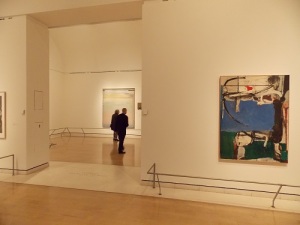
But the main bulk of the show was Diebenkorn's various phases of painting, from early abstracts of the 1950s with soft, rounded organic forms, through to the 1960s with their more linear, geometric, pale pastel colours and chalky surface.  Here's some of the rooms so you can see what I mean.

Again, I just couldn't quite connect with what he was doing.  They're big paintings, and I really wanted to like them, but....

Perhaps it was the flatness, the lack of mark-making...?


This one below reminded me of Cornish artist Peter Lanyon


Glider pilot Lanyon often painted landscape from an aerial perspective, which gave it an abstract, pattern-making feel.  This was combined by also tipping up the landscape so you are also viewing it from multiple perspectives.  A vertigo sufferer, Lanyon also put this sense of out-of-kilter uneasiness in his work.  I felt that this kind of sense was also in these Diebenkorns.

More pattern-making abstracts...


Later works go back to a more figurative style, this time with actual figures in them.  I really didn't like these either - sorry.  The clumsiness of the figures irritated me, and I just couldn't understand what the figures were doing in the landscape.  There seemed to be no connection between the elements.  The catalogue called them 'meditative'. I call them annoying.


These are his life drawings.  Guess what?  They annoyed me too. They channeled Matisse in some places, Munch, Klimt, and sometimes Schiele, with their unpleasantly doll-like poses.  But give him his due, he was good at contextualising the figures.


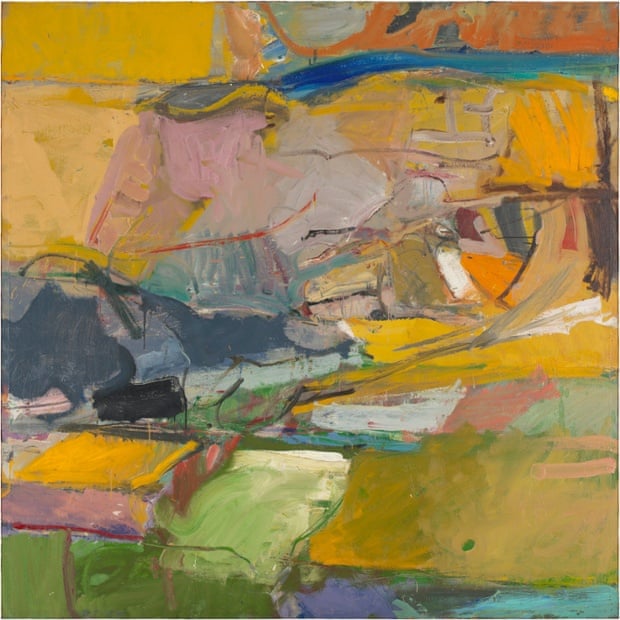
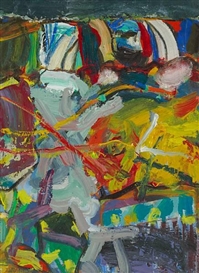
This reminded me of a Duncan Shanks painting, all tumbling abstraction based on direct observation of nature.

Berkeley #57, 1955. Photograph: San Francisco Museum of Modern Art © 2015 The Richard Diebenkorn Foundation 

Duncan Shanks, After Flood (1997)

See what I mean?

Then, hurrah!!  This was my favourite.  I guess it's a cross between his abstract and representational styles.

Richard Diebenkorn, Cityscape 1 (Oil on canvas, 1963)

I was sorely disappointed that he hadn't painted roomfuls like this.

I think you can tell that I didn't warm to the guy.  He seemed to be a painter who was wobbling around all over American Abstract Expressionism, even a bit of Hopper, but with one eye on European art such as Cezanne (well, who isn't influenced by Cezanne, eh?), the flatness and pattern-making and saturated colours of Matisse, the chalkiness and textile-type surface pattern of Bonnard.  Which should mean I really liked his work.  But I didn't.  I just couldn't connect with it, either emotionally on a personal level, or in any of the mark-making as an artist.  

Diebenkorn described his practise as a 'search for rightness', but it just came across as a hotch-potch of spot-the-influences, like he was some sort of absorbant, spongy shape-shifting sea-creature, changing his surface every so often as a result of some sort of colourful external stimulus in his surroundings, camouflaging his real self.

It's not a bad show.  In fact, it's a great show - well laid out, well curated, telling Deibenkorn's story well, so top marks to the Royal Academy for all that.  It wasn't the RA, it was me.

Obviously I have a real downer on Mr Deibenkorn, so I will leave you instead with his Top Ten Tips on how to start a painting.  Read and learn.

NOTES TO MYSELF ON BEGINNING A PAINTING

1. Attempt what is not certain. Certainty may or may not come later. It may then be a valuable delusion.

2. The pretty, initial position which falls short of completeness is not to be valued – except as a stimulus for further moves.

3. DO search.

4. Use and respond to the initial fresh qualities but consider them absolutely expendable.

5. Don’t “discover” a subject – of any kind.

6. Somehow don’t be bored but if you must, use it in action. Use its destructive potential.

7. Mistakes can’t be erased but they move you from your present position.

8. Keep thinking about Pollyanna.

9. Tolerate chaos.

10. Be careful only in a perverse way.

Monday, 1 June 2015

Inventing Impressionism - Part 2


(Read the first part of this blog here.)

Returning to Paris from London in 1872, Paul Durand-Ruel was fired up with enthusiasm for Impressionist paintings, and sought out as many as he could.  As well as Monet and Pissarro, he bought work by Degas and Sisley, purchasing in bulk.

As their dealer, Durand-Ruel looked after his artists carefully, making sure that they had the freedom to produce the work without worrying about practicalities.  To this end, he paid them monthly salaries against future work, settled bills, and generally provided moral as well as financial support.  He also gave them the security of his backing, with the promise of growing profiles, access to clients and exhibition opportunities.

Overall, Durand-Ruel was a risk-taking trend-setter, creating the new taste in art in society by creating desire and demand, and then supplying that demand.

Take a look at Monet's Railroad Bridge, Argenteuil.

 Claude Monet, Railroad bridge, Argenteuil (Oil on canvas, 1873, Philadelphia Museum of Art)

Now, when I was studying Fine Art, we learnt how the Impressionists painted not only in a new style - quick, loose, expressive brushwork painted en plein air, thanks to the invention of portable, collapsable tin tubes of oil paint - but they used new subject matter, namely the modern world around them.  

Monet's painting has a luminous quality to it - it's full of light - but it is also full of drama, as the modern industrial world of the railway plunges across the tranquil river. Just the sort of subject matter that an Impressionist painter looking at the world around him would paint.

However, if you bear in mind that behind the painter is a dealer, who has a middle class client base lined up to look at your paintings, you are going to obviously have one eye focussed on what appeals to your audience.  So it is very striking when you look round the exhibition that not only are all the paintings of a certain size (a size which a painter can carry with him out into a field, but also conveniently fits very handily into the decor of a Parisien sitting room) but also that Monet has been savvy enough to paint a subject with maximum appeal to his customers.

Argenteuil was 15 minutes from Paris by train, and was a popular weekend destination where wealthy Parisiens would hire small boats exactly like the one in the painting.  So it's a scene which speaks of the new middle-class leisure activities, and the new ways to travel. This is a scene which appeals to people who are, quite literally 'going places'.  It's a highly aspirational piece, all about money and if you put this on your wall, then you're telling everyone that you've arrived.

So the question is - how much were the decisions about subject matter, style, size and presentation dictated by the fact that the Impressionists were working hand in glove with Durand-Ruel?  Durand-Ruel manipulated the market to accept the radical new style of painting, but then to what extent did that market subsequently dictate what product the painters produced?

The First Impressionist Exhibition took place in 1874, a landmark year in Fine Art History.  It was a year which could easily have bankrupted Durand-Ruel, and consequently the Impressionists, due to a banking crisis and a glut of unsold work.  

However, in 1876 they tried again, with Durand-Ruel giving backing, premises and expertise to launch the cunningly named Second Impressionist Exhibition. 250 works went on display, to a lukewarm response.  

Paintings included Renoir's sickly sweet "Study: Torso, Sunlight Effect"...

Pierre-August Renoir, Study: Torso, sunlight Effect (Oil on canvas, 1875, Musee d'Orsay)

...and Monet's Springtime, showing a middle-class lady relaxing in her finery, but looking more like one of those toilet-roll hiding crinoline dollies on her tea break.

Claude Monet, Springtime (Oil on canvas, 1872, Walters Art Museum, Maryland)

But then...BLAM!!

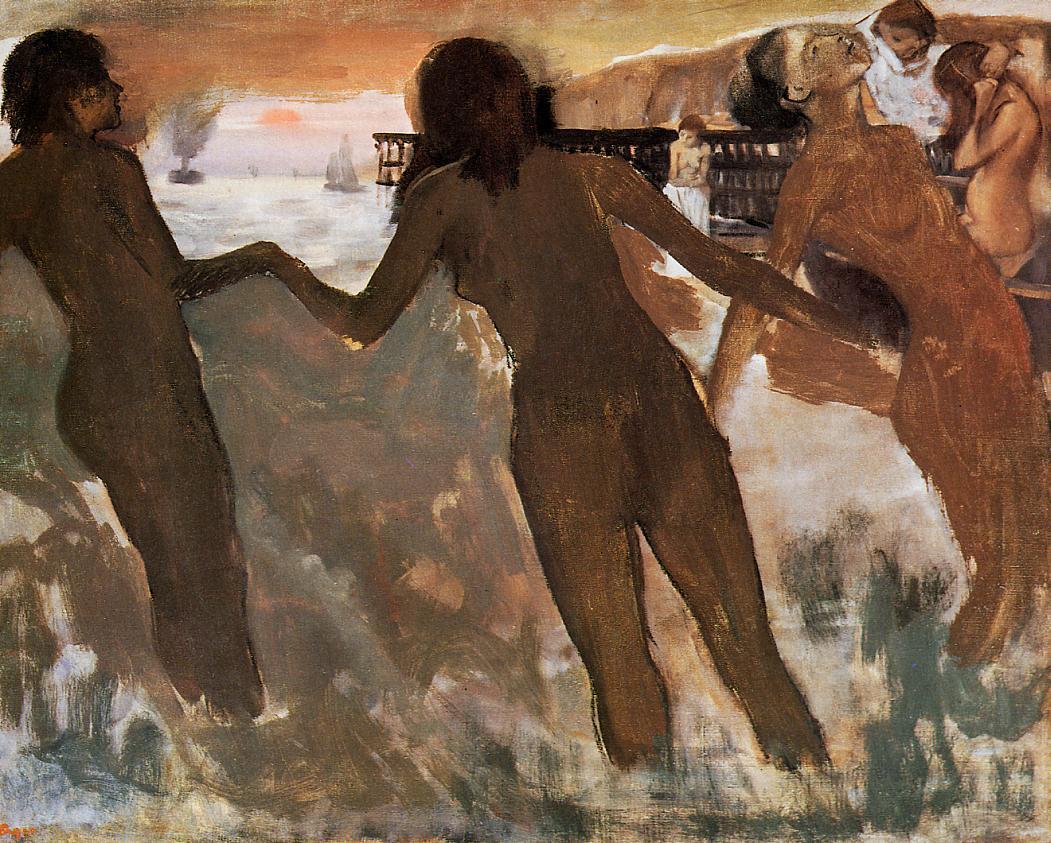
Edgar Degas, Peasant Girls Bathing in the Sea at Dusk, 1869 (Private Collection, Ireland)

Seeing this across the room at the exhibition, I thought I had just laid eyes on the most stunning painting I had ever seen, and couldn't take my eyes off it.  It was unlike anything else in the room.

I stood in front of it for a very very long time.

Lots of people came up and peered at it.   
"Is this guy lazy or what?" snapped an American lady.   
"Terrible!" declared an elderly woman frostily, rattling her pearls in agitation.  
 It would seem that Impressionism still has the power to disgust and dismay.

The painting looks very unfinished, the paint thin, the paintwork broad, scratchy or non-existent.  But this gives it an energy, a vibrancy, a sense that the moment it captures is so brief - a brevity of movement, of youthfulness, of the sun going down - that it is like a snapshot.  This photographic sense is particularly apt for Degas of course, for this is one of his (one I have never seen before, as it is from a Private Collection).  Degas made full use of the new medium of photography, by using photographs he took himself as reference material, both as a means to capture difficult poses for his nude studies, and of reinvigorating traditional compositional norms.

Here, the figures combine incredibly minimal information - flat, brown forms painted broadly in thin paint - with heart-breakingly delicate detail, such as the head of the girl on the left hand side, her mouth open, caught in a laugh of delight.  The lines used to describe her face and the outline of her body (and of the body of the central figure) are so assured, so confident and so in charge of what they are saying, that It's very, very beautiful.  They give weight and direction and structure and volume.  I just wanted to stand and cheer.  Degas, I see what you did there.  And I like it.  I understand.

Whilst the two left hand figures have a gorgeous fluidity of line, the right hand one is barely suggested - so much turps is used that the line down the back of her right thigh breaks up. Although their heads are beautifully, expressively realised, their hands, which link the figures together, aren't actually there at all, when you look closely.  And on the right at the top are a jumble of strange, out-of proportion, difficult to read figures who appear to have been collaged in from a whole load of different reference material.

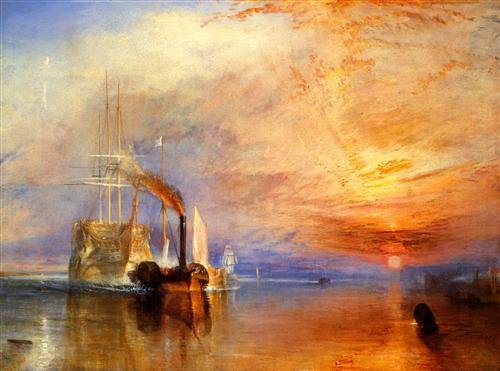
The effect of the whole is a strange sense of exhilaration and melancholy.  There's even a touch of Turner's Fighting Temeraire (painted 30 years previously) in the image of the ships in the distance.

But the most striking thing is how, with its search for the beautiful line, the flattening of form and the sinuous line of the dancing girls, this expressive synthesis by Degas completely prefigures Matisse's La Danse by 40  years.  Forty years!!

Henri Matisse, La Danse (Oil on canvas, 1909)

I wanted to take Peasant Girls off the wall and take it back to my studio for ever and ever.  Despite the derision of the gallery-going public, for whom it so clearly stood out like an ugly, sore thumb, this, for me, was a painter's painting, and a breathtaking tour-de-force at that.

By the 1880s, Durand-Ruel was able to start buying Impressionist artworks again, thanks to some new financial backing.  In order to announce that he was back at the helm, he came up with the ground-breaking idea of holding a series of month-long solo exhibitions.  We take such exhibitions for granted now, but this was brand new at the time.

In 1883, Durand-Ruel gave Monet the full works for his show - adverts, images released to the press, and a huge private view - again, all part and parcel of the modern solo show.  Despite this, things were strained 5 years later, when Monet and Pissarro started selling well with other dealers.  But by 1890, Monet was back asking Durand-Ruel for 20,000 francs to buy his house at Giverny.

Later, in 1892, Monet used this platform of the solo show to promote his 'series' paintings, where he took a single motif of a sinuous line of poplar trees along the bank of a river, and repeated it in different weathers, lights, times of day etc.  He was able to display these paintings as a complete set, a cohesive whole, before they were split up as they were sold to clients.  

They were therefore useful as a creative goal for Monet - envisaging and curating an exhibition space filled with varients on a single repeated motif - and a useful tool for Durand-Ruel to demonstrate his artist's versatility to clients.  

"Look, the poplar paintings also come in pastel colours, or dark colours...
 
Claude Monet, Poplars on the Epte (Oil on canvas, 1891, Tate)

- at dusk, or in the sun 
Claude Monet, Poplars in the Sun (Oil on canvas, 1891, National Museum of Western Art, Tokyo)

..in the wind..
 Claude Monet, Wind Effect, Sequence of Poplars (Oil on canvas, 1891 Musee d'Orsay)
 
....with an ornate frame, or a plane frame, or you can have it slightly bigger...." etc etc.   

Again, it's a symbiotic relationship.  Monet set himself an artistic exercise, and Durand-Ruel capitalised on this, showing his clients how they could choose the pictorial variables based around a constant theme.  Plus, having such a strong theme gave Durand-Ruel a strong USP for publicising the show.

Whilst walking round the exhibition, I listened to what people were saying in front of the paintings, and a number were commenting on hos many of the works were from American art galleries.  There's a very good reason for this.

After the series of solo shows, there was another banking crisis in 1884, and Durand-Ruel was again forced to think creatively to avoid disaster for himself and the group of Impresionists who depended upon him.  His solution was to think big, and make a bold move - this time to expand into fresh, foreign markets.

By 1886, Durand-Ruel had organised a show of 300 paintings in New York, exposing the excitingly fashonable European taste to the newly rich American collectors.  The show was a wow.  Prices went up.  Germany, with its progressive collectors,  was also eager for the new art.  And so American and European museums and collections began to acquire Impressionist work.

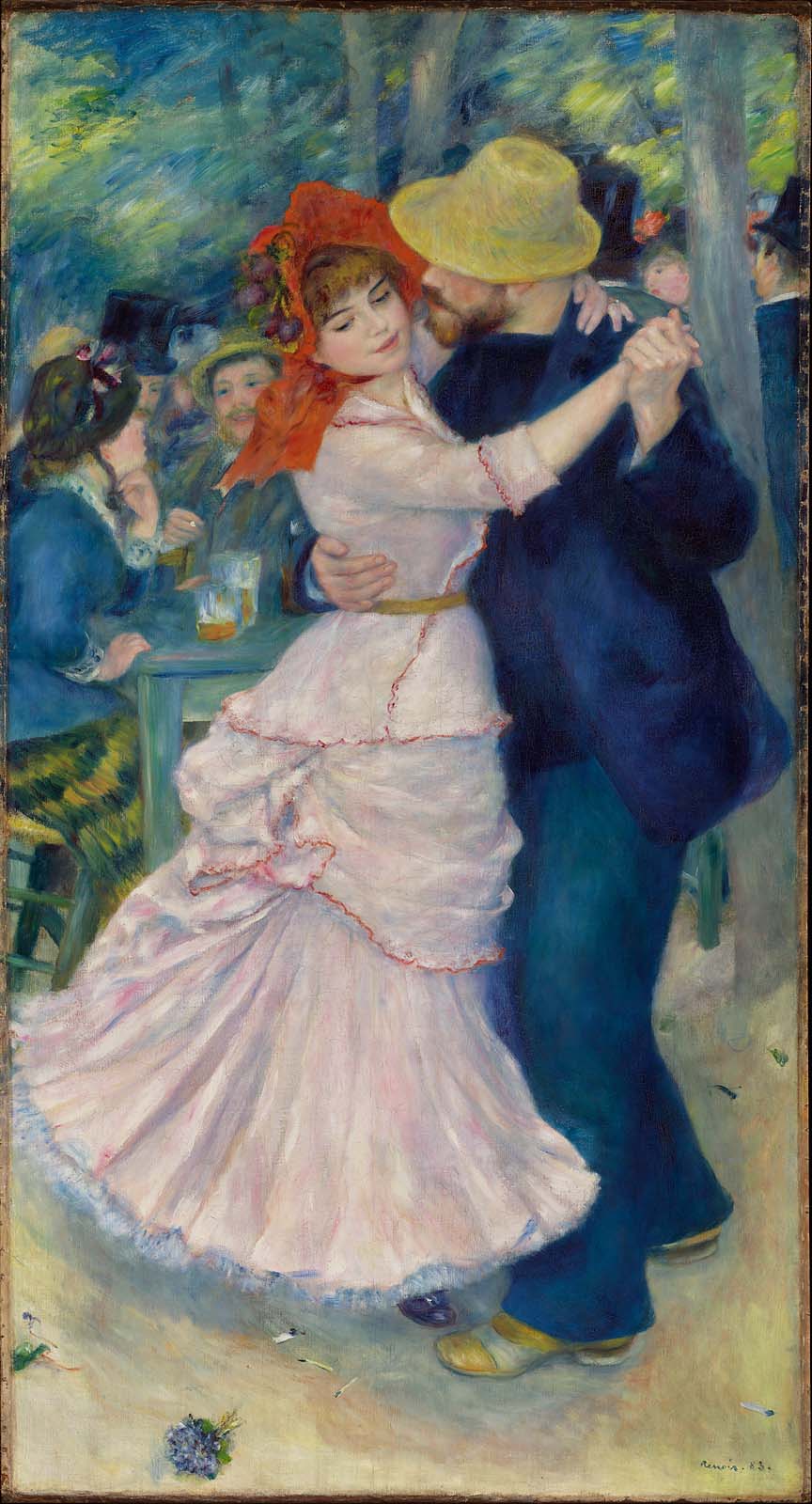
I'm usually not so keen on Renoir, but this was one of my very favourite paintings when I was a teenager, and I had a postcard of it which I loved.  It was such a wonderfully carefree, colourful swirl of a painting, very romantic.  Who wouldn't want to dance under the trees?

Pierre-August Renoir, Dance at Bougival 1883 (Oil on canvas, Museum of Fine Arts, Boston)

The woman is very much the focus of attention, both the viewers and the man's. This is emphasised by her pretty face being framed by the orangey-red tones of her bonnet, which stand out against all the complimentary blue shades.  

However, when you look closer at the real thing, there's an ambiguity in the relationship.  There's a palpable tension that she's both enjoying the attention and pulling away.  Meanwhile it's the man that is very much driving the action, pulling her towards him.

It's a big painting, and what I noticed when looking at the real thing (which I hadn't noticed before because my postcard cropped off the lower part) was all the detritus on the dance floor  - cigarettes, used matchstick ends, a dropped flower posy.  Which does make you feel slightly uncomfortable about what's being said in the painting about things being casually used and discarded. 

The model for the woman is in fact Maurice Utrillo's mum, Suzanne Valadon.  Here she is.


Maybe she was having an off-day.

As far as I can make out, the painting has had around 12 owners, included being consigned to Durand-Ruel three times in 1883, 1886 and 1889.  Over the next 50 or so years, it trekked backwards and forwards from New York to Paris, through dealers and private hands, increasing in price, until it was sold in 1937 to the MFA in Boston for $150,000.

So how did it all end?

Well, on to 1905.  Impressionism had been around for over 30 years, and new kids on the block such as Picasso were on the scene and painting this sort of thing...

Pablo Picasso, Two Youths (Oil on canvas 1905)

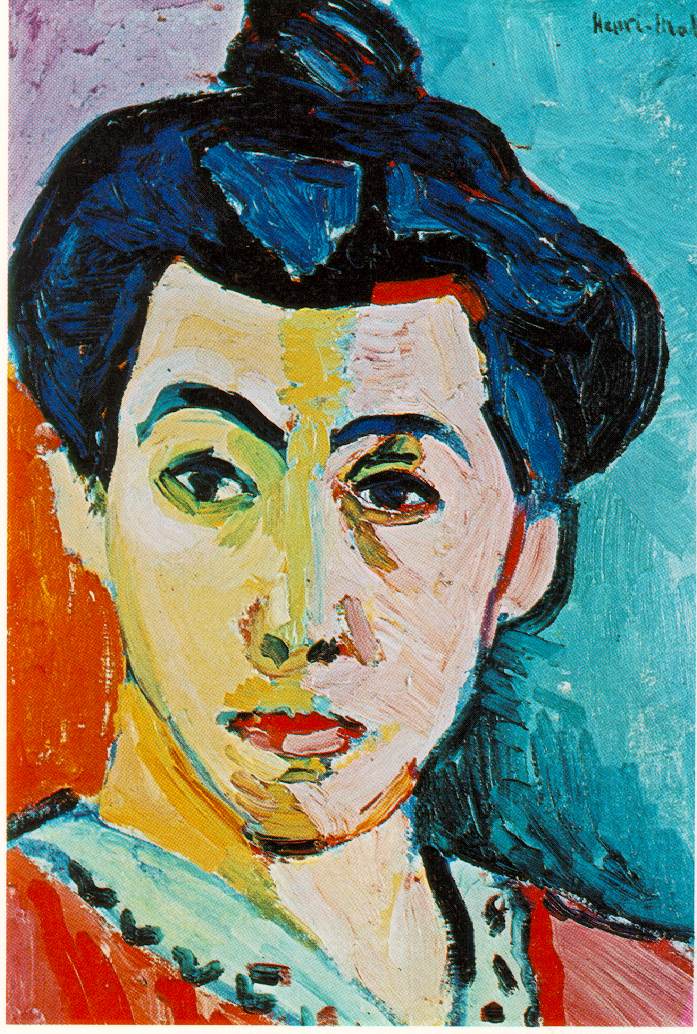
...and Matisse was knocking out this...

Henri Matisse, Madame Matisse with a Green Stripe (Oil on canvas, 1905)
 
In other words, Impressionism was accepted as mainstream, and had lost the power to shock, as there were far more shocking things to shock the art world with now.  Durand-Ruel therefore felt confident enough to hold the biggest, finest, largest  exhibition of Impressionist art ever, at the Grafton Galleries in London, in an attempt to finally crack the British market.
 
To do this, he curated a show of 315 paintings, including 196 from his own private collection, telling the history of Impressionism.  That's an important word, 'curated'.  What he was doing in this sweeping panorama of the Impressionist movement was to tell visitors a story.  That's what every good art exhibition should do - it should draw you in and take you on a journey, telling you a story.  A well-curated exhibition should take you by the hand and lead you through its narrative with its logic.
 
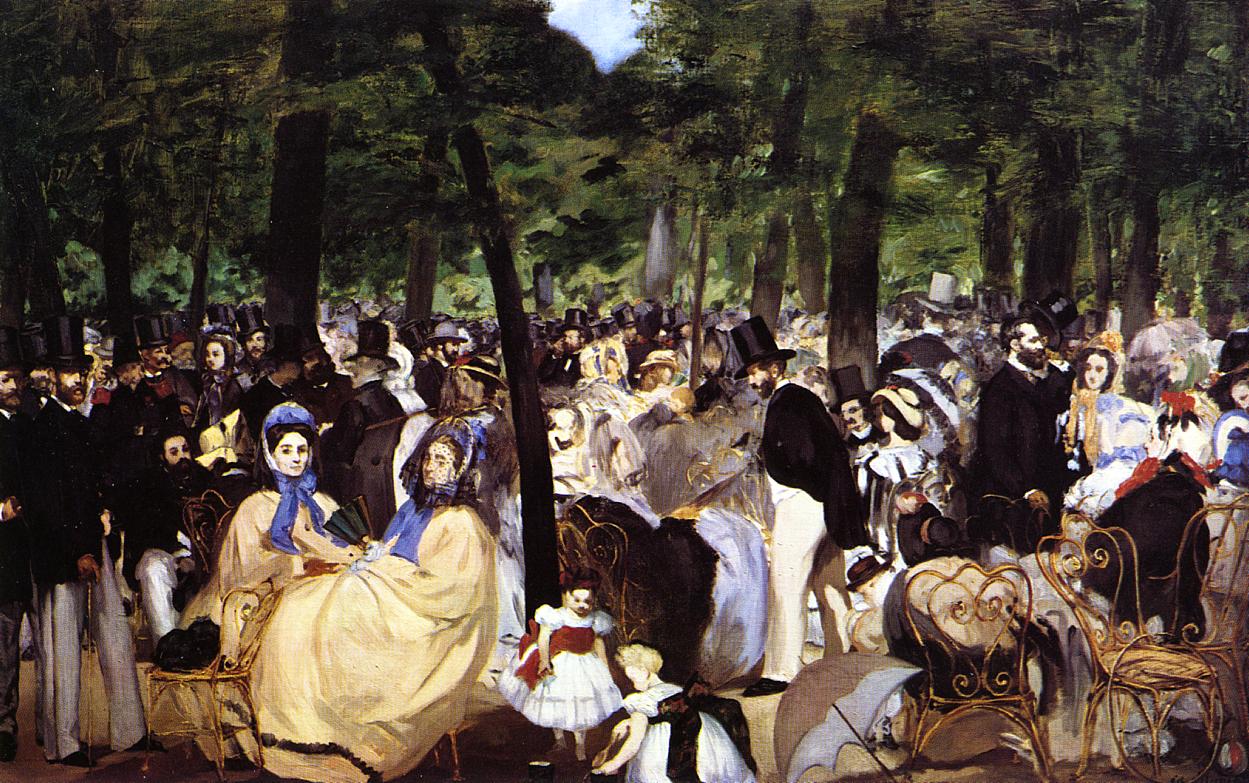
Included in the show were such weel-kent art history gems as this.

Edouard Manet, Music in the Tuileries Gardens (1862, Oil on canvas, National Gallery, London)

This painting is always a real surprise when I see it, as it's so much smaller than I imagine.  It should be huge - all those figures, all those trees!  But it's not at all.  It's such a strange painting as well.  

The title refers to music, and some of the figures are looking out at the viewer.  Are we therefore the music, the orchestra?  But others aren't paying any attention at all, and the scene is actually quite chaotic.  Chairs are facing in every direction.  The orderly society is actually very disorderly.  In fact, in the section in the middle, you can't actually make out what's happening at all, it's just a jumble of marks.  And as for that bendy bendy tree trunk - what's going on?  Also, the focus is very strange - some figures in the distance are blurred, others are in clearly identifiable.  There are many portraits of Manet's family and friends, and indeed a self-portait as well.  Maybe the music is just an excuse to get all these people in the one place.

It's actually a very odd picture indeed.

The public responded well to Durand-Ruel's block-busting extravaganza, and the show attracted huge crowds and critical acclaim.  
 
Unfortunately it only sold 13 paintings, but it had far-reaching influence, and not only laid down the template for gallerists, but created the accepted art historical story of the Impressionist movement.  Durand-Ruel had told his own story.
 
Paul Durand-Ruel retired in 1913.  Degas died in 1917, Renoir in 1919, Durand-Ruel himself in 1922 and Monet in 1926.  By this time, there had been a world war and the seeds of Modernism were planted.  However, Durand-Ruel's legacy is that of creating the modern art market in which this Modernism would be promoted, curated, exhibited and sold.

Sunday, 31 May 2015

Inventing Impressionism

Very often, you get the sense that galleries put on exhibitions of Impressionist painters merely as a way of selling a lot of fridge magnets in the gift shop. 

So it is rare to come across an exhibition so thoughtful, thought-provoking and comprehensive as Inventing Impressionism at the National Gallery in London.


It's an exhibition about landscape as a business, and a lucrative one at that.  The subject of the show is Paul Durand-Ruel, the Parisian art dealer who pioneered not only the Impressionists, but the invented the whole profession of the modern art dealer.  

Here he is, painted in 1910 by Renoir.

This art market business is an area considered too mercenary to touch on in art schools, who instead concentrate on ideas rather than studying history, learning craft, or preparing for a career.  By insulating today's students from the realities of the art market, art school ill prepares them for life as artists, and completely misunderstands that the vehicle for creativity is the creativity of business itself.  

This exhibition shows how integral the art market quickly became to the working lives of the artists it facilitated.

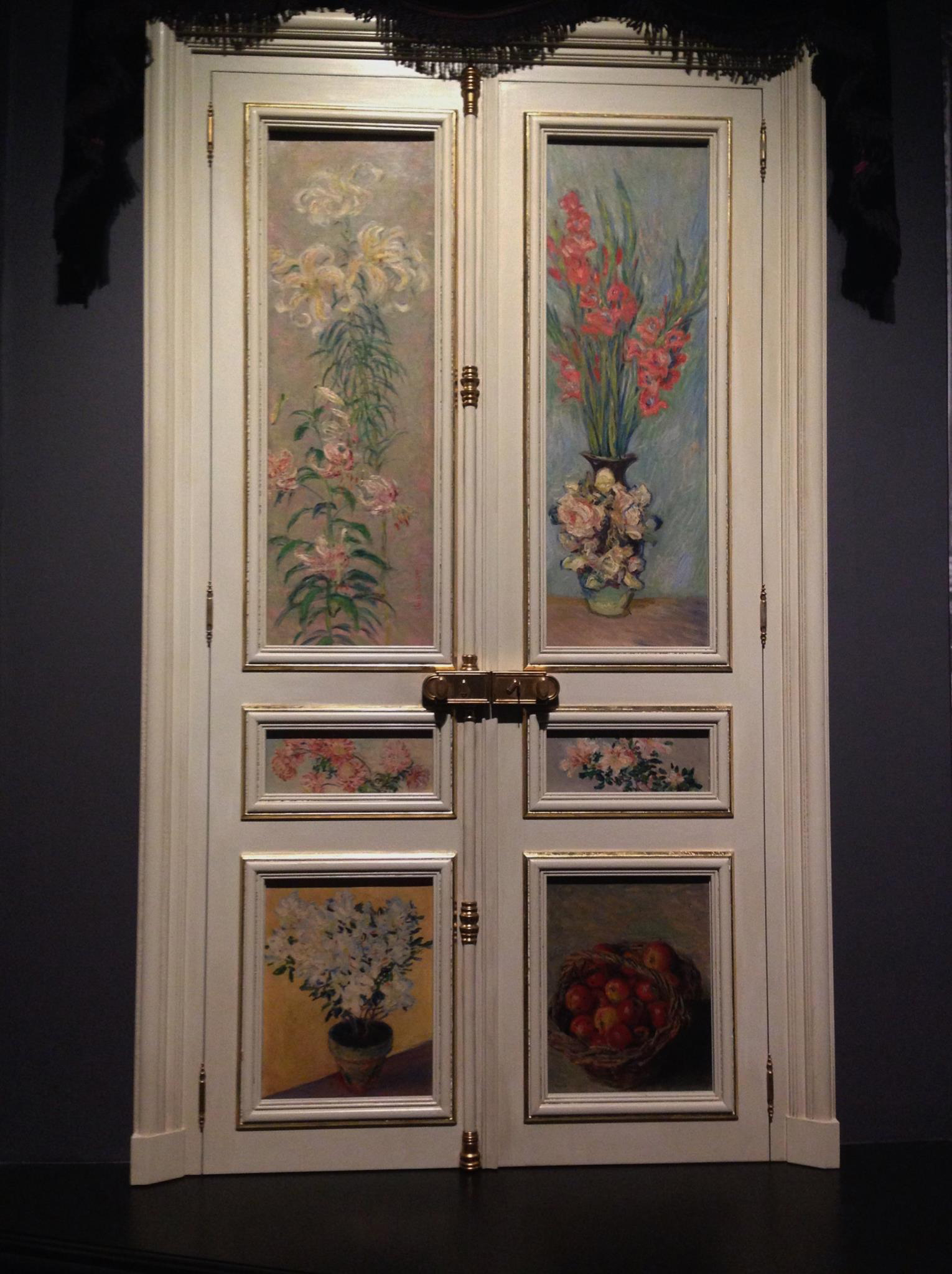
The exhibition opens with a recreation of Durand-Ruel's Parisian sitting room.  Here, amidst fine furniture and fittings, are paintings by Renoir, and Monet, and sculpture by Rodin.  Even the panels on the doors are painted with still lifes by Monet, reminding me of the Bloomsbury Group decorated farmhouse at Charleston.

 Claude Monet, French Door, Grand Salon.  Photo - Laura Vezzo, Artslife

Claude Monet, French Door – Gran Salon. Foto Laura Vezzo ArtsLife - See more at: http://www.artslife.com/2015/03/08/inventing-impressionism-paul-durand-ruel-alla-national-gallery-di-londra/#sthash.F9UUVmNK.dpuf
Charleston Farmhouse

As the son of an art dealer, the Barbizon School painters and new-fangled Impressionists were Durand-Ruel's passion.  He raised his sons and grandchildren to expand the firm, and the painters quickly became an extended part of the dealers' family.  Renoir's portraits of the Durand-Ruels meet you with their direct gaze and piercing eyes. 

By decorating his own house with the 'merchandise', Durand-Ruel was doing a number of things when he invited his friends and clients in to his salon.  Firstly, he was demonstrating how much he personally admired the new circle of painters, who were largely rejected and shunned by the art establishment.  And he was also demonstrating how the paintings and sculpture would look in a domestic setting, one of taste and class.  He was making the art desirable, accessible, fashionable.

The second room of the exhibition shows the beginnings of Durand-Ruel's business.  When he took over from his father in 1865, he seized the chance to corner a market he felt had been unjustly ignored. Using methods he borrowed from the world of finance, he found backers and partners for purchases, sought exclusivity deals, worked to push up prices at auction, and brought his product before the public through exhibitions and publications. Being savvy enough to take these models of business and marry them with his knowledge and love of modern painting was where his truly creative genius lay.

This is Courbet, who along with Corot and the Barbizon painters, painted with an earthy realism which was spurned by the state-run, jury-selected Salon, and polite society in general. This was exactly the reason why Durand-Ruel loved the work, because it was fresh, modern and alive.


Rejected by the Salon, Courbet's Apples are bruised, pitted and imperfect, and were in fact painted in prison when Courbet was in the clink for six months for being a revolutionary in 1872.  These are not idealised fruit, they are - quite literally - fallen fruit.  And painted by a radical!  No wonder they were rejected tout de suite by the Salon - and no wonder Durand-Ruel gave them pride of place in his gallery window.

Here's more fallen fruit by Courbet.

Gustave Courbet, Woman in the Waves, 1868

This is Venus, but a Venus who's been around the block a million times, and who doesn't give a hoot about showing off her underarm hair.  It's a subversive image (although not as graphically subversive as L'Origine du Monde - a link which is perhaps wise not to open at work), which had Durand-Ruel splashing out a record price to Courbet just 3 years after he'd started business.

This room also displays a lovely work by Millet, which he again paid a record sum of 20,000 francs in 1872 (the painting at that time being about 15 years old).

Jean-Francois Millet, The Sheepfold, Moonlight (1856)

It has a silent, earily other-worldiness spirituality about it which oddly reminded me of Paul Nash.

Paul Nash, Totes Meer (1940)

The next section looks at Durand-Ruel in the new market of London. 

In 1870, France declared war on Prussia, and Durand-Ruel shifted a large quantity of stock to London for safety.  Turning this necessity to his advantage, he opened a gallery in New Bond Street and started to hold regular exhibitions.  This was a new idea - normally exhibitions were retrospectives of dead artists.  Here, they were events to promote living painters, in whose careers patrons were invited to invest and participate.  Durand-Ruel brought a new, fashionable event to London from the Continent, and in the process, exposed his painters to a fresh market.

Durand-Ruel was also introduced by Barbizon painter Daubigny to two other painters who were similarly taking refuge in London at the time - Monet and Pissarro.  Both were out and about, painting en plein air, and depicting modern life as they saw it.  Durand-Ruel snapped up their work.

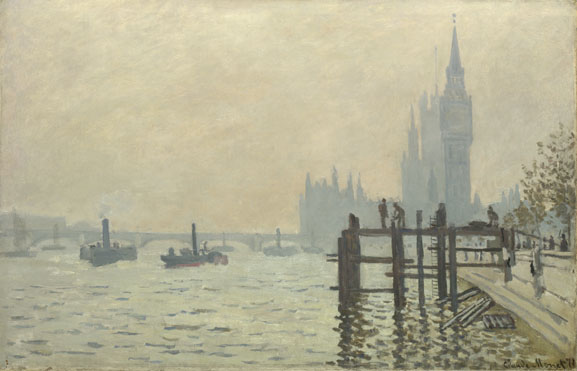
Here's Monet painting the new Thames embankment.

Claude Monet, The Thames Below Westminster (1871, National Gallery)

Using an off-white ground, Monet uses a limited palette of greys, salmon pinks and yellow ochre to create his atmospheric picture.  There's a beautiful use of negative space in the sky, made up of a myriad of similar sized brushstrokes, contrasting with a range of different, more fluid mark-making used to create the effect of the water and the trees.

The wonderful thing about the Inventing Impressionism exhibition is that it flows, with each room feeling like a natural progression, containing a topic which doesn't feel forced and with paintings that are entirely pertinent.  Thre's a logic running through it all.  Nor is it a show which is overwhelming.  

The next section is all about Edouard Manet, a challenging artist whose rapidly painted work was constatly rejected by the establishment, and he struggled to promote his work.  Well, guess what...

Returning from London in 1872, Durand-Ruel found two Manet paintings (The Salmon and Moonight at the Port of Boulogne) at another artist's house.  He bought them on the spot, and set out to find more.  

All the paintings in the Manet room of this exhibition were purchased in a single month, as Durand-Ruel descended on Manet's studio and bulk purchased 23 paintings for 35,000 fancs - 40 times the annual wage at the time.  It made Manet instantly spectacularly rich, but was a huge gamble for Durand-Ruel (you have to wonder what else he gambled on, and lost).  


Edouard Manet, Moonlight at the Port of Boulogne, Oil on canvas 1868 (Musee d'Orsay)

This strategy - of purchasing an undiscovered artist in bulk, salting away the stock, creating an excitement about it, and therefore increasing the 'worth' of the artist, then controlling the release of pieces to a receptive and eager market at increasingly higher prices - was also famously followed by Albert Barnes (he of the Barnes Foundation in Philadelphia).  Create a market, starve the market, feed the market.  

Barnes was a chemist who made his fortune with the formula for an eye cream for babies.  He then set about trying to find the formula for Good Art.  

Barnes found impoverished Chaime Soutine sloshing about in paint and animal carcasses in his squalid Parisian flat-come-studio in 1924, and bought up 52 of his paintings for cash on the spot.  (The amount varies depending on whose letters you read, but it works out at between $15-30 per painting. Barnes considered he got a bargain, which he most certainly did from the less-than-savvy Soutine, especially when you compare what Durand-Ruel was paying his artists.  However, Soutine was ecstatic, and immediately ran out of the flat with the cash, hailed a taxi, and headed to Nice in the south of France.)  Barnes, in creating a market in an artist through all his contacts, was suddenly sitting on a small fortune.

But back to Manet.

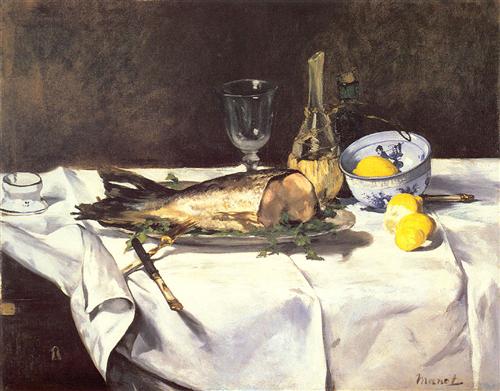
The most arresting painting in the exhibition here was, for me, The Salmon.

Edouard Manet, The Salmon (Oil on canvas, 1868, Shelburne Museum, Vermont, USA)

In a loose and fluid style, Manet is referencing 17th century Spanish painters such as Velasquez, and Dutch still  life paintings in the balancing of the knife on the edge of the table, with its implications of the precariousness and fragility of life and its ephemeral values.  It's also a tour de force in portraying different textures, especially the skin of the fish.

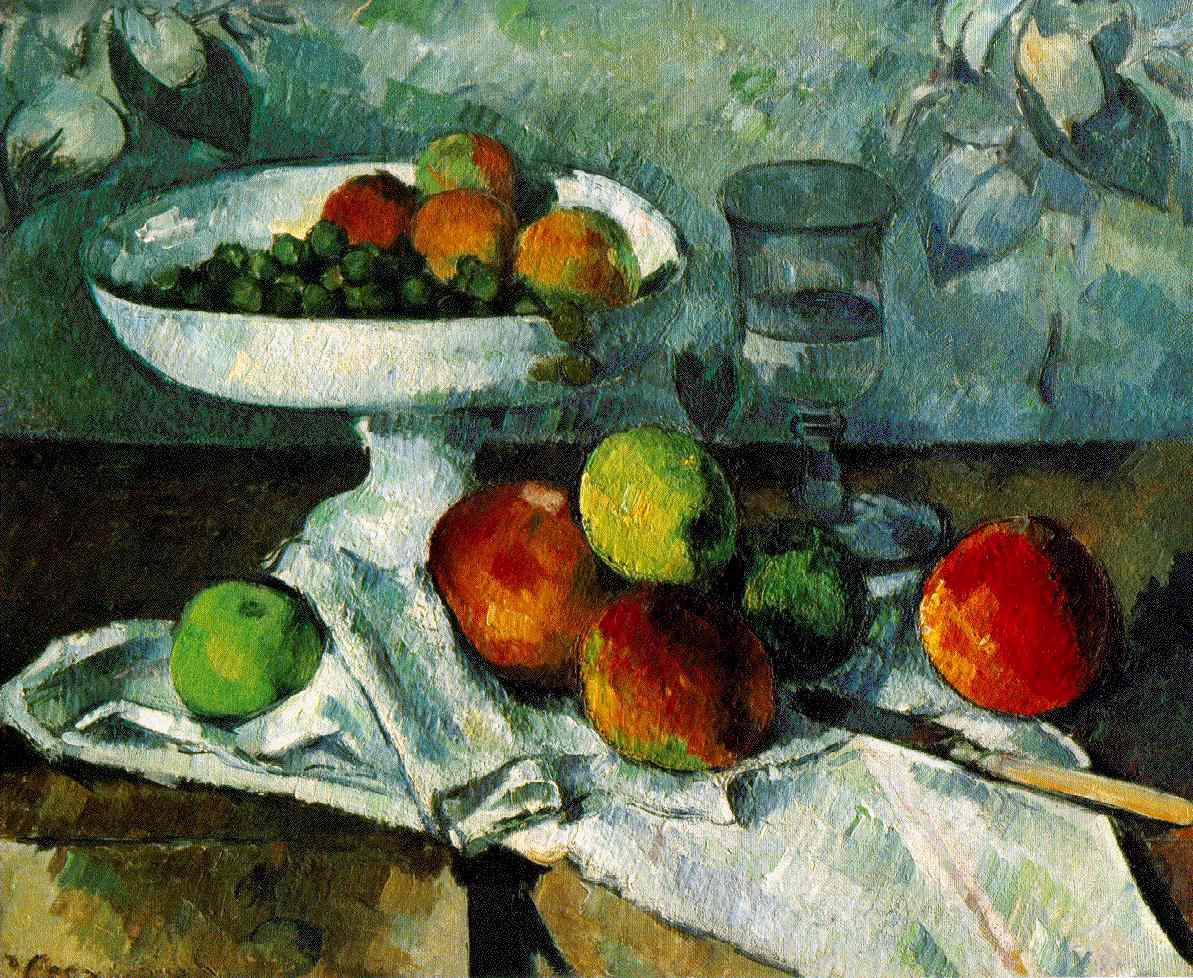
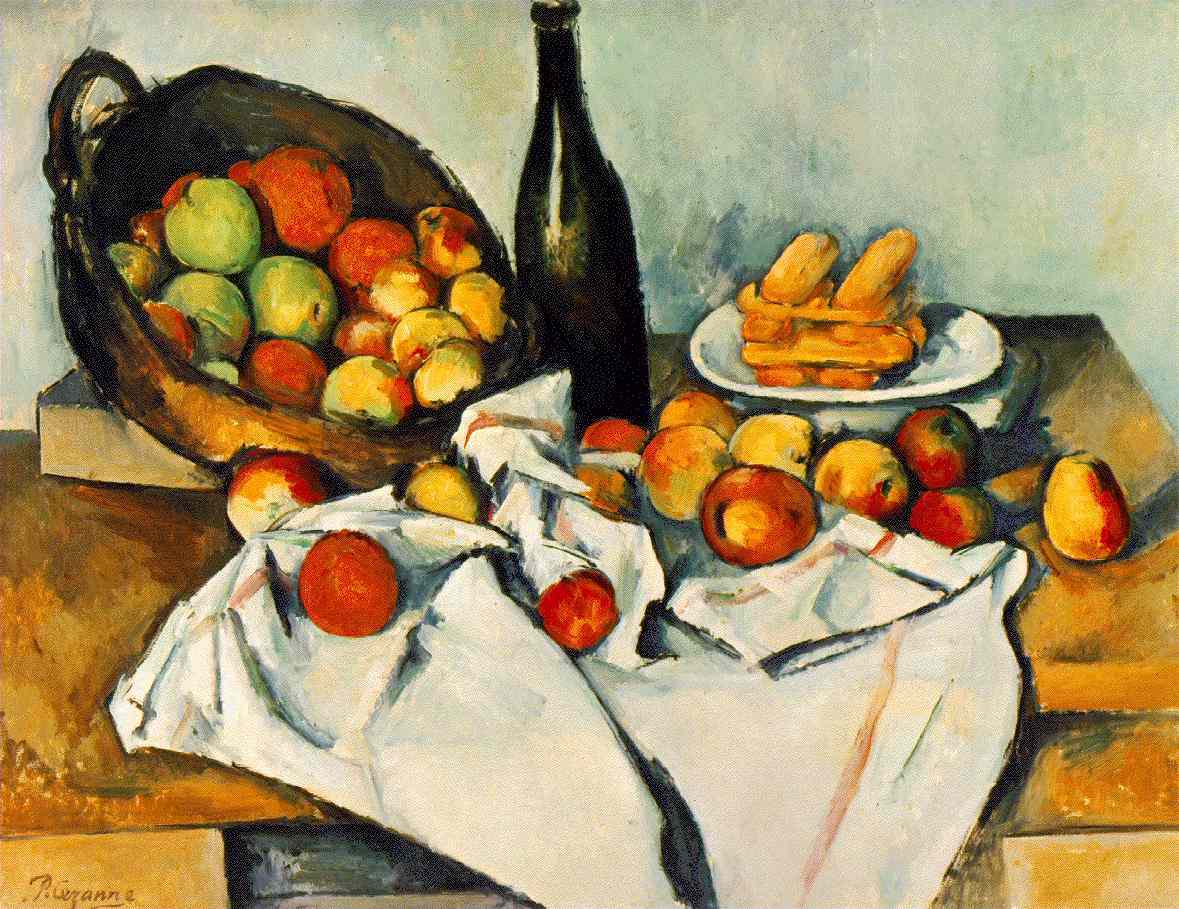
However, what really struck me here was how what Manet was doing has elements of Cezanne.  Take a look at this - here's that knife motif again..

Paul Cezanne, Still Life with Compotier, Oil on canvas, 1879


But more notably, here's Cezanne displaying a lot of the elements from the Manet, if you look closely.

Paul Cezanne, Still Life with Basket of Apples, Oil on canvas, 1890, Art Institute of Chicago

Cezanne was the father of modern painting and abstraction.  He begins to look at objects in new ways and release them from traditional depiction, to look at space and form and volume differently.  

So in his still life, although initially making sense as a basket of apples on a table with a bottle and some fruit scattered on a cloth, it is actually spatially ambiguous.  The table edges don't line up.  You are unsure how to read the surface that the still life sits on.  The ellipses of the bottle, the plate and the basket don't quite make sense.  Not all of the fruit could occupy the space that they sit in - objects are both flat and round at the same time, two dimensional and three dimensional.

Now take a look at the Manet.  Look at that line of the table running along the back.  It doesn't add up either - it's higher on the right than the left.


Nor do the ellipses of the glass or the ceramic object on the left completely add up.  The bowl on the right is tipped up unsettlingly.  It's not overt, as these elements are not the thrust of the painting, Manet's not breaking all the rules all at once.  It's too early for that - this is a painting 20 years before the Cezanne, and Manet was, in his painting, already challenging enough conventions as it was with his virtuouso paint handling.  

What Manet is saying is, "Look, I can be the next stage in the still life tradition, but I can do it in a new, modern way - and my picture is all about fishscales and lemon and cloth and glass and china, but more importantly it's all about PAINT".  

But, I would argue, those little seeds of abstraction which Cezanne potted up and grew on are right there as well.

And there we must leave it until the next blog, because there's plenty more. 

Read Part 2 HERE.