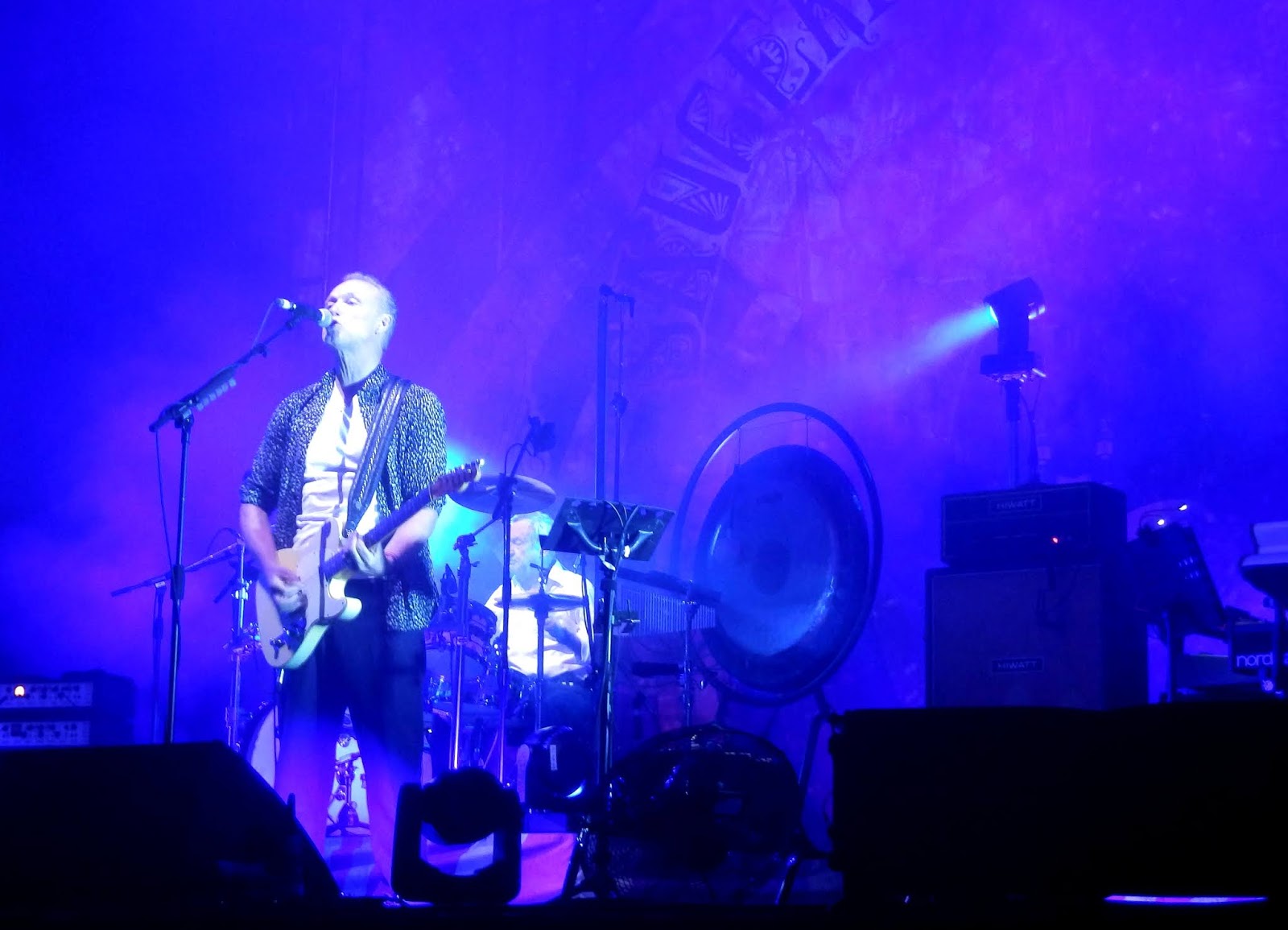
Saturday, 9 February 2019

Duncan R Miller Solo Show, London

Whilst there's no substitute for seeing the real thing, here's some photos from the opening of my solo show in London.

Many thanks indeed to everyone who came along to the preview, and helped to create a really enjoyable evening with a real buzz. Lovely to hear all your stories and your kind words about the work.


Thursday, 11 October 2018

Steve Hackett, London Festival Hall, 4 October 2018

The Festival Hall is like a groovy 1950s concrete space pod about to blast off into an outer space as designed by Lucienne Day, all spiky and sputniky - and tonight it was the setting for Steve Hackett and a 41 piece orchestra - yikes! 

Now, I've seen the train crash that can result from rock 'n' roll meets classical - Yes versus Larry Grupe at the Hollywood Bowl is still seared onto my brain.  So what was this going to be like?

Well...turns out...it's going to work out fine.

(Apologies for the out of focus photos.  I was in the front row, but Kevin a couple of seats along was shoogling.)


Here's some of the Heart of England orchestra, and the camera guy filming the concert.  At no point did the orchestra cause Steve to compromise in terms of tempo or the Steveness of the music - instead, it gave a depth and richness to it, and they fairly cracked along in terms of timing.

Steve and Nad.
 

Amanda Lehmann, Steve's sister in law, guested, singing on The Serpentine Song (one that's all about Steve's father and full of meaning for him) and Shadow of the Heirophant.


John Hackett, Steve's brother was also there.  I saw him recently in Kinross with his band.  (I left at half time.)


Nad is good in that he is dramatic enough to reference and echo the theatricality of the performance of Peter Gabriel, but without copying him.  That's a tough thing to pull off.


Land of the giants!! 

Sunday, 30 September 2018

Nick Mason's Saucerful of Secrets, Armadillo Glasgow 28 September 2018

"I don't know whether they're the saucers or the secrets", said Nick Mason from behind the drums, introducing the band.  

But quite honestly, who cared?  They could have been either. Or neither.

With swirling melting wax lighting effects last seen courtesy of the Boyle Family in the 60s, and playing a setlist of the early Pink Floyd you thought you'd never ever hear - See Emily Play, Arnold Layne, Point Me at the Sky - this was a hypnotically psychadelic night of the weird, the wonderful, the playful, the meaningless and the downright earsplittingly profound. It even had That Guy Gary Kemp from Spandeau Ballet.  

What more could we ask for?  Set the controls for the heart of the sun indeed.

Are you looking at me...?
Are YOU looking at me?


Tuesday, 4 September 2018

Painting a Painting - Queen's View with Ben Lomond

Here's another series of photos showing the stages of painting a painting.

Here's the photo that I took of Queen's View to the north of Glasgow, in some beautiful autumn sunshine, with Ben Lomond in the distance.


Back in the studio, I've got one of my largest sized of canvas, a 40" x 48" linen canvas.  

I've prepared it with a lovely warm lilac background as the midtone to work from.  Having this colour on the canvas as a base means that you're not working out from a very stark white, which can shine out between marks.  

The lilac background informs all the colour choices you make in the rest of the painting, so it literally sets the tone.  

It's how Turner painted his watercolours - he soaked his papers in buckets of red-coloured pigment, which unified the busy turmoil of marks and gave a warm glow to the work.  

Caravaggio painted out of black backgrounds with no preparatory drawing - that suited his dark character and need to paint fast (he was a man on the run from his enemies).  

Impressionists painted out of white backgrounds, which made their colours have a bright intensity which expressed the sense of outdoors light and airiness that they were trying to capture, giving a spontaneous feel away from stuffy tradition. 


It's physically a big size of canvas to work on, and is quite a challenge.  Just actually  stretching to make the marks right across in a small crowded studio is quite difficult!  Also,  it's hard to get the space to keep standing back from the painting to see how it's going.  Standing back regularly is very important - you can see where you're going wrong!!


As I work, it becomes clear that it's all about the blues of the sky working with the complementary oranges of the quiet middle ground, and the yellows and the lilacs working together.  I want it to have a really autumnal feel.  

The sky and the foreground are quite busy and detailed, so it's important to have that calm, quiet middle section with not much going on in the way of brushstrokes or detail.


The middle ground must be completely finished before I put in the long strokes of the foreground plants on top of it.  There's no going back!


Gradually, it all comes together. Concentrate!

I don't have a firm idea of how I want the painting to look when it's finished - I can't actually picture that at all - but I know how I want it to feel, and the painting becomes itself as I paint it.  

As I've said before, I try not to be too prescriptive, but to let passages of paint just happen.  It's like you're curating the marks into one composition, rather than forcing them to be there.  I can guide the paint, but if I don't let it become its own thing, then it looks too forced.


Just painting what I see!


Friday, 31 August 2018

Painting a Painting - Preston Mill

I'm back in the studio painting again in preparation for my big show in London next year.

A solo show takes a huge amount of preparation and forward planning.  So over the last few months, I've been out and about getting material and photographs  for the show, and for the last week I've been preparing canvasses and so on.

Here's the first big landscape that I've done.  This is the photo from Wednesday of the scene of hayfields and late poppies at Preston Mill, East Lothian.


In the studio, here's the first stages of the painting. Here's my palette..

Here's the painting set up on the easel.  Note the mid-tone blue background that I've chosen to use - it's a nice foil for the orangey tones of the fields (blue and orange of course being complimentary colours).  

I've only very roughly sketched out the main components of the composition for guidance with some loose notes done using a thin wash of oil paint. The photo is pinned on the easel for reference.


Then it's just a case of painting what you see, looking for the patterns and rhythms, the light and darks (which are always either lighter or darker than your mid-tone background).


Building up the forms.  It's important not to be too prescriptive, but to let the painting be itself. 

(Preston Mill is in the top left part of the painting.)


Foreground last!


Here's the finished painting.


Apparently the haybales were gone the next day, so it's a very fleeting scene, very fragile.

Monday, 6 August 2018

Salt and Silver in Connecticut

Three years ago, I wrote about a really lovely exhibition of early photography at Tate Britain, called Salt and Silver.  Salted paper prints were one of the first forms of photography, a technique first shown in Britain in 1839.

You can read the article that I wrote then HERE, and see some of the seldom-displayed images which were on loan from the Wilson Centre for Photography in London. 

 Roger Fenton, Cantiniere, 1855

Now the show has just opened in the Yale Center for British Art in Connecticut (who knew there was such a thing?), and you can see a short film about it HERE.

Enjoy!