Showing posts with label Elizabeth Frink. Show all posts

Wednesday, 22 February 2012

The Sculpture Show, part 2

You can't have a show about 20th century sculpture without having work by Barbara Hepworth - which is fortunate, because she's one of my favourite artists.  I've been to see her work at the new Hepworth Gallery in Wakefield, at the Yorkshire Sculpture Park,  and several times to her inspiring studio in St Ives.

Her work is very feminine, very nurturing - not surprising, because she had four children, including triplets with fellow artist Ben Nicholson - and very rooted in the landscape, referring not only to her native Yorkshire but also to her adopted Cornwall.  

Don't mistake feminine for namby pamby - this is work of sensuous strength and vitality, and forms a complete contrast to the rooms later in the exhibition of hard-edged male militaristic or machine aesthetic art.

This is Curved Form (Oracle) 1960.
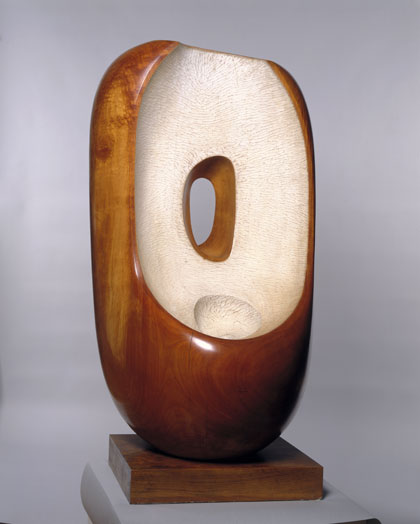

Made of carved guarea wood, the tactile fluid form is smooth and natural on the outside and more textured and painted on the inside.  It is sensuous and mysterious, suggesting perhaps a seed-pod, nurture, reproduction and ripeness.  

This is Wave of 1943.
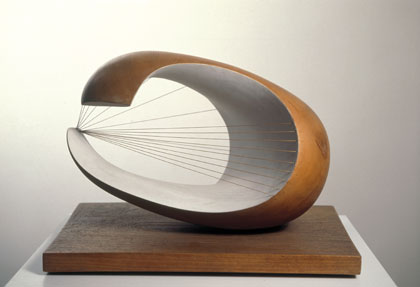

Again carved in wood and painted, is contains strings, and so suggests a musical instrument or aeolian harp.  This gives a sound dimension to it, almost as if you listen very closely, you can hear it, like putting your ear to a seashell.  The sculpture is meant to be a view of the sea, encapsulating many viewpoints of a landscape in one (rather like a Peter Lanyon painting).  'The horizon of the sea is enfolded by the arms of the land to the left and right' (wrote Hepworth), with a great sweeping gesture held by the tension of the strings.

(Not all of her sculptures are of wood, nor are they small - there are many epicly-sized public sculptures and Wakefiled has the most amazing plasters.)

The next room contained Epstein and Gill, not their best examples.  It included a great clunky ugly alabaster by Epstein. 

However, the 'Geometry of Fear - 1950s Britain' was a very interesting room.  Elizabeth Frink's small bronze birds from 1959 aren't pretty, delicate things.

 
These are disjointed, fractured forms, menacing and militaristic, like something out of Star Wars.  They are the bronze version of Ted Hughes' poem Hawk Roosting (published around the same time these sculptures were made).  Both creative forms, poem and sculpture, are born out of a post-war Britain that has itself been taken apart and brutalised, and is trying to find itself again.

Similarly, Kenneth Armitage's 1957 figure on its side, with its stick-like legs, has literally been knocked sideways and can't stand on its own two feet.
In the room also are Eduardo Paolozzi's assemblages - large forms created out of make-do-and-mend recycled scraps and objects.  

 Eduardo Paolozzi St Sebastian 1957 bronze

It's as if they are self-made figures, trying to piece themselves back together and find themselves again, and to create a new world order out of the chaos in which they find themselves.  They are rather touching in their rag-bag appearance, and almost heroic, as these are figures that are, indeed, putting themselves back on their feet.

Overall the exhibition is a very deft piece of curating, the Geometry of Fear room especially (although it would be wrong to think that all post-WW2 sculpture consisted of the fractured forms suggested displayed in that room - just look at what Hepworth was doing in the same era).  

However, it is a difficult thing to make sense of such a big subject, but by making good use of the layout of the gallery, it manages to tell a cohesively thought-provoking, if not exhaustive, story.

Monday, 23 January 2012

At the London Art Fair

Even in the cold of January, the London Art Fair at the Business and Design Centre in Islington has lost none of its vibrancy, and remains a fresh, up-beat annual event and a great start to the year.

It’s a slightly awkward space, with a split-level main hall, and further stands housed upstairs, but once you understand the space, it’s a nice venue to explore and get lost in the art.

As soon as I went in, I was met by an excitingly large Henri Gaudier Brzeska relief of two wrestlers.

Henri Gaudier Brzeska Wrestlers 1914

However, this version was cast in the 1960s (Gaudier Brzeska having died in the first world war at 23) so it's arguable how much it is an 'original' - however it's yours for £85,000!  It was just one of many high-price tag (or even POA ) works for sale at the fair - obviously there's the market out there for them.

Also on the same stand was a gorgeous Peter Lanyon, with more of his work, including a blue glass sculpture, at Offer Waterman and Co.  Lanyon was a Cornish artist, whose edgily visceral landscape work was always very much about experiencing a place, and has a very tangible excitement about it.  He was a glider pilot although he suffered from vertigo (ultimately he was killed in a flying accident), and he liked to incorporate this seen-from-the-air viewpoint combined with an element of off-balance tension into his work.


Peter Lanyon Blue Glass Airscape 1960( glass, ceramic, plaster & paint on cork)

Another Cornish-based artist (though originally from Scotland) was Margaret Mellis, whose drfitwood construction was on the Cyril Gerber stand.  Her studio must have been a complete fire-hazard, as it was piled high with stacks of found wood which she collected from the Cornwall beaches.

There were plenty of other big names of 20th century art to get your teeth into Elizabeth Frink (especially the large Fighting Cocks bronze), Joe Tilson's Wooden Relief 1960 at Austin/Desmond Fine Art, the Boyle Family's Fire Series with Melted Records with Richard Saltoun (they used to do the groovy visual effects at early Pink Floyd concerts), even Charles Rennie Mackintosh's delicate watercolour Alder Catkins, Walberswick of 1914 (Mackintosh was arrested as a suspected German spy while he was at Walberswick because of his thick Scottish accent and constant sending of letters to foreign places) Yours for £28,500!  Ewan Mundy also had a lovely William Gillies ink drawing of Anstruther for £4250 - yum.

I must mention Jo Taylor's work with Lena Boyle Fine Art Although I'm no expert on horses, I do love her large-scale equine collages, with their gorgeously expressive lines.

 Jo Taylor Desert Horse II (mixed media on paper, 31 x 27 in)

I must also draw attention to a (distant) member of the family firm, Adam Bridgland, with his very distinctive graphic work with TAG Fine Art.  His Darling Our Holiday Will Solve All Our Problems looked eerily of-the-moment.

 Adam Bridgland Darling This Holiday Will Solve All OUr Problems 2006 (Enamel Plaque 100cm x 100cm)

It's always strange when you see your own work at a gallery or an art fair.  In this case, my work was with Duncan Miller on a stand at the back of the main hall, which meant that you could see it from quite far away down one of the main corridors.  It's like seeing your work afresh, in its Sunday best.  It was great to view it in such a location getting a lot of positive attention at the fair, and also in such estemmed company as Joan Eardley and the Scottish Colourists.

I hope that those of you who attended the fair, and especially those of you who were able to make use of the complimentary tickets, will have had an equally interesting and fruitful time.  

If you were there, it would be great to have your feedback!