Wednesday, 19 December 2012

Skyfall Paintings in the National Gallery - Can You Be Bond and Q?

Since I've been blogging recently about the paintings in Skyfall, and as I was in London over the weekend, I decided to pop into Room 34 of the National Gallery and visit the scene of the Bond art history action.

"Is it possible to sit on the same bench as Daniel Craig and Ben Whishaw and pretend to be Bond and Q?", I wondered.

So on your behalf, I went in to check it out.

(If you haven't read the blogs, here they are, talking about Bond meeting Q In the National Gallery,  the stolen Modigliani painting and the key painting in M's office.)

Here's Bond in the National Gallery in London meeting Q for the first time, in Room 34 which holds iconic British paintings by the likes of Turner, Gainsborough, Stubbs and Constable.

View the scene in a video clip here.

Clearly in the film, the seating arrangements consist of a long black wooden bench.

 
Indiewire.com

The first thing I found was that if you go to the real Room 34, there is instead a long leather couch in the centre of the space to sit on, which has a padded back to it.   Here's Room 34.

Bugbog.com
(Bond and Q would have been sitting at the far end, facing the left hand wall with their backs to the right hand wall.)

However, in the film, this couch has been replaced by a simple bench.  Obviously a couch didn't suit the scene as well.  

Having a bench means that both Bond and Q are clearly framed by each of the paintings behind them without the interference of the back of the couch being in shot.  

It isolates each of them within the frame of a painting, with the subject of the particular painting behind them acting as a shorthand for their characters. 


MGM 
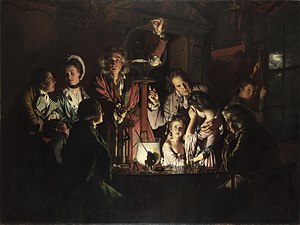
Q is backed by Joseph Wright of Derby's cutting-edge scientific piece Experiment on a Bird in the Air Pump of 1768...

...and Bond is framed by Thomas Gainsborough's The Morning Walk of 1785.  
 
This is described in the note beside the painting as a marriage piece.  The two figures are dressed in their wedding clothes.  A dog is a traditional attribute for such paintings (as in Van Eyck's The Arnolfini Marriage) and is a symbol of fidelity. Make your own speculations here - Bond as the dog, looking at its mother-figure mistress?  New M and old M? Bond's fidelity to Queen and country?  His marriage to his work?

Additionally,  the shot of the two characters framed within frames in similar poses 
is also a device which links them together, both visually and psychologically  (mirroring being a term in psychology referring to individuals unconsciously copying each other).  Although they don't know each other at that point, it shows - literally - that there is a bond.

Of course, the painting that Bond and Q are actually looking at and contemplating as a metaphor for Bond himself is Turner's The "Fighting Temeraire" Tugged to Her Last Berth to be Broken Up of 1839.


This is in fact a relatively small painting to contemplate from the distance of the bench, it has to be said.

If you go to Room 34 expecting to see this scene, you'll be somewhat disappointed.  The room does not have the same arrangement of paintings, and as I've said, there's no bench.

Bugbog.com

It's a long room, with The Fighting Temeraire beside the central door in a long row of three other Turner paintings (in the above picture, it's the first painting on the left beside the black arched door).  The couch is not opposite the painting so you can't sit and look at it like Bond.  

On the right wall, The Morning Walk is there (it's two to the left of the big horse painting), but not positioned so you can line it up with The Fighting Temeraire in front of you.  

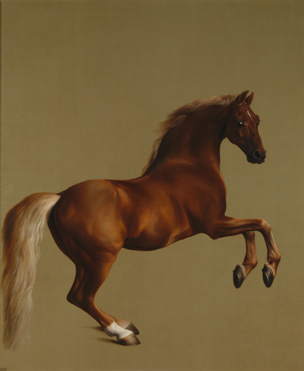
There is no Experiment on a Bird in the Air Pump (which I couldn't find on display at all).  Instead there are works by Reynolds and Hogarth, and then further along the very large and distinctive 1762 equestrian masterpiece Whistlejacket by George Stubbs (the big horse painting), which noticeably isn't there in the film clip.

So, disappointingly,  you may not be able to recreate the famous scene from Skyfall at the National Gallery, but don't let that stop you from visiting!  It's an iconic collection, and well worth taking every opportunity you can to see.

Tuesday, 18 December 2012

Conquest Art

Earlier in the year I was contacted by Conquest Art, which is an organisation that encourages people with physical disabilities to take active participation is visual arts.  

Through painting and drawing, these artists discover new abilities and gain self-confidence.  

The artists enjoy copying paintings, and had found it useful to copy, amongst others,  some of my paintings from old catalogues of my solo shows.  So I was happy to be able to help out in a very small way by sending some larger reproductions, which would be easier for them to work with.

A few months later on, here are a couple of the finished pieces based on my paintings, by Conquest Art member Chris Roberson.


In a lovely letter, I was told that Chris gets a lot of pleasure out of copying the work because of the bright bold colours.  And it's great for me to hear that someone is able to get such enjoyment in this way.

Brilliant!

Monday, 17 December 2012

Constable, Gainsborough, Turner and the Making of Landscape

I was at the Royal Academy in London at the weekend to see their landscape exhibition of Constable, Gainsborough and Turner.

It's quite a small exhibition, very academic, but strangely lacking in paintings.  

There is Constable's The Leaping Horse, all pre-Impressionist sparkly white blobs of paint imitating the passage of light (his famous 'Constable snow')
 
 
John Constable, The Leaping Horse (Oil on canvas, 1825)

Constable's subject is ordinary contemporary life, rather than a landscape inhabited by gods and goddesses or the backdrop for historical events.  Landscape itself becomes the subject of the painting.  Constable paves the way for the Impressionists to stride out into the countryside they knew and were familiar with, on the cusp of industrial change, and to record what they saw for its own sake - but this isn't really a point that is made extant.  (Perhaps if Constable had had portable collapsible tin tubes of paint and had lived in a better climate, he would have been an Impressionist 50 years before the Impressionists.)

There is Gainsborough's large dark and dreary romantic landscape with its spotlit sheep, like a more sedate Salvator Rosa landscape but without the bandits or exciting sense of brooding menace.


Thomas Gainsborough, Romantic Landscape (Oil on canvas 1783)

Then there is Turner's rather dull Dolbadern Castle - not exactly the exciting swirl of colour and light that is The Fighting Temeraire.

JMW Turner, ‘Dolbadern Castle’, 1800. Oil on canvas

And then there is a whole load of black and white prints.  

The thrust of the show is that before 1814 and the opening of Britain's first public art gallery (Dulwich), there was no way of seeing grand paintings apart from at auctions or in stately homes.  Prints were an affordable way for the ordinary person (and other artists) to access works of art and put them in their homes. Controlling the output of good-quality prints was also the way for artists the disseminate images of their work, controlling and furthering their careers and making another stream of income.

Which is all well and good, but unless you're into rows and rows of black and white prints, it makes for a very dull show.

The only time I got really excited about any of the exhibits, was when I spied a case containing Turner's brushes.  Why, they were very long, ideal for loose expressive brushstrokes, just like Whistler's long brushes which are on show in the Hunterian Art Gallery in Glasgow!  How thrilling! 

However, it was brought to my attention that actually, this was in fact Turner's fishing rod.  

For more information about the exhibition, which continues until February 17th 2013, click here.

Friday, 14 December 2012

And the answer is....

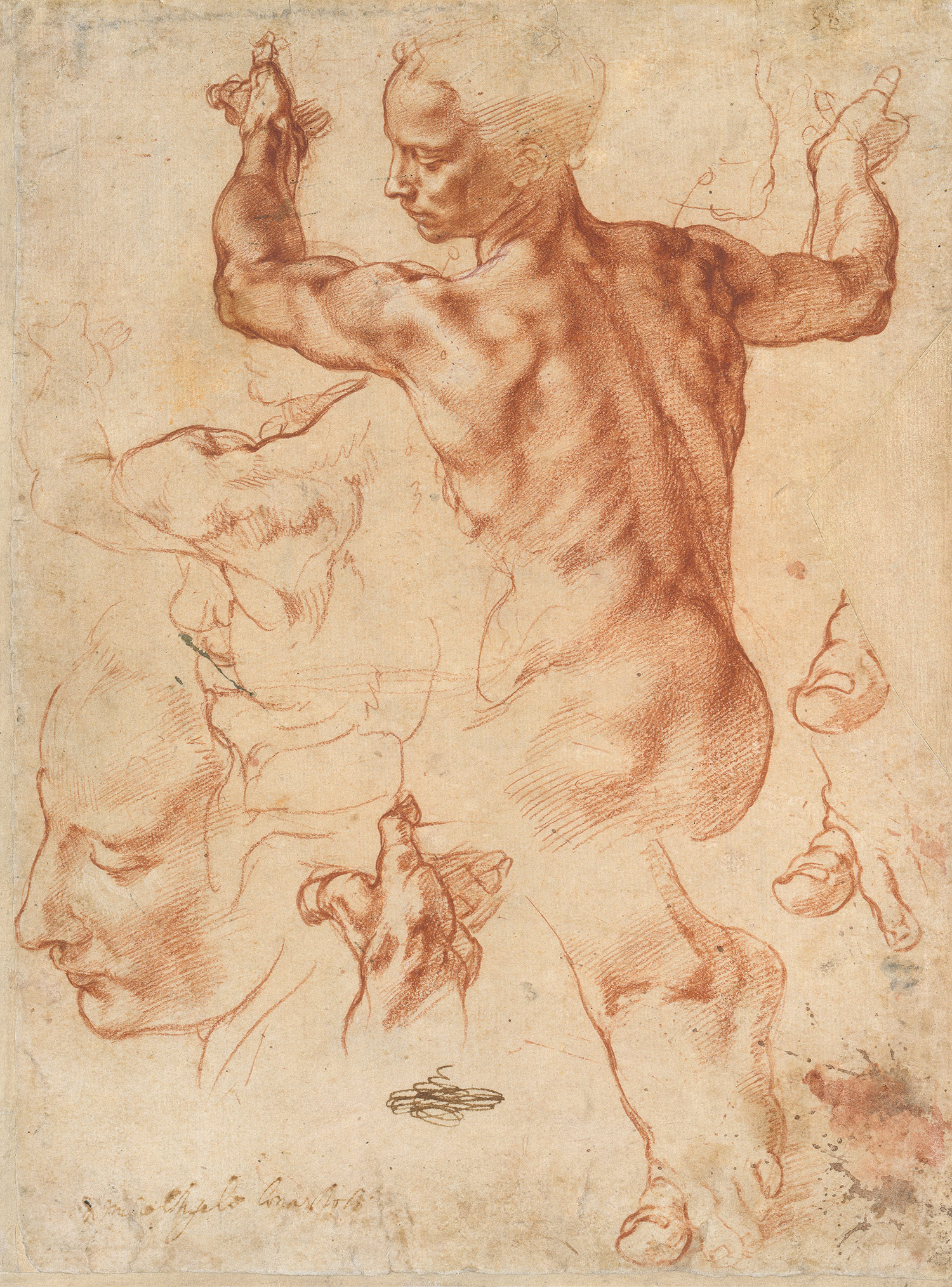
...Michelangelo's lovely Study for the Libyan Sibyl of 1508, which is in the Metropolitan Museum in New York (although I looked for it last time I was there, and couldn't find it).


Only the size of a sheet of A4 paper, the Met themselves call this "the most magnificent drawing by Michelangelo in the United States". Apparently a male studio assistant posed for the anatomical study (hence the masculinity of the female figure, although all Michelangelo's women appear as if they could look after themselves in a scrap).  All I can say is that that studio assistant certainly had a pretty hot set of muscles from grinding all those paints...

The drawing is of course a preparatory study for the Libyan Sibyl, one of the female seers frescoed on the ceiling of the Sistine Chapel (Vatican Palace) in 1508–12. 

Here it is, after cleaning, so the colours just sing.  When you see it in real life, you can't take your eyes off it.


I've explained the complications of fresco painting before here.  Can you imagine your day's work being to balance on top of shaky scaffolding in poor light and paint the complexities and subtleties of this figure, all in one go?  

It's an astonishing thought....


Thursday, 13 December 2012

Another Beautiful Drawing

Right, here's an easy one.

Name the artist, the date, and the place where you can see the finished work that this is the study for.


I'm sure you'll know it (no checking on Google!!).

I did lots of copies of this when I was at University (because we were encouraged to draw and keep notebooks).  It looks simple, but it's fiendishly difficult to get the nuances of the gesture just right.  

Done in red chalk, there's lot of implied movement, and a lovely gentle expression on the face.  It's a very physical, sculptural  drawing, but one that has a calm emotional feel as well.  It's all about contrasts;  between the tension in the body, and the relaxation in the face, and between the masculinity of the musculature of the back and the femininity of the face.

And your answer is...?

And the answer is...

Ok, well done everyone, it's Rembrandt!

Rembrandt van Rijn, Young Woman Sleeping (Ink and gouache, 1654) 


It you want to see the drawing, or find out more about it, it's in the British Museum in London.

Wednesday, 12 December 2012

A Gem of a Drawing

Here's a beautiful little drawing which I've always found captivating.  Can you guess who it's by?


It's done with a soft, fairly long-haired brush (squirrel hair?), one which can spread to do broad fluid strokes, but also be brought to a fine point to draw more precise lines.  

It uses brown ink with a little white body colour (it's there on the sitter's arm and her face, just making the dark ink a little less intense so that it isn't the same value as the arm of the couch, thus avoiding the image jumping around too many marks of the same colour).  There's a mixture of marks, in that some are wet and fluid (around the eyes and under the chest, the arm of the couch), but some are dry and scumbled.

In the background the ink has been thinned to make it paler so that it can be moved over the paper in a wash.  Some body colour has also been applied on top of the wash to knock the background right into the back, make the darkness of the figure punchier.

It's quickly done with confident, loose, expressive, almost calligraphic strokes.  It's almost impressionistic, as there isn't a lot of detail, and yet there's all the detail that you need.

It's very intimate.  The figure is obviously someone the artist knows well, not just a model. There's an air of concern about the figure - not only as if she's got something on her mind, but also as if the artist has concern for her.  The background hangs over her head like a dark cloud.  So it has an emotional punch, something very human about it.

What has always fascinated me about this little piece is that so few strokes can be used and yet it says everything it needs to about volume, the weight and the different textures, but also goes beyond mere representation.  All that in a few licks of ink.

So who's the modern impressionistic genius?  Answer tomorrow!