Friday, 30 March 2012

Happy Easter!

The schools break up today for Easter, so I'm off to be mummy for the next two weeks.


Happy Easter!  See you soon.

Treasures of Heaven

When I was in Paris at Easter last year, I went into Notre Dame.  Whilst I was there, a ceremony took place which had at its centre a large round glass case held by the priests, which a line of people were approaching to venerate, some on their knees.  As I sat and watched, I realised that the object in the case was the Crown of Thorns.


It gave me quite a jolt when I realised what it was I was seeing.  Having studied Fine Art, which is all bound up with the patronage of religion, I've seen a lot of reliquaries and unusual holy objects, from parts of the cross to bits of saints.

I've been to Jerusalem, to the Dome of the Rock, the exact location where Christ is said to have been crucified, and to Bethlehem, supposedly where the stable was.  Bethlehem was rather an underwhelming and unromantic place, but in Jerusalem, you could put your hand into the indentation in the rock where the cross would have been held upright during crucifixtion.  The intense atmosphere of everyone in the confined space of the vaulted room where the rock is was highly charged, and some people actually fainted when they felt the rock.

In Notre Dame, some approached the Crown of Thorns on their knees, and almost passed out when they were in front of it, such was the intensity of the moment.

Whether or not you believe that you can place your hand in the indentation of the stone of the exact spot where Christ was crucified, or that that object in the glass case in front of you in Notre Dame truly is the Crown of Thorns that touched the head of Christ, is not actually the point of a relic.

The potency and power of the object lies in the fact that it is the focus and embodiment of human belief and faith.  As such, it is a direct conduit to heaven, and therein lies its power. Instead of being separated from God, you are by your faith directly connected, just for a moment.

I don't know if you caught the BBC4 programme Treasures of Heaven, in which Andrew Graham Dixon looked at reliquaries, including the Crown of Thorns in Notre Dame.  Unfortunately it's no longer available on i-Player, although you can see more details and a small clip at Treasures of Heaven.  

It's a really interesting little programme, a gem in itself.  However the most memorable and moving moment is also the bit which you will need the strongest stomach for - I'll just say it's a very visceral moment involving an eye.

Thursday, 29 March 2012

Favourite Paintings - Van Gogh

Given the beautiful sunny weather at the moment, this is perhaps an easy choice for favourite painting - Vincent van Gogh's Sunflowers.

Vincent van Gogh Vase with 12 Sunflowers (version 3) (Oil on canvas 1888)

They're happy and vibrant and full of life-affirming optimism, and I think that's why so many people identify with and love these paintings.

Van Gogh had moved down to Arles in the sunny south of France in 1888, intending to set up a studio in the 'Yellow House' with his friend Paul Gauguin.  In preparation for his arrival, Vincent excitedly painted a series of 11 pictures of sunflowers to decorate the house.  Yellow, the colour of the sun, symbolised happiness, with the sunflower being a Dutch symbol of devotion and loyalty which he felt for his friend.  Also, by including flowers from buds and full blooms through to drooping seed heads in the paintings, it is a reminder of the cycle of life.
 
The paint is applied thickly, with love for the medium, and in a huge variety of strokes.  As well as the colour being expressive, the marks are too - fluid, lively, quick, with lots of texture.

Vincent van Gogh Sunflowers (detail) (Oil on canvas, 1888)
 
 Vincent van Gogh Sunflowers (detail) (Oil on canvas, 1888)

Initially, the sunflower paintings followed established painting rules, having a blue background (blue being the complementary of yellow, so that each colour is intensified by being beside each other).  However later paintings in the series have yellow backgrounds, so you have yellow on yellow with yellow, with just a central pop of blue.  It's turning the happiness and the message of the paintings right up to 11.
 
Vincent spent spent the summer of 1888 in a frenzy of work and waiting. Gauguin finally rolled into town in October, bringing a long roll of rough jute as a present, which both painters used as a substrate to paint on.  (You can trace their paintings they they did together at this time by piecing together the paintings that were cut from this roll of jute.)  
 
Having waited for months for his arrival, van Gogh must have been quite overwhelmingly fit to burst when his friend turned up.  Gauguin, however,  seems to have been quite arrogant and domineering. Unfortunately, it all ended in tears, with the actuality of the situation being nothing like the artistic idyll which Vincent had built up in his head.   The two artists didn't agree on anything, from domestic arrangements to painting, and van Gogh couldn't cope with Gauguin's overwhelming critical attitude.  
 
In only 2 months Gauguin was gone, and Vincent was plunged into severe depression.  
 
Eighteen months later, van Gogh was dead.

Vincent van Gogh, Still Life with Two Sunflowers 1887

Wednesday, 28 March 2012

Using Acrylics

For some of the work in the 'Great Welsh Journey' show, I've used acrylics as they're great for quick note-taking.

Acrylics are a synthetic paint which can be diluted with water.  They dry quickly, and once dry, they are plastic-like in nature, and are pretty impossible to get off clothes or brushes because you can't dissolve them with a solvent after they harden, so be careful, and always wash your brushes out as soon as you can! 

Acrylics are like a cross between watercolours and oils to use when painting.  They can be used thickly or drawn into like oils, or thinned down with water to use in washes like watercolour.

Here's some close-ups of some of the work from the show.

This is a small painting called Afternoon at Rhossili.  The card has been prepared with a gesso primer and a warm grey acrylic base coat.

Afternoon at Rhossili (Acrylic on card, 6.5 x 10)

When looking from the clifftop at Rhossili on the Gower Peninsula, you can see the wide sweep of the bay with the water shining over the wet sand.  To get the effect of the water on the sand, I used the acrylic in washes of creams and then blues, with a lage soft cats tongue watercolour brush and plenty of water.  Coats of colour dry very quickly.  You can also see the warm grey of the base coat showing through.

 Afternoon at Rhossili (detail) (Acrylic on card, 6.5 x 10)

You can also draw into acrylic with the end of the brush or a stick, as you can with oils - this is called 'sgraffito'.  It reveals the colour of the canvas, or a dry layer of underpaint beneath.  The marks at the top are the distant lines of waves, the thicker marks at the bottom are grasses on the cliffs.

 Afternoon at Rhossili (detail) (Acrylic on card, 6.5 x 10)

This is a detail from Clouds over Wolf Castle (pictured in yesterdays blog).  Wolf Castle in a dramatic collections of jagged ruins on the crest of a hill which you can see rising up from the road across from Fishguard to Haverfordwest.  

To get the looseness and airiness of the clouds, I again used a large cats tongue brush, but using white on a dried background of sky blue, so that the colours didn't mix but retained their integrity.  The white was also thicker and more substantial, so didn't apply so thinly over the blue, although still allowing for a very free form of mark-making.

Clouds over Wolf Castle (detail) (Acrylic, 10 x 10)

Lastly, this is Houses at Betwys y Coed, which shows how you can apply acrylics thickly with a palette knife or edge of a piece of card.

Houses at Betwys y Coed (Acrylic, 10 x 10)

This is an area with autumn trees, so the paint here indicates volume and foliage.  I've also drawn into the paint so that the lilac of the base coat shows through (lilac being a complementary colour to the yellows of the foliage of the trees)

Houses at Betwys y Coed (detail) (Acrylic, 10 x 10)

These various ways of applying acrylic build up to form a vocabulary of different marks, which you can use in various combinations as part of a painting.   There's no right way or wrong way of applying the paint.  Find what's right for you.  When it looks right to you, and says what you want it to say, then you've got it right.

Tuesday, 27 March 2012

Next show heads for Bristol

My next show heads off in a van to Bristol today.

Called 'The Great Welsh Journey', this very special event is a one-off collection of landscape paintings, drawings and postcards from a journey around the Principality.   

 Rainclouds over Llandudno Pier (Mixed Media 29 x 24)

I went on a trip round Wales in September last year, from Llandudno and Anglesey in the north, through Snowdonia (very wet!!), down to Aberyswyth and the coast, Fishguard, across Pembrokeshire, Tenby, Swansea, round and round the Gower Peninsula, and then across to Neath, Merthyr Tydfil and the Black Mountains to Brecon.  All the while, through sunshine and showers,  my trusty camera was on hand!

 Rhossili Bay (Oil on linen, 32 x 48)

It's a really exciting show, as it was a chance to do something a bit different, with a real mixture of work in different media.  I'm hoping it will give a flavour of the excitement of documenting a journey and discovering a place.  As well as oils, I've used acrylics and mixed media drawings to give a sense of this fluid, quick response to a landscape.

 Clouds over Wolf Castle (Acrylic on card, 10 x 10)

The postcards were also very nice to do, as they're almost like postcards to myself about the journey, and their size means that they look really cute.

Bwlch (Oil on postcard, 5 x 7)

The exhibition also includes works by Welsh artists such as Vivienne Williams. There's a 'meet the artists' preview (I'll be there) on Saturday 28 April 11am - 4pm at the Lime Tree Gallery, 84 Hotwell Road, Bristol BS8 4UB. All welcome! 

Monday, 26 March 2012

New View of Mackintosh Building

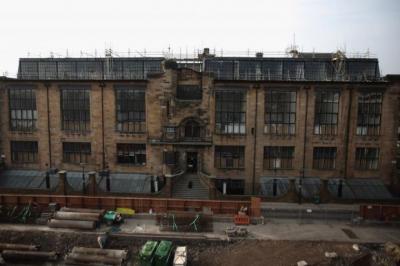
Earlier this year, the 1960s concrete block of the Newbery Tower at Glasgow School of Art was demolished, gradually nibbled away by a rather intriguing dinosaur-like piece of machinery over the course of a couple of weeks.


(Thanks to Anne Morrison for her photos.)

Whilst it's goodbye to the Textile Department, and to the end of term exhibition in the Newbery Gallery, it does mean that for the first time in 50 years, you can actually see the whole facade of Charles Rennie Mackintosh's masterpiece.

Picture: Jeff J Mitchell

It's a great opportunity to see it before the new buildings opposite once again obfuscate the view.  You can read more here in an article in today's Herald.

There's also what promises to be a very interesting programme on BBC4 on Thursday which includes a discussion on Mackintosh and his influence, and also that of arguably the greater talent of his wife, Margaret MacDonald.  Sex and Sensibility: The Allure of Art Nouveau is on BBC4 on Thursday 29th March at 9pm.  You can see details here.  

You can catch up with episode one of this 3-part series about this lusciously sensual decorative style in Paris on BBC i-player here.

You can also read more in a piece in today's Guardian here called 'Art Nouveau - a Magical Style'.

Friday, 23 March 2012

Favourite Paintings - Rembrandt

When I was 8, we did a project on Holland in Primary School, and our teacher brought in some slides of Dutch paintings which we looked at through a viewfinder which you put up to your eye.  One was Van Gogh's Sunflowers, and the other was Rembrandt's The Anatomy Lesson of Dr Tulp (on reflection, a rather strange combination of images).  

Seeing coloured images like that was a reasonably uncommon experience in the 60s, in a house with no books and before colour television, so the experience and surprise of seeing these paintings in that small but intimate way had a rather profound effect.  One image was all about colour, the other all about gesture, both were full of emotion.  I loved them both.

Years later, when studying abroad as part of my degree, I had the opportunity to stand in front of Rembrandt's The Jewish Bride in the Rijksmuseum in Amsterdam, one of my must-see artworks.

 Rembrandt van Rijn The Jewish Bride (oil on canvas c.1667)

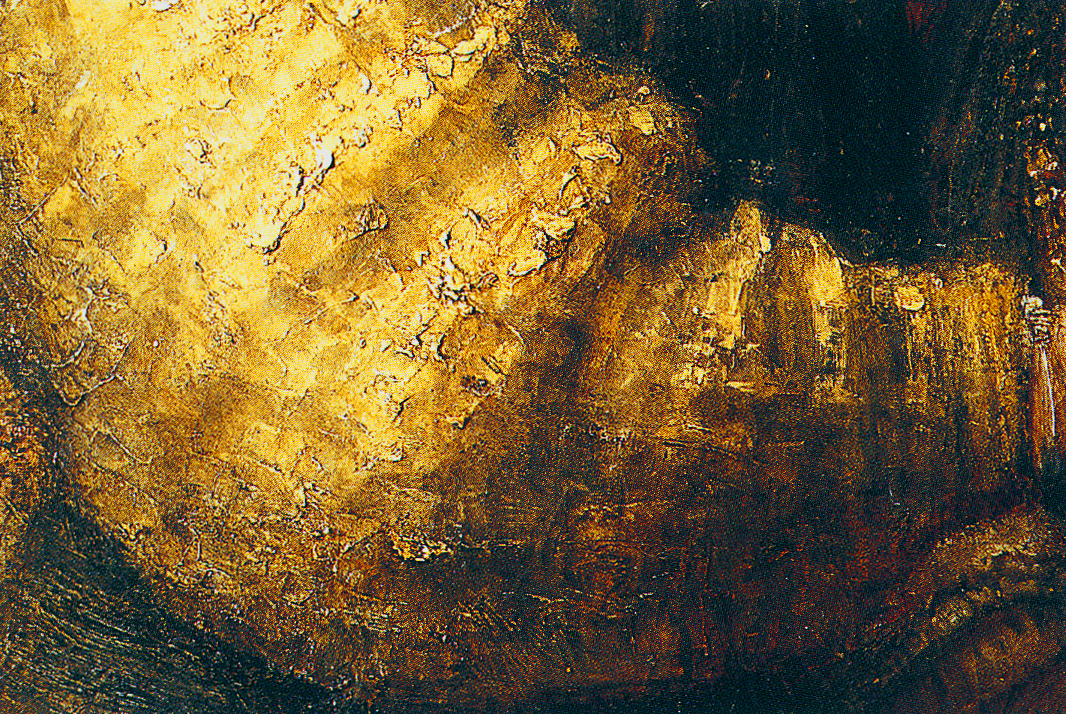
The title is a speculative one added in the 19th century.   It's a big, dark painting, and yet it seems to glow. You can't take your eyes off it when you stand in front of it is because it is all about texture and colour and gesture and emotion.  It had layers and layers of paint and flickering brushwork that suggests different materials and textiles catching the light, and three dimensionality.  This is the golden sleeve of the man.


It's just paint, and yet it has a reality and a volume about it.  It actually seems to be coming out of the painting towards you, but also has a certain abstract quality about it close-up.

There is also a lovely sense of abstract pattern making in the gesture of the hands.


You can see that it's just paint, you can see the actual brushstrokes, and get the sense of the person making the brushstrokes and creating the artifice of the work; and yet it seems to become actual fabric, and light, and flesh, and touch and life, and also more than that - it becomes a real sense of something human and tender.  And that's quite an astonishing thing to do with paint and canvas.

As Fine Art students, we were also lucky enough to visit the Jan Six house in Amsterdam, which was not open to the public.  One of the paintings there was Rembrandt's portrait of his friend Jan Six.

Rembrandt van Rijn Portrait of Jan Six (Oil on canvas, 1654)

Again, it's a big old dark painting with that punch of orangey red, but the stunning thing, which has stayed with me all these years and which was right at eye level, was not the face, but the gesture of the hand pulling on the gloves.  


It's clearly just paint, and big, expressively loose gestural marks of paint at that, and yet it's the volume and weight and movement of a real hand pulling on a glove.  It is a casual yet hugely informed passage of paint which tells you all you need to know about the character of the sitter and the relationship between the artist and his friend, who allows himself to be preserved for all time in this intimate, informal act of dressing.

If you'd like to read more, there's an interesting essay here musing on the meaning of this gesture. 

Whichever way you look at it, it's just genius.