Showing posts with label Caravaggio. Show all posts

Monday, 4 April 2016

Caravaggio Talk

Here's a great talk by Letizia Treves, the Curator of Italian and Spanish Paintings 1600-1800, National Gallery of London.

It's on Caravaggio, and is one of their series of lunchtime talks, and lasts about half an hour.

It's really good, so enjoy!

Caravaggio, Boy Bitten by a Lizard (Oil on canvas, 1596) 
 
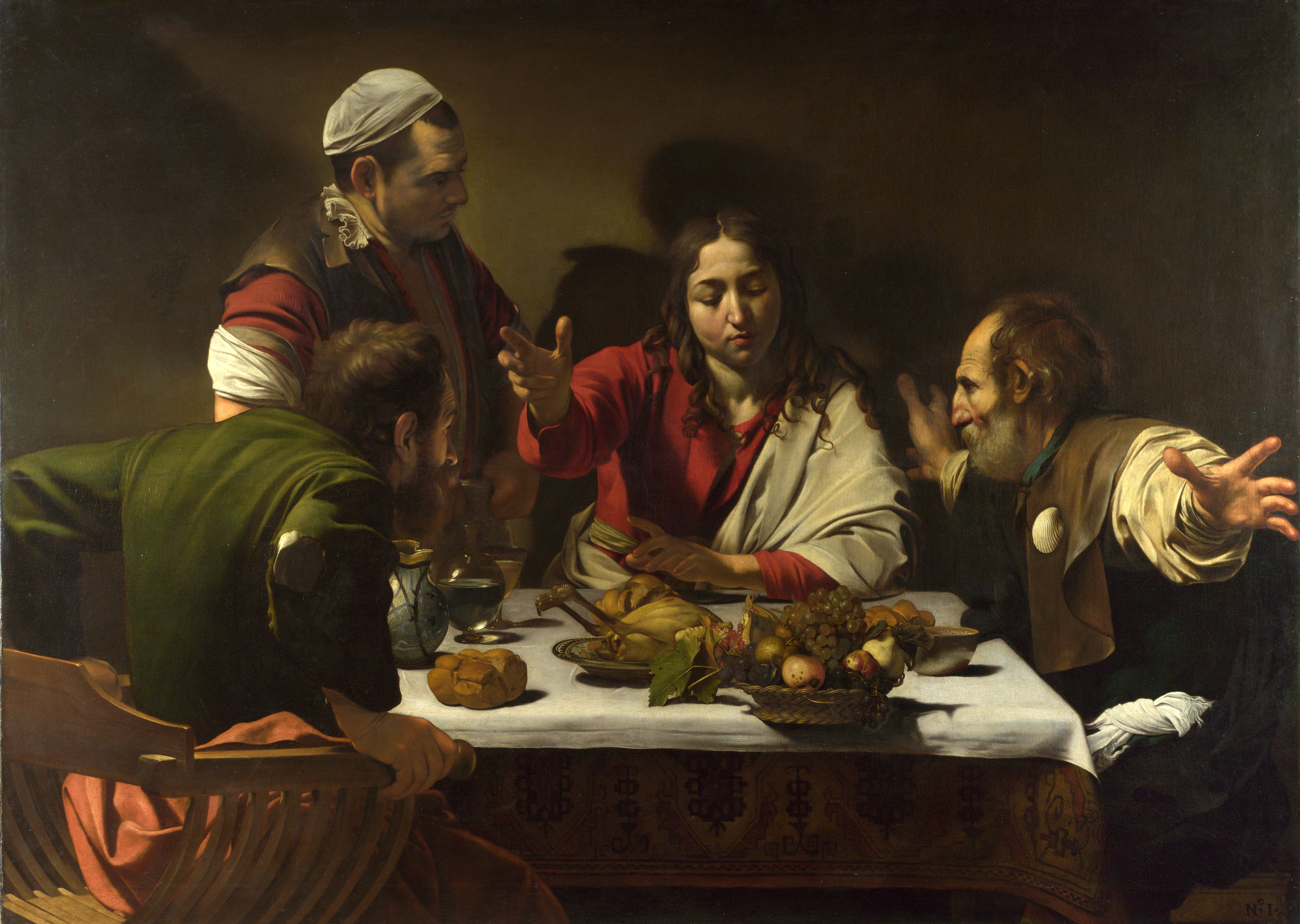
Caravaggio, Supper at Emmaus, Oil on canvas 1602
 
Caravaggio, Salome with the Head of John the Baptist (Oil on canvas, 1607)


Monday, 19 August 2013

Caravaggio at the Edinburgh Festival Fringe

I was through at the Edinburgh Festival on Saturday to take in some of the Fringe action.

First up it was an early morning dip into the murky depths of the dark world of the painter Caravaggio, in Castration on a Tennis Court at the Symposium Hall.  This was a tale full to bursting with pimps, priests, prostitutes and painting, presented in an engagingly effortless, chatty and endlessly knowledgeable style by TV art historian and cerebral hottie Andrew Graham-Dixon.


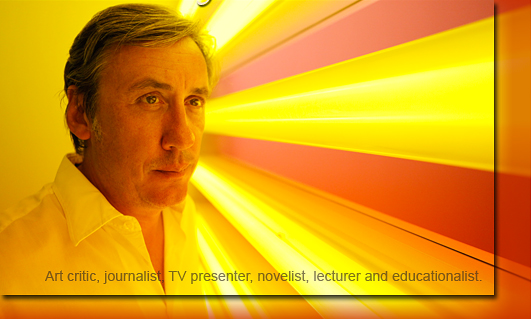
He's the chap was on BBC4 recently, riding a bicycle whilst doing a piece to camera about the Dutch Golden Age.  What a guy.  Here's his oddly radioactive picture from his website, as he illuminates every corner of our cultural darkness.


(Apparently, according to his website, you can actually hire him, for your own private tour.  You can even take him abroad.  Or get him to give you advice in order to make the 'right aesthetic and financial choices'. I wonder how much he costs...?)

And now here was AGD in Edinburgh, the real thing, straight from the late-night recesses of our television screens, hopping onto the stage armed merely with his book and a cup of coffee, and nary a lecture note or a lecturn in sight (nor any strange radioactive rays). 

He launched into a story about the reaction of Keith Richards (of the Rolling Stones) on seeing Ottavio Leoni's drawing of the 25 year old Caravaggio.  Here it is.

"He looks like a bad boy!" rasps AGD, doing Keef, "If he were alive now, he'd be a Rolling Stone!"  He likes doing an impersonation or two, does AGD.

Now, one of the key people who helped AGD's research for his book Caravaggio: A Life Sacred and Profane was none other than the Papal Devil's Advocate (for there is such a job description), a chap called Sandro. He's the guy who dishes the dirt on any prospective saints by trawling for trash in the Vatican Archives.  For the last 32 years, he has spent his lunch hours going through several million records in the Archives on his own personal quest, in the hope of finding rubies in the dust - namely papers which mention Caravaggio.  

So far, he's found a couple of hundred, which must mean a hit rate of about one new document coming to light every six weeks.  Just enough to keep you searching.  The things which have come to light include an inventory made by Caravaggio's landlady in Rome, detailing the contents of his room - his swords and daggers, his chamber pot, his 12 books - but not the titles of the 12 books.  Chinks of light in the darkness, and the eternal frustration of the ommissions.  She also noted that he'd messed up the room by knocking a hole in the ceiling - the possible secret of the dramatic lighting effects of Caravaggio's chiaroscuro...?

AGD has effortless fluid command of the myriads of names, dates and details, and the skill and energy to tell a tale.  This story is one of darkness, passions, violence, danger, and the rule of the street.  Life as a painter on the cusp of the 16th and 17th centuries in Rome was survival of the fittest in the gutters, gritty, brutal and tough.  And yet a painter's job was to communicate the vision of the light of heaven from the very midst of all this profane darkness, to bring religion to the masses by picturing the divine.  No wonder Caravaggio's work was full of darkness and light, and the chiaroscuro of contrasts and contradictions; death and life, opulence and poverty, the sacred and the profane.

The brutality and brevity of life hit Caravaggio from a very young age.  When Bubonic plague swept through Milan in 1576, his family lost nearly every male member.  Father, uncle, grandfather - all were gone in days. Before Caravaggio was six years old, all his male role models were wiped out, and the dead were piled up in the streets.  

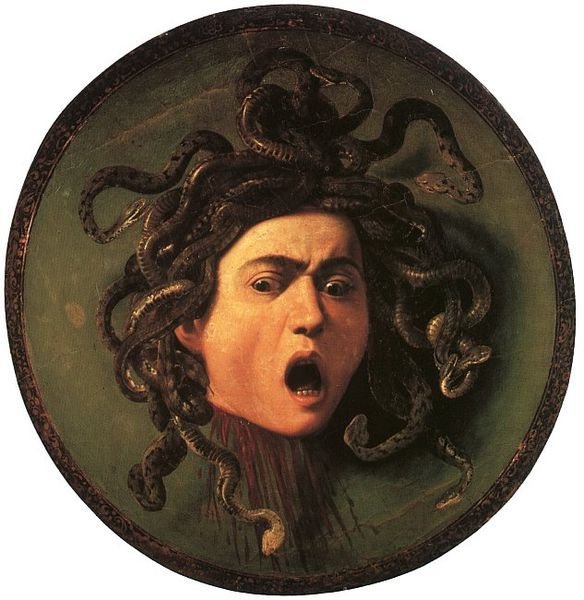
No wonder when he painted a self-portrait, it was like this.


Caravaggio, Medusa (Oil on wood) 1590, Uffizi
Here he is portayed as the Medusa, painted onto a curved shield, which has a handle across the back so you can hold it.  AGD acted out the scene.  In the legend, Perseus is going to slay the snake-headed monster Medusa.   If he looks at her, he will be turned to stone, so he has the shiny round shield on his arm and can see the Medusa's image reflected in it.   He reverses into the fray, sword flailing, and cuts off her head.  As it flies through the air leaving streams of blood,  in the last 12 seconds of consciousness Medusa can see her own death reflected in the polished surface of the shield. 
It wasn't the last time Caravaggio would paint himself beheaded.  By the time he was painting these sort of images, he had already seen much more brutal horrors right on the streets. Plague.  Fights.  Executions.

No wonder Caravaggio's art was all about 'making it real'.  Real people.  Real poverty.  Real dirt.  Real miracles.  Miracles that are there for those who can see, not heralded by flights of angels. He used prostitutes as models (and was probably a pimp himself).  In fact, here his model for the Virgin Mary was a drowned prostitute pulled from the Tiber.

Caravaggio, Death of the Virgin (1606, Louvre)


The swollen body of the Madonna proved to be such a stumbling block for the church of Santa Maria della Scala who commissioned The Death of the Virgin, that it was rejected.  Thus it eventually ended up hung in an appallingly lit long corridor in the Louvre.

Caravaggio's colours were the colours of earth, made from actual earths and clays, not the expensive colours of church-controlled lapis lazuli. Thus he painted the Madonna in a red dress, not a blue one, as was the tradition. 

His paintings are like film sets, like modern installations, using the real light flowing through the three dimensional space of the architecture of the churches in which the paintings were sited to become the divine light in the two dimensional paintings.  The space within the paintings references the space in which we stand when we are looking at them (which is why it is so important to see the work in situ). Filmmaker Martin Scorcese compared 16th century Rome to Hollywood, with winning of a commission for an altarpiece being like getting the rights to make a movie.  

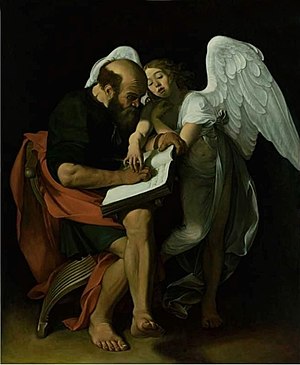
In Caravaggio's blockbusters, which had the common masses of pilgrims buzzing round them like flies, he creates characters that people can actually identify with, that they might meet on the street. Thus, dirty-footed Saint Matthew is fallable and semi-literate, 

Caravaggio, St Matthew and the Angel (1602, destroyed)

Saint Peter takes a huge amount of human effort to kill, 

Caravaggio, Martyrdom of Saint Peter (Santa Maria del Popolo 1600)

Saul becomes like a newborn baby lying in the manger as he falls from his horse, 


and the Virgin Mary's ascension into heaven is suggested not by cherubs, but by a void, filled with an impersceptible breath, a heat, the wave of a curtain in the back room of a house, leaving behind her heavy, swollen body sagging on the bed. People looking at the painting would recognise death when they saw it, as they would have seen it as a matter of course in their lives, and they would certainly recognise it here.  This is mortal death, plain to see.  

But the spiritual, the miracle, is there if you look carefully enough.  Because, says Caravaggio,  that's how it is in real life.  The divine isn't about cherubs and gold and the trappings of religion.  It's right down in the grime, it's real, it's happening all around, you're breathing it in, it's something real and alive and vital and everyday.

Similarly, there are signs of the miracle of the risen Christ in the Supper at Emmaus - but only if you can see them.


Caravaggio, Supper at Emmaus (1602, National Gallery London)

It's all in the shadows.  The shadow behind Christ forms a halo, the fruit basked teetering on the edge of the table (between life and death) casts not the shape of the fruit, but the tail of a fish - the ixthus.

And the arguments!  You wouldn't want to have been a waiter in Caravaggio's Rome - one waiter was assaulted by an artist for daring to serve a meringue that was too crunchy.  Or was it not crunchy enough?  And Caravaggio got into trouble for smashing a plate into the face of a waiter who brought him a dish of buttered artichokes rather than ones dressed with olive oil.

The fact that Caravaggio got into a fight over a buttered artichoke was no arty-joke.  Sorry...

However, as AGD explained, there was a logic to Caravaggio's anger (and he was a man full of energy and anger and passion). In this case,  the waiter was actually making a racial slur by insinuating that fine Roman olive oil was not worth wasting on butter-sloshing northerners like Caravaggio (Lombardians being famous for their love of lashings of butter and cheese).  So Caravaggio smacked him in the face, gashing it open and knocking out teeth.  You don't like my face?  Well, no-ones going to like yours much once I've finished with it.

And now onto the subject of the whole talk - namely that castration on a tennis court.  Caravaggio was never, it seems, beaten when it came to one-on-one fighting with a sword.  And in this case, he killed man, on a tennis court -  Ranuccio Tomassoni.  Not that they were actually playing tennis, as AGD acted out for us, sweeping back his floppily unruly fringe once again in a gesture that annoyed my follically-challenged lecture companion.  No, you could be put to death for holding a duel.  Instead, this was a smokescreen - hold a game of tennis and pretend that a fight broke out, that it was a crime of passion.  Oh, those hot-headed Italians.  We squeaked in our comedy squeaky seats in excitement.

Caravaggio, it seems, was aiming for Tomassoni's groin, with the aim to castrate him, in an act of revenge appropriate to the nature of their dispute.  However, in the split second that it took for the sword to pierce Tomassoni's groin, the course of Caravaggio's life was changed forever, and its downward spiral had begun.  For the blade pierced the femoral artery, and the man bled out in seconds.  According to accounts, the tennis court was awash with blood, fountains of it all over the place in shocking torrents, covering the onlookers; he was dead in moments.

By this time, we'd been going for an hour and twenty minutes, and the janitor was getting agitated about the next show coming on - so there we pretty much stopped.  Not that there isn't about another 30 years worth of material (probably) which could seemlessly issue like unstoppable streams of silk from the lips of the prodigiously elephantine-memoried Mr Graham-Dixon.


Here he is afterwards, signing my copy of A Life Sacred and Profane whilst I burbled some complete and utter total nonsense. 

Hey ho - never meet your idols, eh?

Later the same day, I met Rick Wakeman, and did pretty much the same thing.

Thursday, 25 October 2012

Caravaggio and the Importance of Seeing the Real Thing

When I studied my MA in Fine Art, we were sent to look at artwork in situ across Europe.  We were told that, in order to understand art, there was no substitute for seeing the real thing.  I'd never been abroad before, so the whole trip was rather mind-blowing.

One of the places our class of 14 visited back in the late summer of 1983 was Rome, and one of the top places to see on our list was the church of S Luigi dei Francesi, which holds the St Matthew cycle of paintings by Caravaggio.

When you see them in books, you see this.  Here's St Matthew being called by Christ.

Caravaggio, The Calling of St Matthew (Oil, 1600)

Here is St Matthew being instructed by an angel.

Caravaggio, St Matthew and the Angel (Oil, 1602)
 
And here's how the story ends up, with the martyrdom of St Matthew.

Caravaggio, Martyrdom of St Matthew (Oil, 1600)

All well and good.  But seeing them in books doesn't give you an idea of their size, for example.  Also, they were painted for very specific positions in a particular chapel of the church, taking into account the architectural features which surround them.  This is very important to the understanding of the works.

Here's the paintings in the chapel, if you stand back from them.


You'll see the St Matthew receiving the holy word from the angel is above the altar, and the two other paintings flank the sides.  The angel painting wasn't the first one that Caravaggio did for the centrepiece - the original one was rejected for being too radical.  Unfortunately, it was destroyed in the second world war, but here's a photo of it.

Caravaggio, St Matthew and the Angel (Oil, 1600, First Version (destroyed))

The first version encapsulates what Caravaggio was trying to do with his religious paintings - paint religion as something that real, ordinary people could connect with by showing saints as real, ordinary people.  Unfortunately, this St Matthew was far too real and ordinary for the Church.  He's shown as an awkward, middle-aged man with dirty feet thrust out towards the viewer, his hand actually being touched and guided across the page by an angel.  It was too much.

However, his second version - with a suitable distance between St Matthew and the angel - still has a concession to Caravaggio's radical vision.  In the church, you are looking up at the painting, over the altar.  The marble altar is in real life, and then it is also along the bottom of the painting.  St Matthew is rather oddly kneeling on a stool to take dictation, and the end of the stool is thrust out, off-balance, over the edge as if it is going to tumble down onto the altar.  So on the face of it, it is a balanced painting, but on closer inspection it is actually about being caught off-balance - it thus externalises in a more subtle way what St Matthew is feeling.

But back to the importance of seeing the work in real life.  It's all about the light.

The Chapel reads like a giant book, from left to right.

On the left, in the Calling, the light comes from the right hand side.


The direction of the light, which just catches Christ's summoning hand and falls on Matthews face, is therefore a guiding spiritual light, the light of God.

However, remember there's a real window above the altar in the chapel.

 
So there is also real light coming down from above - but not at the same angle as in the painting.

Stand right at the centre of the entrance to the Chapel, and you'll see that the light hits...


..the face of St Matthew, like a natural spotlight.  How clever is that??

In the Angel painting, the light source is from above, from the direction of Heaven, where the angel is descending from.  The light therefore is also a spiritual light.  It doesn't get any natural light from the window above.


The Martyrdom painting on the right has the light source coming from the left, same as the natural light, which comes in to spotlight...


...the palm of martyrdom being handed to St Matthew.


Compositionally, it would have been impossible to put St Matthew's head up at the top, at the point where the light hits, so Caravaggio had to work out some other solution.  His answer was to spotlight the attribute of matrydom instead of the protagonist, which in turn also drives the dynamicism of the composition.  It makes our eyes dart round to read and try to make sense of the moment of confusion, giving a sense of movement and action.

The scene is set at a baptism (hence the opportunity for some semi-naked male figures), so we are standing down actually in the water of the baptism pool (the dark void on the edge of which St Matthew is lying).  We, too, are being baptised, are in the pool, and the implication is that we, too, are in a vulnerable state of near-nakedness.  That makes the moment of the killing of St Matthew, during a sacrament, even more of a betrayal, both for him and for us.

The natural spotlight hits the arm of the angel which carries the palm frond, which in turn drives our eyes down the upraised hand of St Matthew and the heart of the story and the action.  We then read down his other arm, and then in a clockwise circle round the action, with characters dynamically bursting off outwards into the darkness as if an explosion has gone off.

Just imagine Caravaggio getting the commission for these paintings, and coming into the Church to look at the site where his work would be placed.  

He would have stood at the spot where visitors can stand today, and considered every aspect of the actual site, all the existing paintings, the decorations, the altar, the window, the way the light came in, the angles, the architecture, how they all played and worked together.  How could he use all these elements to give power to his canvasses, to help tell the story more effectively so that people could feel that they were right in the heart of the biblical action, making it real and relevant? 

He would obviously thought very carefully about how and where the natural light would come in and worked out where, on his canvasses, he would have to position the narrative and the figures in order to make the whole thing work.  So he's using the actual space of the Chapel as part of his narrative. It's all part of a multi-media, 3D concept.

It's very exciting when you see it and realise what he's doing, using the light on the very day you visit the Chapel as part of your experience and understanding of the paintings, even though it was conceived as an idea over 400 years ago by someone who's long since dead.  He set it going and it's still working away.  


The pictures weren't meant to be seen in books by scholars.  They only come alive when you, as one ordinary person, stand in front of them, in that church, at one particular point, and read them.  Caravaggio is speaking directly one-to-one with you through the Chapel as a whole.  

The paintings really speak on a totally personal level, and that's a very powerful thing.  The man was an absolute genius.

He even put himself in the painting.  Here here is.


 That's him at the back with the beard.


He's saying I'm human and fallable and vulnerable, and I, too, can bear witness to great religious moments, just as you can. 

So go and see the paintings.  They may not be as easy to see or study as they are in books.  But in order to understand them, there's no substitute for seeing the real thing.


Monday, 8 October 2012

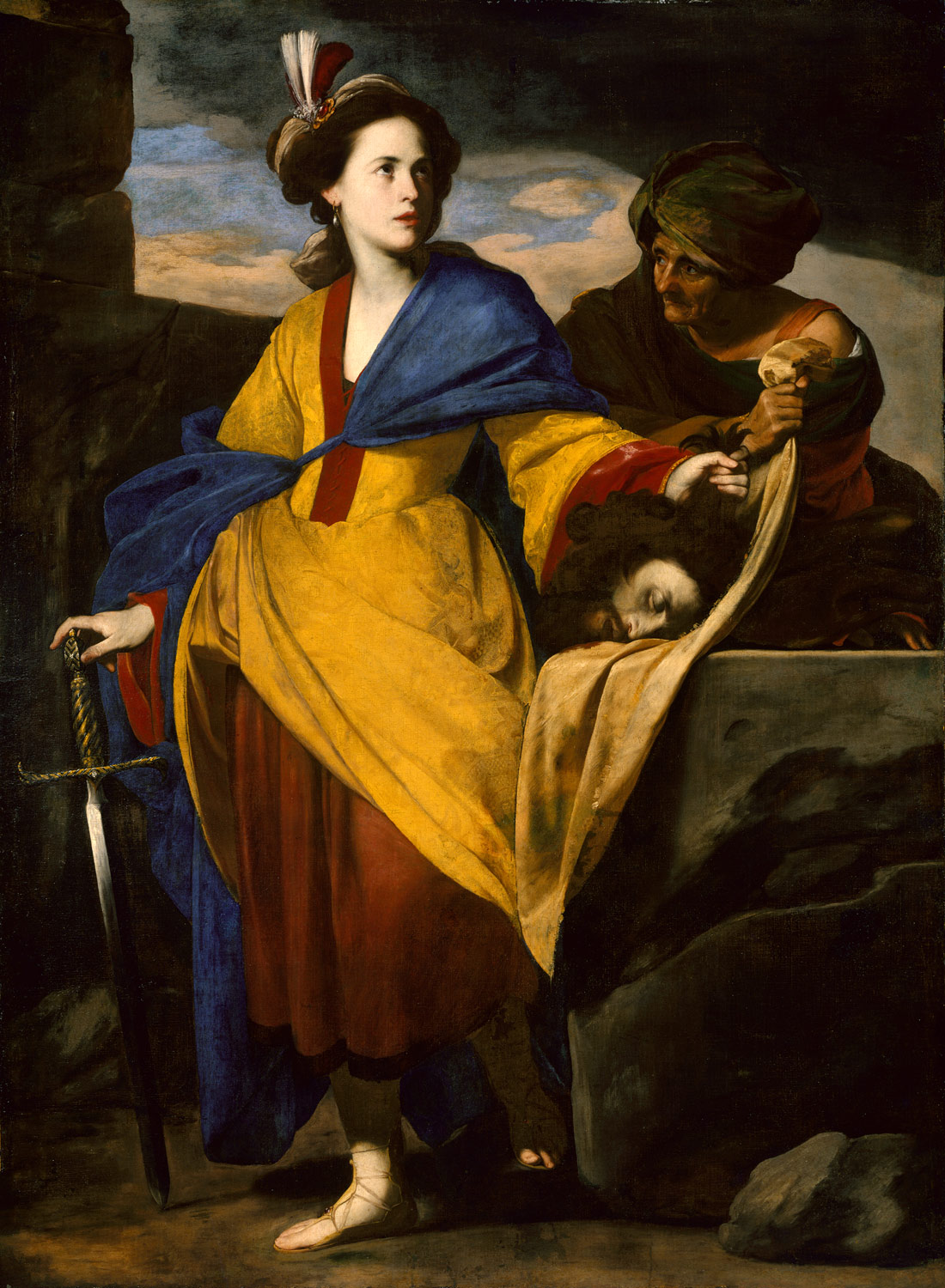
Favourite Paintings - Massimo Stanzione's 'Judith with the Head of Holofernes'

Whenever I'm lucky enough to be in the Metropolitan Museum in New York, I'm always struck by this painting.

Massimo Stanzione, Judith with the Head of Holofernes (Oil on canvas, 1640)

It's a big painting that you have to look up at, and it's set against the dark red background of the museum wall.


It's by Neopolitan painter Massimo Stanzione - not exactly a household name - and the subject is the story from the Apocrypha of Jewish heroine Judith beheading Holofernes.  As it explains in the card beside the painting


I suppose I have a thing about paintings of my namesake.  It's a subject explored by a number of painters throughout art history, from the another-day-in-the-office version by Lucas Cranach the Elder in 1530


to Gustav Klimt's opulent Secessionist sensuality in 1901


Stanzione was a 17th century  Italian painter,  often called a 'Caravaggisti' (painting in the dramatic chiaroscuro (literally meaning 'light dark') style of Caravaggio).  

In fact. Caravaggio painted his own version of Judith half a century earlier.


Caravaggio, Judith Beheading Holofernes (Oil, 1598)

Whilst Stanzione's painting obviously is influenced by the dramatic lighting effects of Caravaggio, Caravaggio's style was somewhat more visceral and earthy.  In his depiction, the deed is actually taking place, and we are spared none of the detail of the blood, the pain, the effort and the pragmatic stoicism.  

Stanzione is more classical and lyrical.  His version of Judith shows the calm after the storm.  Judith steps forward in Apollo Belvedere pose (the classical statue often referenced by artists).


The head of Holofernes lies with an expression almost of sleep.  A divine light catches Judith's face, confirming the righteousness of her deed.


I suppose what I like about this picture, and what's so eye-catching, are the colours and the big, beautiful  rhythms of the composition.  It jumps off the wall at you and captivates you.

Judith's dress is composed of big triangles of red, blue and yellow ochre, and the directions and movement of this drapery sweeps your eye around the painting.  The line of her right leg is on the golden section, and this line is carried up to the top of the painting through the red line of her bodice, and then is carried further up by the feather in her headdress, before it just twitches round to the right, and carries the eye down to the curve of the line of the edge of cloth in which the head is being held.  

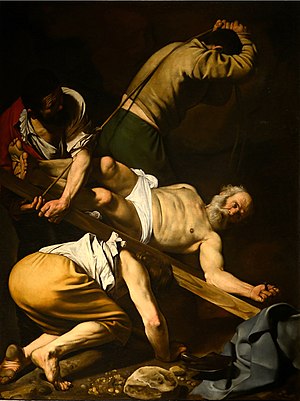
It's a lovely cartwheel composition with a really dynamic sense of movement.  Caravaggio did the same thing in his composition of the Martyrdom of St Peter.

 Crucifixion of St. Peter (1600-01) by Caravaggio in the Cerasi Chapel, S Maria del Popolo, Rome

Now, Stanzione, whilst not a particularly well-known artist, was a very interesting one.  Born in Naples in 1586, Massimo decided to become an artist at 18.  He studied in Rome, influenced by Caravaggio, and then moved back to Naples in 1630 with feminist pin-up girl Artemisia Gentileschi.  Here she is.

Artemisia Gentileschi, Self Portrait as the Allegory of Painting (Oil, 1630)

She is the artist that Germaine Greer called 'the magnificent exception' - the woman who made it as a respected artist in a world and a profession that was totally the domain of men.  

Her father was the Caravaggisti artist Orazio Gentileschi, and he hired a painter called Agostino Tassi to tutor his daughter in 1611.  Tassi raped Artemisia, and a trial followed when her father pressed charges, during which Artemisia was tortured using thumbscrews.  Tassi was given a year in prison but never served the sentence.  

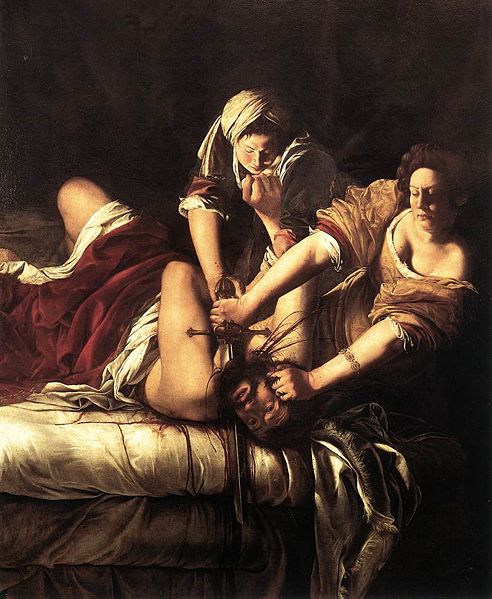
No wonder, then, that over 90% of Artemisia's art contains impassioned depictions of heroines and strong female protagonists, including Judith, and no wonder that the head of Holofernes is being hacked off with such blood-splattering vigour.

Artemisia Gentileschi, Judith Beheading Holofernes (Oil, 1614)

However, Stanzione must have greatly respected Artemisia's reputation as an artist, for apparently their relationship when they moved to Naples in 1630 was that of an informal apprenticeship, with each artist influencing the other.  Stanzione's work was enriched with greater light effects, and Artemisia's became more classical, less angry.  They even collaborated together on The Birth of St John the Baptist.

Both Artemisia Gentileschi and Massimo Stanzione died of plague in 1656, which swept through Naples in that year and virtually wiped out an entire generation of Neapolitan artists. 

Monday, 23 April 2012

Favourite Paintings - Cezanne

I suppose there can be no real appreciation of the history of art without an appreciation of the work of Paul Cezanne.  Fortunately, he's an artist who also happens to produce very very beautiful paintings.

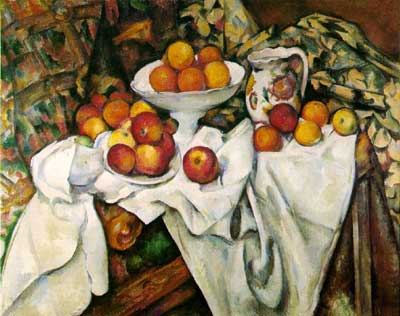
This is Still Life with Apples and Oranges.

Paul Cezanne, Still Life with Apples and Oranges (c. 1895—1900, Oil on canvas, 74 x 93 cm Musée d'Orsay, Paris).

Even if you've seen this painting a million times before, have a really good look at it now.  Just take a look at the whole painting.  

How does it strike you?  How would you describe the picture?  What do you see?  How does it make you feel?  Does it make you happy?  

The fruit seems scattered in quite a jolly, random way, the jug seems pretty and familiar; it's a pleasant, unthreatening domestic scene.

Take a closer look.  Obviously, this being a reproduction, you can't see the canvas and the brushstrokes and the way that the paint is applied - if the real painting were in front of you, you'd look at all of these things - but have a look at the space.  The nice fullsome round fruit, the jug and the bowl - are they really as round and full of volume as they seem?  

The central apple is very real and round, but the fruit at the top left at the back - they seem almost flat.  And the bowl seems tipped up and squint.  What exactly is the whole arrangement sitting on?  Is there a chair underneath?  A table?  It's unclear as to how it all works, which on further reflection, is a little unsettling.  There seem to be a number of different answers to the questions, all of which are largely unresolved.

If you look at how the composition works, what appears at first quite random is in fact carefully orchestrated in a series of dynamic geometric shapes which underpin the whole painting. 

If you join the corners of the painting by drawing a giant imaginary 'X' across the picture, then slap bang in the middle is the apple, like the fulcrum of a wheel.  

Once you notice this, the whole composition turns with a forward motion like the spokes of a wheel (you can see something similar at wortk in Caravaggio's Crucifixtion of St Peter.)

 Caravaggio Crucifixtion of St Peter (Oil, c1600)

If you divide the painting in half horizontally, then all the fruit is sitting above the line in the top half.  All the fruit forms a rough pyramid shape, and there are pyramids of fruit within that shape that echo the pyramids of the folds of cloth.

The bowl is tipped up so that it appears more flattened than it should.  The plate of apples is also tipped up.  There is also an ambiguous area on the left hand of the stem of the bowl, where there is a shape that might be a piece of fruit in front of it, or the darkness of the fabric behind.  

 Cezanne Still Life with Apples and Oranges (detail)

It floats between being positive and negative space, in front or behind.

The cloth in the top right, with its shape, colouring and pattern, also look strangely reminiscent of one of Cezannes other favourite motifs....

Cezanne Still Life with Apples and Oranges (detail)

 Cezanne, Mont St Victoire (Oil, 1890-94, National Gallery of Scotland, Edinburgh)

So is it a cloth or a mountain?   Fabric or earth?  Or just paint and pattern?  Lines and colour on a two dimensional surface?

Paul Cezanne (1839-1906) was contemporary with the Impressionists, but paved the way for Picasso and Cubism, and all that is 'modern' art.  He painted over 200 still lifes, with the aim of 'conquering Paris with an apple'.  These still lifes were very carefully considered over a long time - so long that he would even use wax fruit as props, with wooden blocks to prop up plates to stage-set the arrangements.  

These weren't just paintings about fruit - these were essays in the essential pattern of geometry that he perceived as underpinning nature itself  - the “cylinder, sphere and the cone”.  Hence referencing a mountain in a piece of cloth - the same principles govern the shapes of both.

He saw the pattern in forms and the rhythms of nature, and in the flattening of objects and his playing with perspectives he showed that the experience of looking is about the assimilation not just of one viewpoint - for no-one observes from only one fixed point - but from the experience of looking and of piecing together in your head many, many viewpoints.  

Which of course leads to this...

  Pablo Picasso Les Demoiselles d'Avignon (Oil, 1907)

...but that's a story for another day.

Thursday, 9 February 2012

Favourite paintings - Caravaggio

If I was to be give one painting in the world to own, then I think it would probably be this one.


It's The Deposition from the Cross by Caravaggio, painted in around 1600-1604, and it's in the Pinacoteca in the Vatican in Rome.  It's just beautiful.  You look at the real thing close up and you think 'how did he do that??'

It shows Christ being taken down from the cross to be laid in his tomb.  It's a huge painting, and when you're standing in front of it and looking up at it, the figures seem to tumble down onto you in an almost inevitable movement towards the grave, in which you seem to be standing.

It's a fine example of the dramatic lighting that Caravaggio was famous for 'chiaroscuro' or 'light dark'.  It's almost like looking at a still from a film where the characters are bathed in a spotlight.  

Caravaggio was pretty clever in his use of light - often the paintings were commissioned for specific places within chapels (such as in S Maria del Popolo in Rome), so he used real light sources in the chapels which hit the figures in the paintings in the same direction as the painted light source.  In The Calling of St Matthew, this is divine light, following the gesture of the hand of Christ as he calls Matthew.  

But it is also real light from a window to the right in the chapel where the painting is hung.  Caravaggio is playing a complicated game on lots of different levels.  His paintings communicate with and refer to their surroundings as well as with us.  He's extending the 'world' of the painting into our personal space, which is a pretty conceptual, sculptural idea.  

He filled his work with plain ordinary people in contemporary clothes in the scenes of biblical events.  Sometimes he even included a portrait of himself in the scene, to say 'I'm right here - you are too.'  The figures in the deposition have dirty fingernails and bare feet and struggle awkwardly with their task, something which outraged patrons and shocked polite society when they saw Caravaggio's paintings.   I doubt he cared much.  His message was that religion isn't about saints and heaven, as so much of Baroque art was, it's about ordinary people right here and right now (and that included women - he was an amazing painter of women as real women).  It was totally inclusive.  He didn't compromise.

To get the drama of the light and dark in the paintings, Caravaggio painted quickly out of a dark ground, moving towards the light colours.  There weren't any preparatory sketches, he just got right on with it.  

He painted from life, posing a group of models, and then scratching the main thrust of the composition and main lines into the ground with the end of a brush.  If you stand to the side of a lot of the paintings, you can see this when the light catches the marks.  (You can see it especially clearly on The Sacrifice of Isaac.)  

He painted fast.  He had to, as there's only so long models can hold poses like that, plus he was usually on the run.  He had quite a temper, and was always getting into trouble.  This was a man who matched his work.  He was dressed in black, dark eyes, dark hair, dark beard, slept in this clothes because he was always ready for a quick getaway.  He picked a fight with a waiter about a plate of artichokes (the old butter/olive oil debate).  He killed someone during a game of tennis.  His paintings were all light and dark and simple and complex, and so was his life, all contradictions.  What a guy.

I could go on for ages.  Luckily, the world's hottest fine art historian has recently published the definitive biography of Caravaggio, so if you're interested, read Andrew Graham Dixon's 'Caravaggio; A Life Sacred and Profane'.   

Agree?  Disagree? (Not with Andrew Graham Dixon being hot - no-one disagrees with that on my blog).  Got a favourite painting of your own you'd care to share?  Then let me know, either below or at judith@jibridgland.com