As this is both Armistice Day and Remembrance Sunday, I'd like to show you this.
It's the War Memorial at Little Common in Sussex, and my Grandfather, WILLIAM BRIDGLAND, who was a monumental stonemason, helped to make it.
I've been to visit it, and it's right in the middle of the village. It's surprisingly big, probably about 15 feet tall if I remember. It was funny to think that he'd been a part of making it, most probably the lettering.
My Grandfather was born in 1887, and was a boy soldier in the Buffs (the Royal East Kent Regiment - the name Bridgland can be traced back through many generations to Kent). He served in Singapore, Hong Kong and India. Here he is, aged about 18.
He then went on to fight in
the First World War in France,
and fought at the Battle of the Somme. Here he is in his uniform.
One of the key engagements in the battle was the capture of Lesboeufs on
25th September 1916. During the advance upon the village, the
Buffs were on the flank of two Regiments of Guards, amongst whose officers was
Harold Macmillan. The Buffs lost 26 men killed wounded or missing.
The
Diaries of Oliver Lyttleton mention that the Germans retaliated by using gas
shells. Although my Grandpa's war records have been lost, my cousin Colin Bridgland has traced a huge amount of family history, and he speculates that it is possibly this
particular gas attack in which my Grandpa was injured.
He was invalided back to England
and sent to the Summerdown Military Hospital
in Eastbourne and later at Hill House in
Wadhurst. Here he is (on the left) in his convalescent uniform, writing
the 'Hill House Weekly', presumably in the grounds of the military
hospital.
 It's quite an
affecting photo. Here are two survivors of the Somme, one of the
bloodiest battles in history, setting up a cosy little tent as the
pretend office of a home-made newspaper, with the props of a giant inkwell, a
flower vase, and a wastepaper basket with scrumpled-up pages. It's
pure escapism, almost child-like, but there's quite a bit of humour about it as well. (I also note that
having been gassed was no
barrier to carrying on smoking, but I guess if you're going to be sent back to the Front, then that's the least of your problems.)
It's quite an
affecting photo. Here are two survivors of the Somme, one of the
bloodiest battles in history, setting up a cosy little tent as the
pretend office of a home-made newspaper, with the props of a giant inkwell, a
flower vase, and a wastepaper basket with scrumpled-up pages. It's
pure escapism, almost child-like, but there's quite a bit of humour about it as well. (I also note that
having been gassed was no
barrier to carrying on smoking, but I guess if you're going to be sent back to the Front, then that's the least of your problems.)
It
was at Summerdown that he met my Grandma, who was staying just a short distance
away. (She was companion to the author Noel Streatfield at the Vicarage.)
They were married just a few months later, in Eastbourne in 1917.
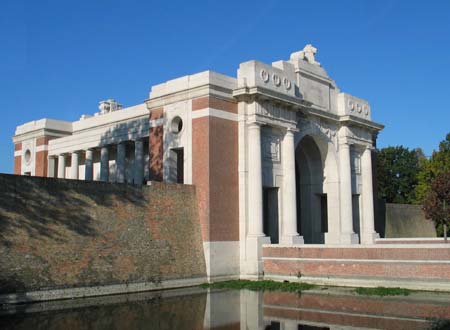
After the war, my Grandpa became a monumental stone mason, working for the Commonwealth War Graves Commission. One of his duties was to help carve the lettering on the panels of the 56,000 names on the Menin Gate War Memorial in Ypres.
He also was involved in the work on a number of war memorials in Sussex, such as at Little Common. It must have been very sobering to carve name after name on such massive memorials to those who had died, when you yourself had survived. The one at Little Common (below), which is right in the middle of the village, is a physically massive stone, made of very hard granite, so it must have been a very challenging piece to carve, and physically very difficult, especially for a man who never really recovered his health after the war.
It must have also
been very frustrating, as the memorials are built to a prescribed
pattern, someone else's design, so as a stonemason you don't have your own artistic input into it, and of course the lettering had to be very precise. My Grandpa did watercolours and drawings in
his spare time, and I was told that he decorated the fireplace at home a
la Bloomsbury Group at Charleston House (which isn't far away from Eastbourne).
The war work dried up, though, and along came the Depression of the thirties. My Grandpa was then a caretaker at a local school in Eastbourne until he died, aged 53, during the second world war. So I never met him.
Ironically, despite giving many hundreds of soldiers the dignity of a named final resting place, he didn't have a gravestone of his own until very recently.