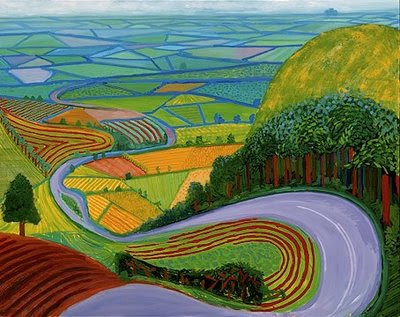
Just as we are coming into spring itself here, so you progress through the seasons in the massive Hockney exhibition.
I left you earlier in the week half way through the show - now, in Room 7, is the explosion of Hawthorn Blossom with the depiction of what Hockney calls 'Action Week'.

David Hockney Hawthorne Blossom, Woldgate No. 6 2009 (oil on canvas, 60 x 72)
I wasn't so keen on these pictures, although Hockney obviously found the experience of the hedgerows and lanes bursting forth with frothy, creamy fullness and the whole expulsion of bounty a very... exciting experience. Instead of delicate forms, the resulting foam-laden branches take on the guise of sea-creatures, writhing about in an agitated manner like some over-inflated Roger Dean stage set.
Room 8 is Trees and Totems, and the mood changes to one of the cycle of life, and to death and decay. Hockney takes something almost insignificant, a dead tree stump in the woods near Woldgate, and turns it into an iconically massive motif.
 | |||
| David Hockney Winter Timber 2009, oil on 15 canvases (36 x 48" each) 108 x 240" |
There it is on the right side of Winter Timber, right on the golden section, dividing up the painting into parts with two completely different eyelines. Here are quick, fluid brushtrokes in purple, cadmium yellow, coerillium and viridian. In further paintings, the truncated form of the 'totem' becomes a motif of the inevitability of death, like Rembrandt's flayed ox. Given that Hockney himself is not in the first flush of youth, it is quite a potent image.
There are also some lovely, lyrical charcoal drawings in this room, drawn from observation and uncluttered by colour. Like most of Hockney's work, they have little sky, but a lovely rhythmic balance of light and dark.

David Hockney 'Cut Trees' 2008
The Arrival of Spring fills room 9 (4 more to go, but I didn't know this at the time as, in the scrum to get in, I hadn't been given my included-in-the-price guidebook).
In this room are 51 prints from an i-Pad and one large painting. Hockney uses his i-Pad as an image-making tool, and in planning the final prints as large-scale, so makes adjustments to colour and form that are needed for the change in scale and mdeium from hand-held i-Pad to Royal Academy wall. It's no wonder this room has a sense of theatricality - Hockney used to design stage sets, and indeed, built a stage-set model of the Royal Academy with miniature print-outs of all the paintings for the planning of the layout of the show.

Here is Hockney, with his painting The Arrival of Spring, as big as a theatrical backdrop.
But centre stage is the drama of nature, like a technicolour Judy Garland musical. The pictures are dated, so you follow through the coming of spring from the almost undetectable to the blazing fanfare, in sometimes almost shimmeringly 3D paintings.
The focus is down on the vegetation, rather than the sky, and all this bursting, undulating, writhing force of nature is strangely contained within their little rectangular boxes. There are no people in the paintings, although there are cars and road-signs and some ruined buildings. There are reminders of people, like some post-apocalyptic world where nature has taken over. This contrasts strangely with the heaving hurly burly of humanity that fills the Royal Academy trying to look at these paintings. None of them featured in the Hockney's miniature stage-set of the show.
Feeling that the show has reached a certain climax, you do wonder what could possibly be next. Room 10 is The Sermon on the Mount, which is not my favourite work. This is a painting by 17th Century French artist Claude Lorraine, which Hockney has digitally 'spring cleaned' and then reinterpreted on a huge scale. What you are faced with is Christ giving a directive from a massive throbbing red edifice, like Tatlin's Tower, or a giant carrot.

Once you think 'giant carrot', you just can't take it seriously, especially when you are so tired, so hot, and have been jostled to bits by fellow visitors for a couple of hours by now.
Then it's on to films. Or it would be, if you could get anywhere near them. The rooms are packed, so you can't just leisurely stroll in, sit down in the middle, and enjoy the multi-screen experience as it is meant to be viewed.
Hockney strapped small video cameras on to apparatus and drove down country lanes to take films of the countryside and hedgerows from multiple viewpoints, which are then projected onto multiple screens.

Each is a different experience of the same thing, a different bit of time. There are other films, including one in an office, and some flexible young men and furniture, but I could only see them from a very oblique angle near the doorway.
With the end in sight, and the smell of the gift shop in my nostrils, it was a quick dash through Yosemite at the end, and out into the piles of catalogues. "This place just gives me a headache," sighed the gift shop lady behind the counter, "All the people. All the heat. All day."
It's a truly amazing exhibition. It has to be seen to be believed, and it catapults landscape into the 21st century as a vast multi-media, multi-experience, great cutting-edge visceral roaring thing that is at the very heart of life itself.
Hockney makes landscape into the most important thing you could ever, ever have a painting about. Not all of it is great. Not all of it is stuff you'd want to have in your front room. But at 74 years old, it's hats off to the sheer human energy and dynamism of this plain-speaking visionary man.
If you're like to watch a 3-minute gallop through the show, then you can watch The Telegraph's art critic Alistair Sooke in this video, which is part of his on-line review of the show.