Showing posts with label David Hockney. Show all posts

Sunday, 4 August 2013

Painting with Pixels

Here's a picture by David Hockney, whose work I've talked about I've talked about before in my blog here.


David Hockney, The Arrival of Spring

This is a work which the 76 year-old artist created using an i-Pad, and then has been blown up to a vast size. Pixels are used like paint.  An old dog learns new technological tricks in order to create.

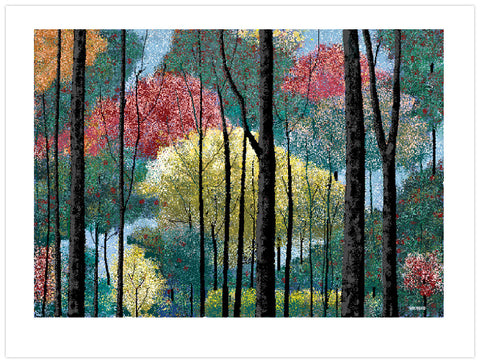
Here's a picture by American artist Hal Lasko.

Looking Up, Hal Lasko

Making Mr Hockney look like a spring chicken, 98-year-old Mr Lasko, who is registered blind with wet macular degeneration,  made this using Microsoft Paint.  

Trained as a graphic designer, he took up creating with the computer in recent years when his sight began to go, and now works up to ten hours a day on pieces.

I'd like to see his work blown up to fifty feet long and put in the Royal Academy.

 Hal Lasko, Woods in Avon

Read more about Hal Lasko HERE.

Thursday, 7 March 2013

Turning Landscape Art on Its Head

This is Horatio McCulloch's painting Loch Maree.

Horation McCulloch, Loch Maree (Oil on canvas, 1866)

It's a fine traditional, Scottish Victorian painting, by a fine, Scottish, Victorian painter.  

Here is Mr McCulloch, looking every inch the fine, Scottish, Victorian painter.

Photograph of Horatio McCulloch (Hill and Adamson, 1847)

And here's Loch Maree.  You can see that in order to step up the romantic Highland drama (Salvator Rosa has a lot to answer for), Mr McCulloch accentuated the ruggedness and the steepness of the mountains as they rose out of the loch.


However, to today's tastes, it's quite a brown, dull, old-fashioned painting.

So how do you make a dull, brown old-fashioned painting look exciting and new in a gallery today?

By doing this, apparently.


 Picture: Colin Mearns (The Herald)

Yes, by hanging it upside-down.  

Although it's not just an upside-down Horatio McCulloch any more.  Oh no.  This is now an installation by the artist Rachel Mimiec entitled 'A Pause of Pages: Reflection on the Practice'.  It's currently on display at the Gallery of Modern Art in Glasgow, and has 'attracted excitement', according to The Herald newspaper.

"Once it's been hung upside down like that, you are being forced to notice details about it that you haven't seen before," said 'A Spokesman'.  "And also when it's upside down you are not looking at what's being painted so much as how it's being painted."

When I took life drawing classes recently at the St Ives School of Art, our model did the final long pose upside down for that very reason - it meant that we were forced to consider her body afresh, to go beyond what we know about how things fit together, and to see her as a shape, a volume, a movement, a feeling, a still life, a pattern, a sculpture, a texture.  

Drawing a nude is about far, far more than clinical measurement and exact representation.  As well as being a representation of another human being, it's also a self-portrait of the artist, as well as a dialogue between the model and artist. A good model won't just hold a pose, they'll give you a pose. 

It's not a medical text-book illustration, with exact muscles and joints.  It's a feeling, a moment.  When we were in the life-drawing room in St Ives, we could hear the sea, and the sun was setting, and it was beautiful, and as an artist, that's the sort of sense you have to put in the drawing.

The same goes for landscape.  Loch Maree isn't just about a representation of a place, although you can actually go there and still see the scene that McCulloch painted.  It's about the time and the values - social, moral, economical, political -  in which McCulloch lived, and which moulded him as a person, and also about him as a person.  Have a look at that image-moulding photograph setting him out for posterity.  He's quite a rugged, romantic looking guy.  There's quite a sense of brooding intensity going on there, like the scenery.

So I'll leave it with you about the upside-down paintings.  I'm all for anything that makes you look afresh at an unfashionable painting, especially if it's a landscape one, because landscape has to run the current gauntlet of being an untrendy, unhappening genre.  Which, if you saw the Hockney Royal Academy show last year, is blatently a load of old nonsense.  

It's just that the expressive potential of landscape is a bit too subtle for today's tastes.  It's not an in-your-face diamond-studded skull.  As a viewer, you have to work with landscape.


Friday, 9 March 2012

A Bigger Picture - David Hockney Exhibition Part 2

Just as we are coming into spring itself here, so you progress through the seasons in the massive Hockney exhibition.  

I left you earlier in the week half way through the show - now, in Room 7, is the explosion of Hawthorn Blossom with the depiction of what Hockney calls 'Action Week'.

David Hockney Hawthorne Blossom, Woldgate No. 6 2009 (oil on canvas, 60 x 72) 
 
I wasn't so keen on these pictures, although Hockney obviously found the experience of the hedgerows and lanes bursting forth with frothy, creamy fullness and the whole expulsion of bounty a very... exciting experience.  Instead of delicate forms, the resulting foam-laden branches take on the guise of sea-creatures, writhing about in an agitated manner like some over-inflated Roger Dean stage set.
 
Room 8 is Trees and Totems, and the mood changes to one of the cycle of life, and to death and decay.  Hockney takes something almost insignificant, a dead tree stump in the woods near Woldgate, and turns it into an iconically massive motif.
David Hockney Winter Timber 2009, oil on 15 canvases (36 x 48" each) 108 x 240"   
 
 
There it is on the right side of Winter Timber, right on the golden section, dividing up the painting into parts with two completely different eyelines.  Here are quick, fluid brushtrokes in purple, cadmium yellow, coerillium and viridian.  In further paintings, the truncated form of the 'totem' becomes a motif of the inevitability of death, like Rembrandt's flayed ox.  Given that Hockney himself is not in the first flush of youth, it is quite a potent image.

There are also some lovely, lyrical charcoal drawings in this room, drawn from observation and uncluttered by colour.  Like most of Hockney's work, they have little sky, but a lovely rhythmic balance of light and dark.

 David Hockney 'Cut Trees' 2008

The Arrival of Spring fills room 9 (4 more to go, but I didn't know this at the time as, in the scrum to get in, I hadn't been given my included-in-the-price guidebook).  

In this room are 51 prints from an i-Pad and one large painting.  Hockney uses his i-Pad as an image-making tool, and in planning the final prints as large-scale, so makes adjustments to colour and form that are needed for the change in scale and mdeium from hand-held i-Pad to Royal Academy wall.  It's no wonder this room has a sense of theatricality - Hockney used to design stage sets, and indeed, built a stage-set model of the Royal Academy with miniature print-outs of all the paintings for the planning of the layout of the show.  


Here is Hockney, with his painting The Arrival of Spring, as big as a theatrical backdrop.

But centre stage is the drama of nature, like a technicolour Judy Garland musical.  The pictures are dated, so you follow through the coming of spring from the almost undetectable to the blazing fanfare, in sometimes almost shimmeringly 3D paintings. 

The focus is down on the vegetation, rather than the sky, and all this bursting, undulating, writhing force of nature is strangely contained within their little rectangular boxes.  There are no people in the paintings, although there are cars and road-signs and some ruined buildings.  There are reminders of people, like some post-apocalyptic world where nature has taken over.  This contrasts strangely with the heaving hurly burly of humanity that fills the Royal Academy trying to look at these paintings.  None of them featured in the Hockney's miniature stage-set of the show.

Feeling that the show has reached a certain climax, you do wonder what could possibly be next.  Room 10 is The Sermon on the Mount, which is not my favourite work.  This is a painting by 17th Century French artist Claude Lorraine, which Hockney has digitally 'spring cleaned' and then reinterpreted on a huge scale.  What you are faced with is Christ giving a directive from a massive throbbing red edifice, like Tatlin's Tower, or a giant carrot.


Once you think 'giant carrot', you just can't take it seriously, especially when you are so tired, so hot, and have been jostled to bits by fellow visitors for a couple of hours by now.

Then it's on to films.  Or it would be, if you could get anywhere near them.  The rooms are packed, so you can't just leisurely stroll in, sit down in the middle, and enjoy the multi-screen experience as it is meant to be viewed.  

Hockney strapped small video cameras on to apparatus and drove down country lanes to take films of the countryside and hedgerows from multiple viewpoints, which are then projected onto multiple screens.


Each is a different experience of the same thing, a different bit of time.  There are other films, including one in an office, and some flexible young men and furniture, but I could only see them from a very oblique angle near the doorway.

With the end in sight, and the smell of the gift shop in my nostrils, it was a quick dash through Yosemite at the end, and out into the piles of catalogues.  "This place just gives me a headache,"  sighed the gift shop lady behind the counter, "All the people.  All the heat.  All day."

It's a truly amazing exhibition.  It has to be seen to be believed, and it catapults landscape into the 21st century as a vast multi-media, multi-experience, great cutting-edge visceral roaring thing that is at the very heart of life itself.  

Hockney makes landscape into the most important thing you could ever, ever have a painting about.  Not all of it is great.  Not all of it is stuff you'd want to have in your front room.  But at 74 years old, it's hats off to the sheer human energy and dynamism of this plain-speaking visionary man.

If you're like to watch a 3-minute gallop through the show, then you can watch The Telegraph's art critic Alistair Sooke in this video, which is part of his on-line review of the show.

Telegraph review of David Hockney with video


Tuesday, 31 January 2012

Degas and the Ballet: Picturing Movement

I thought I'd mention a really excellent show which I saw recently at the Royal College of Art in London - I don't know if anyone else managed to see it.  (It's unfortunately finished now, but I hadn't started the blog last year, so that's why it's only just getting a mention!)  

I'm sure you're all familiar with the work of Degas and his Impressionist paintings of young, ballet dancers, women bathing and frisky horses.  Certainly, the image used on the poster would lead you to believe that this was going to be a very sickly sweet show all about pastel-coloured young girls in tutus, ending with a nice line in fridge magnets in the gift shop.


However, what this exhibition managed to clearly document (and all kudos to the curators for putting together such a well thought-out and thought-provoking show) was the development of Degas' lifelong obsession with the figure in movement.  

Degas was working at a time in the 19th century when there were great technical advances in photography and early film, which were embraced by the artist in the same way that David Hockney is embracing the i-Pad as a tool to make art in his new show at the Royal Academy.  

Degas' compositions were pieced together from various studies made from various sources, so that a group of ballet dancers could come from a variety of different studies of individuals or small groups, made in a number of media.  The information from all the sources was then jigsawed together to make the final picture, giviing an informed sense of a place and an event, rather than an actual documentation of one specific event - almost like one of his early history paintings.

The pose of the figures would often have a casual, fleeting sense to them, as figures can when caught off-guard by the camera, giving a feeling of capturing a moment in time and a fleeting glimpse of something temporal. 

The really exciting thing in the exhibition was the inclusion of his little-seen photographs and their relationship to other work.  Here's one of his photos...


Degas, Dancer Adjusting Her Shoulder Strap (Modern gelatin silver print, 1895)

And a pastel and gouache based on the pose - note all the changes made whilst working out the composition, almost as if the figure is blurred in movement, or as if several viewpoints of the same figure were amalgamated into one - which of course, is what Picasso was doing later in 1907 at the birth of cubism.


Another photograph (the intense colour is due to a chemical reaction during development of the plates)...

Degas, Dancer, Arm Outstretched (Collodion on glass, 1895)

And a related pastel with the figure from the photo at the left hand side


So far from being a chocolate-box artist, Degas was instead a modern, radical artist who thought profoundly about visual problems and was fully attuned to the technological developments of his time.  

Born in 1834, largely self-taught, this free-thinking and experimental approach paved the way for others in the modern age - look at his incorporation of real objects into his bronze sculpture of the little dancer aged 14, with its ribbon in the hair and tutu made of actual material.  That's something everyone from Picasso to Rauschenberg has done.
 
 
Again, giving her age of 14 in the title emphasises the temporal movement, and the quick passing of youth.   

Increasing blindness forced Degas to give up working in 1912, and for the last 5 years, he was a sad figure shuffling around Montmartre.   

One of the most touching things in the exhibition was a short piece of film taken of Degas walking on a street in Paris with his niece.  It is strikingly ordinary, with chattering shop-girls on a break at lunchtime walking sassily down the street and playing to the camera.  But Degas doesn't notice he's being filmed.  It's both ordinary and extraordinary, in that those few seconds capture a fleeting glimpse of one of the true great of art history, just for a moment, not doing anything special, but preserved on a short loop of time.  It's strangely appropriate, rather profound, and very touching.  It's a work of art in itself.