Showing posts with label Paul Nash. Show all posts

Tuesday, 15 November 2016

Paul Nash at the Tate

The wonderful Paul Nash exhibition at the Tate Britain in London is currently on at the moment, and is a great introduction to the work of this very English and rather mystical artist.

This is an exhibition which takes you through the lyrical, Georgic drawings of his early years (during which his home life involved his mother dying in a mental institution in 1910), and his repetative, comfort drawings of a family group of trees.  

Paul Nash fought in the First World War, later acting as a War Artist.  Here he is in uniform in 1918.

          Paul Nash by Bassano Ltd whole-plate glass negative, 29 April 1918 (c) National Portrait Gallery

However, whilst he was invalided out after a fall in the trenches, his entire battalion of the Artists Rifles were killed. Not surprisingly, this affected him very much mentally (causing a breakdown in 1921).  His huge, stunning canvas The Menin Road, is in the exhibition, and its stark, barren vision is immensely striking.


Paul Nash, The Menin Road (Oil on canvas, 1919)

After the war, in 1921, the year of his mental breakdown, he became fixated with the geometry of the landscape.  He painted nature by means of Cezanne's  cylinder, sphere and cone,the cube which he saw naturally appearing in the landscape in the form of giant anti-tank blocks of concrete or man-made groynes.  


Paul Nash, The Shore at Dymchurch (Oil on canvas, 1923)

His most famous work is perhaps a Second World War picture,  Totes Meer, an eerie painting which looks like an abstract  sea of metal waves in the landscape.   

(There's a great little film about Totes Meer here.  )

In fact, as this film and a series of photographs that he took show, Nash was merely painting what he saw, namely a dump of wrecked second world war enemy aircraft near Cowley in Oxfordshire.  

This is perhaps the key to Nash's work - his paintings often look surreal, but in fact they are super-real, they are super-observed.  His chalky, strange, very English landscapes remind me of work by Eric Ravilious, Edward Bawden and Eric Gill.  They are ordered and ancient and pastoral, and yet there is something tortured writhing beneath the surface.


 Paul Nash, Totes Meer (Oil on canvas, 1941)

The last room sadly doesn't have The Battle of Britain, which I'd hoped to see


but it does have a strange sense of floating and flying in the paintings very much like the final room of the recent Georgia O'Keeffe exhibition at the Tate Modern, where she painted abstract scenes of clouds observed from above.  It's almost like a precursor of death.  

In this room are some of Nash's last series of sunflower paintings (a flower symbolic of life and death), which return to his love of William Blake, being based on his 1794 poem Ah! Sun-flower.


Paul Nash, The Eclipse of the Sunflower (Oil on canvas 1945)

Nash died of heart failure in 1946, and is buried with this stone carving of a hawk on his grave, which he has painted 10 years earlier.

Paul Nash, Landscape from a Dream (Oil on canvas 1936)

Now, as much as I loved the show, there is an annoying thing with moderncurators.  The exhibition is often about curating and the curators more than it is about the artists.  

So here, the agenda is not to introduce Nash to an audience who haven't seen his work, or to showcase him as a war artist, but to present Nash as an 'international modernist painter'.  Which means they dispense with any sort of introduction to the man, as if the paintings spontaneously appear on their own, and that the life of an artist doesn't reflect in and inform the work.  

So, no need to give us a picture of the man, or tell about when he was born, or how he was brought up, or his family, or his mother's illness, or his own mental breakdown, or his lack of personal relationships.  Nope. 'Paul Nash was a key figure in debates about British art's relationship to international modernism' we are told.  What a load of alientating elitist nonsense.  

Which begs the question, just who is this show aimed at?  

People who never been to an art show before? 
People with an interest in art who just want to see something interesting and a bit challenging for an afternoon?
People who have never seen the work of Paul Nash?  
People who perhaps know one aspect of his work, but want to learn more about him?
Experts who are so up on Paul Nash that they would be insulted if you even hinted at any biographical insights?  
Other curators?  

I suspect it's the latter.

So do go to the show - but to get the best out of it, read up on Paul Nash's life and times beforehand. 


Monday, 26 October 2015

Mystery Solved! The Painting in M's Office in Skyfall

Thanks to a very Alert Reader (you know who you are!), the mystery posed here of the painting in M's office has finally been solved!  My thanks go to them and their hard work in tracking it down.

Here it is behind Miss Moneypenny, Naomie Harris.


I've spent a great deal of time trawling through various online resources, including the Your Paintings website - hot on the theory that the painting was owned by a major London Institution, or was perhaps of a London park such as Hampstead Heath (with its Fleming connections), or a painting by a contemporary of Turner or Constable.  Turner, of course, is memorably referenced in Skyfall, as in the scene in the National Gallery, and again in the scene in M's office 

The reason I thought of Hampstead was that Bond author Ian Fleming lived there (as well as having a house in town).  As a local resident, he objected in the 1930s to the proposed demolition of old cottages nearby for the construction of the modernist-designed terrace buildings at 1-3 Willow Road.  
These were designed by architect Erno Golfinger. However, the old cottages were demolished, and the futuristic new houses duly built.  A furious Fleming got his own back by naming one of his most famous villains Goldfinger.

However, I digress.  

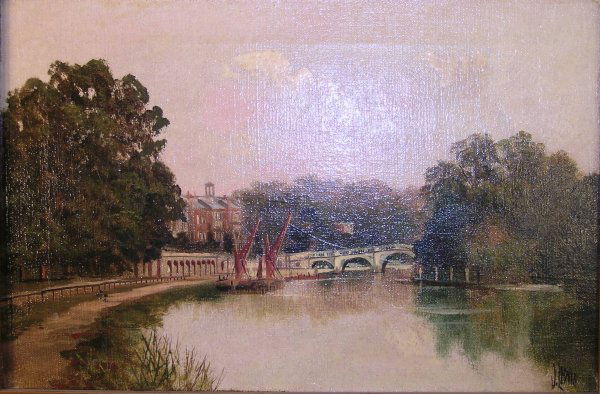
The painting in M's office turns out not to be of Hampstead, nor is it by a contemporary of Turner.  It's by James Isaiah Lewis (1860-1934) and is View down over Ham Fields from the Top of Richmond Hill, Surrey.  It shows the curve of the river Thames in the distance.

Here is one version in its original frame.


Lewis was a prolific artist, beginning as a photographer's assistant, and then working in Richmond producing local paintings for local people.  He often sold work to nearby pubs - apparently he had a somewhat beer-related lifestyle, and ultimately died a poor man, despite painting and selling prolifically.   

He regularly painted small pictures in pairs, finding these popular with local newlyweds. And he painted this same scene of Richmond many, many times, almost like printing a photograph, but just with slight changes to size or detail.  Just have a look at the sky in the version above - it's not the same as the Skyfall one.

Here is the companion piece to the above painting (a companion piece being a painting which was painted to match so that they could be hung as  a pair).  It's called View of Richmond Bridge, and they measure a dinky 8 x 12".  They were sold on Feb 9 2007 from Halls Fine Art Aucitons as Lot 446C.


Lewis also painted the Richmond scene as an oval, which you can buy for only £750 from the Bowman Gallery.


Or here it is in a 16" x 14" version, available for sale from the same gallery.  again, look at the clouds - it isn't this one in the film.  How many versions did he do...?


This version of Richmond Bridge sold in January this year for £400 at auction.  Looking at it closely, it's a pretty formulaic painting, and it measures 20 x 30".


Now, I'd say that the one in M's office is about that size.  It's large enough so that we can actually make it out.  But it's a pretty obscure painting to recognise - it's taken us nearly 3 years to track it down!!

So what is it telling us?  

It's a calm, pastoral scene of England in the great landscape tradition, but moving towards the turbulent Modern era (it was painted about 60-70 years after Turner's Fighting Temeraire, the ship which represents Bond himself).   Lewis died in 1934, and after him came English Modernist landscape painters such as Paul Nash, with his vision of a surrealist, spiritual England that is both familiar and futuristic, with an underlying tension of disharmony, violence and turmoil.


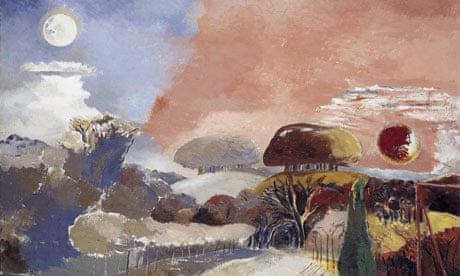
Paul Nash, Landscape of the Vernal Equinox (1943)
Landscape painting starts to become just as much about the self as it does about the actual place.  It is also a reflection of the mind of the artist.
If this painting of the view of the Thames from Richmond Hill is therefore meant to represent Moneypenny - and she's standing right in front of it, in the same way that Q and Bond sat in front of paintings in the National Gallery which each told us something about their characters - then it's perhaps telling us that she, too, is calm and ordered.  She is based in tradition, rooted in London and England - as shown in the painting by the curve of the Thames, the lifeblood of London. However, she is looking towards the new, more turbulent era. 

So Moneypenny and Lewis are bridges between the old and new, between the traditional, ordered and formal, and the new world of often violent turmoil and chaos, where the familiar becomes unfamiliar.  
Perhaps you no longer know who your enemies are... 

Therefore,  according to my theory, look out in the new Bond film Spectre (out this week!) for lashings of retro old-school Bond references, but plenty of modern new twists, violence and chaos!