Tuesday, 24 July 2012

Arise, Sir Bradley of Wiggins

Yes, the Modfather of British Cycling has done it*.


Watch out for Chris Froome next year!

*born in Ghent, Australian father

Wednesday, 18 July 2012

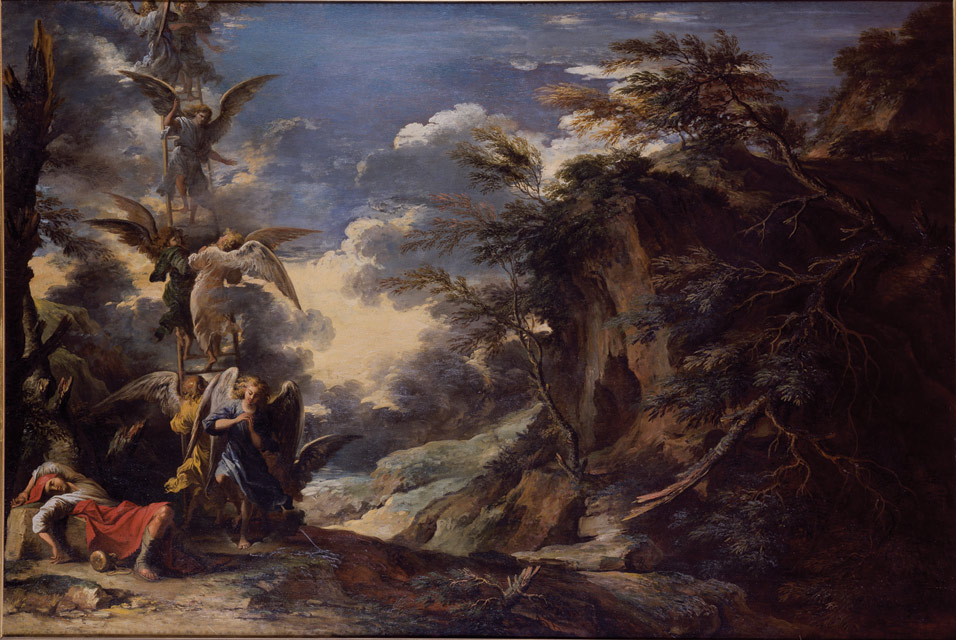
Salvator Rosa's 'Landscape with Jacobs Dream'

I was at Chatsworth House in Derbyshire at the weekend, and in amongst all the grandeur, I came across this great painting by Salvator Rosa.   It's called Landscape with Jacob's Dream.

Salvator Rosa, Landscape with Jacob's Dream (Oil on canvas, 1665)

It's funny when you walk round the corner in somewhere like an old stately home, and you unexpectedly come across a Rosa - it's like meeting the black sheep at a family get-together.

It's a big painting, with Rosa's rugged romantic landscape of rocks and trees taking up the right two thirds and the rather colourful psychadelic dream of Jacob taking up the left hand third.  What hits you is the unusual (for Rosa) punch of three pops of primary colour - red yellow and blue - of the bottom three figures.  That bright, advancing red garment of Jacob, the subject of the painting, is right down there jumping out of the bottom left, and keeps drawing your eye.

There's a discarded wine flagon at the side of the rather abandoned-looking Jacob, which might suggest the origin of the colourful dream - Rosa's good on the nice little quirky details. (His Humana Fragilitas in the Fitzwilliam in Cambridge has a little pile of owl pellets in front of the rather queasy looking owl in the bottom right if you look closely.)  

The landscape echoes the turmoil of the dream, as the trees strain towards the angels as they ascend and descend the ladder to heaven, in a great swirling, agitated circular composition.

It's a big, mature painting, made when the artist was 50.  Here it is in situ at Chatsworth...

Salvator Rosa, Landscape with Jacob's Dream - Chatsworth House

..and here's Jacob in all his loosely painted glory.  Apologies for the camera work (the lighting was really bad with lots of reflection), but take a look at the way those rocks are painted.  There's lots of lovely, loose impressionistic brushwork.  I've blogged before about Rosa here, and how he was out in the great outdoors painting en plein air over 200 years before the Impressionists.  You can really see that in a passage of paint such as this.

Salvator Rosa, Landscape with Jacob's Dream (detail) (Oil on canvas, 1665)

Here's another detail, of the trees on the right hand side.  Again, apologies for the reflections, but they do allow you to see that the leaves  of the tree are painted with raised impasto.  See that area of white where the light is reflecting off the varnish in the bottom right?  You can see dark shapes in the middle of it.  This is the raised paint of the leaves on the branch of the tree coming down from the top right.  The paint is rough and stippled to give the texture of the foliage.

Salvator Rosa, Landscape with Jacob's Dream (detail) (Oil on canvas, 1665)

So instead of the paint surface being smooth and flat so that you can't see the brushmarks, you can very much see the way that the painting is put together - that's a very modern idea.  It's saying that the hand of the maker is allowed to be seen, and the personality of the painter is incorporated as part of the illusion of the painting, rather than being subsumed by it. 

You may not have heard of Rosa today, but he used to be wildly popular, both in his own time and later for the Romantics, for whom he embodied thrillingly wild landscapes peopled with excitingly rugged bad boys.  

Rosa was a bit of a rugged bad boy himself.  Here he is...

Salvator Rosa,  Portrait of the artist, half-length, in a brown doublet 
(c1645, oil on canvas, unlined
29¾ x 23 5/8 in.)
Phew!

Yes, Rosa may not be a name on everyone's lips these days, but there was a show of his work at Dulwich Picture Gallery in London in September 2010, the first major UK show since 1973 (the tercentenary of his death).   This self-portrait was sold at Christie's in London in 2010, just before the Dulwich show opened.

Christie's described it as having 'unfettered strokes and free handling typical of Rosa's graphic work, with brown pigments over a ground layer left partly visible (with) the immediacy of the alla napoletana style', with 'rapid execution, constructed of economical, broad brushstrokes'. 

It had an estimate of £100,000-£150,000.  It sold for - wait for it - £769,250, well over $1.1 million at the time!  

No wonder - take a look at that face.  It's a very intense and compelling image, full of a brooding personality.  It's over 350 years old, but it feels very modern.  It's a manifesto of the self, pertinent today for an age that's all about the self, self-image and self-promotion - something Rosa excelled at.

Maybe this tells us that we're entering a new era of popularity for Salvator Rosa...?

Visit the Chatsworth House website here.  Beautiful house, lovely gardens (very difficult maze to even get into...).  They've also got a small but stunning exhibition of drawings on at the moment, which includes a Rembrandt, a Leonardo and a Titian.

Tuesday, 17 July 2012

Le Gentleman

Although it's a rest day on the Tour de France today, it looks like (whisper it) Bradley Wiggins is going to win.  That's right.  A British cyclist.  Winning.

The Sun

Dubbed 'Le Gentleman' by the French press after his handling of Sunday's sabotage, where carpet tacks were strewn on the course (rumoured to be put there by a group of militant bald Frenchmen, enraged at the sight of Wiggins' overly-luxurient Noddy Holder side-burns), defending champion Cadel Evans was marooned at the side of the road for what seemed like an age, 29 others got punctures and Robert Kiserlovski crashed and broke his collarbone.  Wiggins, taking his yellow jersey responsibilities seriously, slowed the pelaton to allow the mayhem to get sorted out so that there were no unfair advantages.
 
Lets hope that Team Sky work together to let Manx missile Mark Cavenish have his moment of glory on the Champs Elysees.  Cav has been reduced to tea-boy so far in protecting Wiggins.
 
But barring the unexpected - and the Tour is full of the unexpected - it looks like Bradley Wiggins will be the winner at the weekend.
.
Golden age of British cycling?  That's now!

Sunday, 15 July 2012

Cornish Holidays

Did you spend childhood holidays in Cornwall?  If you did, I'd like to hear from you!


I'm preparing for an exhibition of paintings which will be held in spring next year, which has the landscape of Cornwall as its theme.  Three different landscape painters, including myself, will be showcasing their different approaches to painting the same place.

My work is all about an emotional response to a landscape, about what it's actually like to be there, using lots of textures and expressive colour.  Obviously, I'm going to be going to be visiting Cornwall myself, but I'd be very interested to hear from anyone who spent their summers there (or who lives there) and what it means to you. 

What's special about Cornwall?  What sums it up for you?  A particular place? An evocative sound? A colour or smell?  What did you look forward to doing or seeing most on holiday there?  How did going to Cornwall make you feel?


Whatever it is, I'd love to hear from you.  Just leave a comment below - you don't have to be a follower to do so, and you don't have to leave your name.  Or you can drop me a line via my website.

Thank you!

Thursday, 12 July 2012

The Culture Show: Richard Wilson's 'Hang on a Minute Lads, I've got a Great Idea'

Yesterday's episode of BBC's The Culture Show featured a new installation by witty urban sculptor Richard Wilson, based on the final scene of the iconic 60s crime caper 'The Italian Job'.  Thus two great passions of mine come together - art and minis.

Called 'Hang on a Minute Lads, I've got a Great Idea' (being the enigmatic final line of the film) it consists of a full-size coach balanced precariously over the edge of the art deco De La Warr Pavilion in Bexhill-on-Sea in Sussex.


Mark Kermode took to the wheel of a Morris Mini Minor (which is actually owned by a real-life Mr Bridger - what are the chances of that?) to whizz round Bexhill and set the scene before interviewing Wilson about his piece.


Nice car...

Anyway, Wilson's sculptures are all about confounding expectations, about coming across the unexpected and surprising and beautiful in the everyday.  Take his piece Turning the Place Over.  I saw this in Liverpool in 2008 when it was Capital of Culture.  Walking down the street - perfectly ordinary street, perfectly ordinary buildings - a huge round disc-shaped section of a building suddenly flipped and started to turn over.  You don't quite know what's going on.  Buildings just don't do that.  It's hard to describe, but you can see what I'm talking about here in this Youtube clip.

Richard Wilson,  'Turning the Place Over', 2007. Photograph by Alexandra Wolkowicz

The Bexhill installation is another of those crowds-with-their-cameras-out pieces. 

It's a bus.  On the edge of a building.  In a seaside town.  It even wobbles a bit now and then, just like in the film.  Is it going to fall?  Did you see that?  It's slipping!!  And so you have a town on the edge of the sea, sea meeting the edge of the sky, England not so far away from meeting France, and a bus teetering on the edge of a building.

In the Culture Show, Wilson says that he wanted to make 'something of a cliffhanger', to draw attention to an iconic building.  So he chose another icon, a cinematic icon, and put the two together.  Why do something like the Italian Job moment when he could actually just do the moment itself?  "I've played with facades, now I want to play with an edge" he says. 

Now, The Italian Job was made in 1969, but was a film made on the post-1966 wave of British patriotism.  If you've never seen the film - and why not?? - it's about crooks going to Italy to steal gold using three plucky red, white and blue minis, and then almost making off in a red white and blue bus.  Except they make a mess of it right at the very end.  The ending is left literally up in the air.  I saw it first at a special cinema viewing with my mini club when I was 6 months pregnant, and I was a very unhappy woman when the credits started rolling.  "Call that an ending??" I remember shouting at the screen.  But I digress. 


So now in 2012 we have another wave of patriotic fervour, which we always seem to just slightly muck up, or the weather is terrible, whilst things just kind of teeter on the brink.  Jubilees, Olympics, Wimbledon, economic recession, and just a hint that the UK might possibly be about to break up.  

It's all summed up here by a big red white and blue bus wobbling on the edge of an art deco building in Sussex.  It's about national identity.  It's about something small taking on something big (like the minis took on the Mafia). It's about that adrenalin rush of being on the edge of things that makes you feel alive.  It's about about trying really really hard, but being just a bit rubbish and losing magnificently. It's a bit like how Wilson's sculpture is a great idea, but you can actually see the girder holding the bus in place, so it's actually just slightly not as great as it could be.


I've never actually been to Bexhill-on-Sea.  I've seen it often, from a distance (my family are from Eastbourne).  I've even painted it (from the pier at Eastbourne).

  Harvest Moon, Bexhill-on-Sea (Oil, 10 x 10)

But I've never actually been there.  I'd really like to though.

Read about the exhibition on the De La Warr Pavilion website.
See the episode of The Culture Show here.

You can see Richard Wilson's installation (which, incidently, is sponsored by Bexhill boy Eddie Izzard) until 1st October.

PS And if you want to solve the problem of how to get the gold without tipping the coach off the edge of the cliff - here's the answer....

The Independent/John Godwin

Tour de France

The good thing about being in Mummy Mode at the moment during the school holidays is that I've got time to watch the Tour de France.

Today it's Stage 11 in the Alps, short but tough.  But these men are tough.  Unbelievably tough.

In an earlier stage, in a race littered with spectacular crashes, Andre Greipel fell and dislocated his shoulder, but after having it popped back in, got on his bike and not only finished the race, but sprinted in a fight for the line, only narrowly coming in second to Peter Sagan.  They're that tough.

Although Bradley Wiggins is in yellow jersey position, and hopes to be until Paris, I'm cheering for Cadel Evans of BMC.  He's gritty. He's an all-rounder.  He's Australian.  And he doesn't winge either.

This is him in the 2010 Tour.  He crashed in Stage 8 and broke his elbow, but got on his bike and kept on going.

(Joel Saget/AFP/Getty Images)

(Obviously, this is in no way a purely gratuitous image - I'm making an important point.)

The Tour is really engrossing because it's not just about first past the post - it's all about team tactics, and races within races.  

And sweaty men in lycra.

Wednesday, 11 July 2012

Favourite Paintings - Degas' 'La Coiffure'

Here's a paintings by Degas from the National Gallery in London that, when I see it in real life, is very hard to leave.  That's always the sign of a good painting.

Edgar Degas, La Coiffure (Oil on canvas, 1896)

It's a big painting, and it's a red painting.  Big and red.  Those are the things you notice.  It's really audaciously red, with just touches of black, grey and yellow.  What does the colour red say?

Red is passion - love - danger - fire - blood - rubies - lots of intense things.  And it's a Whole Painting in Red! 

Once owned by Matisse (there was an artist who liked to paint pictures about a single colour) it depicts one of Degas' favourite subjects in his later years, and is based on several drawings and an earlier pastel.

Just take a look at the composition of the painting.  What sort of a space are the two women in?  

The space is ambiguous; you can't tell what sort of a room it is, the only hint being a curtain of some sorts at the top left.  The woman having her hair combed must be sitting in a chair, but you can't really see the chair (although in the preliminary pastel, the chair was quite distinct, as are her facial features). 


Degas, La coiffure, c. 1892-1895
(Pastel on paper laid down on board, 75.6 x 51.4cm, Private collection)

The table is tipped up.  The yellow brush (is it a brush?) hangs precariously over the edge.  When you look closely, everything is simplified.  Just take a look at the most important item, the comb,  it doesn't even have any teeth.  The hair isn't even hair, it's just a red mass.


Edges are blurred.  Things are indistinct.  He is playing with abstraction.  It's not the first time he's done a blurred, indistinct painting playing with abstraction about one colour.  Here's his Green Landscape of six years earlier:

Degas, Green Landscape (Monotype, c. 1890, 30.1 x 39.9 cm Museum of Modern Art, New York)

It's a monotype (a one-off print) , so it's a means to an end rather than a finishing point, but it's a way of playing with ideas and possibilities.

But you can still easily read in La Coiffure what's going on, despite its simplification of forms.  The central great figure-of-eight rhythm of the composition, reading from the arm of the woman having her hair brushed, down her hair, round the circle made by the arms of the woman on the right, back down the hair and round the other circle of arms, suggests the steady rhythm of the brushing of the hair.

So why should something so mundane be the subject of a painting? What's going on?

The implication would seem to be that its a mistress having her hair brushed by her servant.  Therefore the left-hand woman is dominant to the other.  However, the maid seems to be the dominant one, the one in charge, almost like a mother.  Maybe she is a mother.  Maybe the woman having her hair brushed is about to become a mother - she seems to be pregnant.  But it's difficult to decide whether the brushing is producing pleasure or pain (she does seem to be wincing somewhat in the earlier pastel).  Maybe it's both.   

It's not a painting about history, or war, or Greek myth.  It's about women's lives, an intimate moment, an everyday thing of no significance.  Painted by a man.  A man watching it, in the room as well.

Degas loved painting women.  He paid them to take baths in his studio, and drew them getting in and out of the bath, sponging themselves, drying their bodies.  

Degas, Woman Drying Her Hair (Femme s'essuyant les cheveux),
(Pastel and graphite on brown wove paper mounted on board, 1889)

Which is all rather voyeuristic, but they don't seem to have minded.  They always seem perfectly at ease.

Degas comes across as quite a gruff, geeky kind of guy, but one who understood women, and one whom women were quite happy to be with.  He had female friends, and enjoyed their company, accompanied them whilst they went to the races, chose hats, visited art galleries, but didn't, by all accounts, want to ever take it further than that.  No thanks.  Instead, he put all that sort of energy and passion into the art. (You can read an article about it here in The Guardian.)

He loved the ballet, and endlessly painting and drawing ballet dancers, the way their bodies twisted and moved and worked, like the bodies of nervous horses.  In fact, his bronzes or horses are very like his bronzes of ballet dancers.

 Degas, Horse Clearing An Obstacle (Bronze, 1888)


Degas, Arabesque (Bronze)

Women aren't idealised by Degas.  They are observed.  The bedroom scene where hair is brushed becomes like a scene in a play.  It becomes a drama.  There are women observed, understood, but not touched.

So why do I like La Coiffure?  I guess it's because it's such a big, bold, splash of colour.  You can't ignore it, and it's such a burst of visual pleasure.  I suppose I like the calmness and the rhythm of it, and the texture of the paint, the way you can involve yourself in the surface, discover it.

It's a painting that was, as I said, owned by Matisse, who of course went on to paint his own big, red abstract painting...

Henri Matisse, The Red Studio (Oil on canvas, 1911, MOMA)

I know which I prefer...