
Wednesday, 13 February 2013


Tuesday, 12 February 2013
Manet: Portraying LIfe
Edouard Manet. The father of modern art?
Certainly, if you visit this exhibition of his portraits currently showing at the Royal Academy in London, then that's probably the conclusion you'll come to. Because this is an exhibition that demonstrates that he was an artist of innovation, audacity, honesty, and striking modernism.


The introduction to this show pretty much puts its finger right on why this should be.
Manet was born into a prosperous family in Paris in 1832. Rejecting a career in the Navy, he trained as an artist under academic painter Thomas Couture, and copied Old Masters, especially Dutch painters. So far, so traditional. But he also began painting in an age with new technologies such as photography and the railway, amid a hot-house of innovations and industrial expansion. Exciting times indeed!
But the main thrust is - his well-to-do background meant that not only did he have access to smart Parisian society, with its actors and writers, but crucially he didn't need to make a living as an artist. Thus he could pretty much throw convention aside, with freedom to choose his subjects, composition and technique and please himself. And what pleased him, in these pictures of his friends and family, were images of potent urban realism amidst a palpable modernity.
Take a look at this, from the first room of the exhibition.

Manet, Fishing (Oil on canvas, 1862, Metropolitan Museum of Fine Art, New York
This is a pretty bonkers allegorical mish-mash of collaged together elements. The painting looks like one of those transfer scenes you used to be able to buy for pennies in the newsagents, where you got a background onto which you could rub images of cars or dinosaurs.
The light is coming in from a variety of different directions, you don't know when it's set, and there's little connection between the groups of figures. Nor does there seem to be any focal point, as your eye skids around the scene. It just doesn't engage you.
Six years later, however, Manet is painting this, one of the most enigmatic images in modern art.

Manet, The Luncheon (Oil on canvas, 1868)
Now you're talking!
There are three figures in a an enclosed room, like a stage set, although it's a stage where you don't quite know what the story of the play is, or at what point you've come in at.
There's a maid, who looks out of the picture, a dandyish young man who stares past you, and you can make out a well-to-do older man in a top hat sitting at the table on the right. He looks across at the maid, and blows smoke. There is armor and a sword on the chair on the left, a Dutch-style still-life on the table, with a knife hanging over the table edge, and a cat washing.
What's this scene all about? It's not a scene from history, or a novel. Are we just coming across an everyday domestic moment? What could have happened that's worthy of being committed to this large canvas? Is something about to happen? Has it happened already? And despite the title, no-one's having lunch.
To give you a bit of complicated family background, the boy in the painting is Leon Leenhoff, son of Suzanne Leenhoff, who entered the Manet household in 1849 when she was 19 as music teacher to Manet's two younger brothers. Suzanne had son Leon in 1852. Leon's paternity has always been shrouded in mystery (and was probably a mystery to Leon too) - read more here. However, Suzanne and Manet married in 1863, so it's possible that Manet was the father.
Whilst the man and the woman in the painting aren't exact portraits of Manet and Suzanne, they do have strong physical similarities to them, so they certainly make reference to them. The maid holds a jug with the letter M on it, as if she is a vessel owned by Manet. The man looks at her with an air of nonchalent ownership. She looks with a pride at the back of the boy's head, as he stares, bored and indifferent out of the painting. There are oysters on the table. The cat licks itself. The cutlery hangs literally on a knife's edge. There's an air of sexual tension, of something unresolved, unsaid.
Then there's a whole room of the exhibition devoted to just one painting, Music in the Tuileries Gardens, which usually hangs nearby in the National Gallery in London.

Manet, Music in the Tuileries Gardens (Oil on canvas 1862)
This painting of the Tuileries Gardens in Paris was Manet's first
major work depicting modern city life. The band is playing and a
fashionable crowd has gathered to listen. They look out towards you. You are the band, the performer, there to entertain them.
The picture includes portraits of Manet's family and society friends and family, as well as a portrait of Manet himself. It's a very compositionally complex painting, with a restricted palette, clear brushwork and abstract pictorial components - take those odd bendy trees punctuating the picture plane. It's a huge statement to make, both of modern urban Parisian life and of the act of painting itself, and done the same year as Fishing.
The next room helpfully gives you a chronology of Manet's life, which ended when he was only 51 (after a long illness which resulted in a foot amputation). It's useful to see the large map of Paris, which shows how his friends houses and studios were all clustered together around the Gare St Lazare and the Opera.
Next is Manet's Cultural Circle, both literary and artistic, and the stand-out painting here is of sister-in-law and artist Berthe Morisot.

Manet, Berthe Morisot with a Bouquet of Violets, (Oil on canvas 1872)
It's a small painting, with a figure set in a shallow ambiguous space (as so many of the portraits are). It's difficult to read exactly what's going on with the ribbons of her hat. It's a very restricted colour palette, and you hardly notice the violets of the title.
What does strike you is her eyes. She engages you with a fierce intelligence. It's as though the light comes out of her from within.
Later there is a portrait of her in mourning.

Manet, Berthe Morisot in Mourning (Oil on canvas, 1874)
Here she is completely different. Her face is crumpled in grief, here eyes brimming with tears, fast strokes of paint conveying her fragility.
However, even in her grief, she obviously consented to pose for him, to have spent time sitting and having it recorded for posterity. She was an artist too, so it's a strangely knowing, almost indulgent thing to have done, making the intensity of her grief public, allowing Manet to use it as a subject for a painting.
The section of the exhibition about Manet's cultural circle was less engaging. These are portraits about power, wealth and status, and are consequently less interesting, I found.

Edouard Manet, Portrait of M. Antonin Proust, 1880
But hurrah! What a glorious final room with his model, Victorine Meurant.
Manet met her in 1862, and she posed for seven of his major works, including the scandalous Olympia (sadly not here) and Dejeuner sur l'Herbe, of which a version is included here. Here's the famous version...

Manet, Dejeuner sur l'Herbe (Oil on canvas, 1863)
It doesn't get much more enigmatic than this. The two men are his brothers, there's those bendy trees from the Music in the Tuileries Gardens, those mish-mash transfer-scene groups of oddly-scaled figures from Fishing, the Dutch still-life from The Luncheon, the reference to classical statuary. Victorine has thrown her clothes off, yet stares right at you, perfectly at ease, in fact more at ease than the men with their clothes on. Just what kind of a picnic is this? No wonder it, like Olympia, caused a scandal and became a cultural icon.
And so to the star of the show, the last painting that Victorine sat for, The Railway, glowing on the big dark walls of the Royal Academy.


Manet, The Railway (Oil on canvas 1873)
I've already spoken about the painting in my blog here. Victorine is now 10 years older than she was when she sat for Dejenuner sur l'Herbe, but she doesn't look it. It's one of those paintings that you don't want to walk away from from, and it's worth the price of the ticket alone.
This is a show which has its moments, but also has distinct lulls. Room 3 for example, which contextualises Manet's life and gives you his chronology comes (ironically) at an odd point in the proceedings. Similarly, the society portraits lack spark.
And of course an exhibition entitled Manet: Portraying Life which doesn't have the exemplar of Olympia

or indeed Dejeuner sur 'Herbe, is always going to be a show which has a giant glaring elephant-in-the-room sized gap at its core. Which means it's a block-busting show which doesn't quite deliver, as it can't truly tell the story of Manet without them.
This is a show which has its moments, but also has distinct lulls. Room 3 for example, which contextualises Manet's life and gives you his chronology comes (ironically) at an odd point in the proceedings. Similarly, the society portraits lack spark.
And of course an exhibition entitled Manet: Portraying Life which doesn't have the exemplar of Olympia
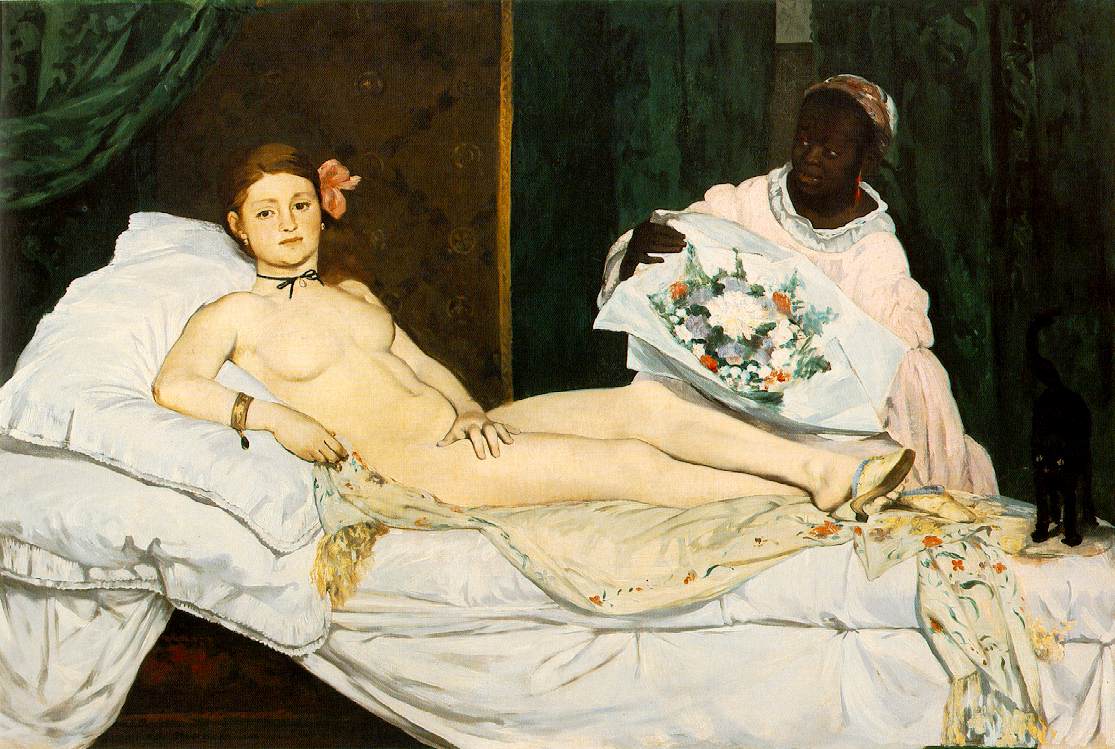
Manet, Olympia (Oil on canvas, 1863)
or indeed Dejeuner sur 'Herbe, is always going to be a show which has a giant glaring elephant-in-the-room sized gap at its core. Which means it's a block-busting show which doesn't quite deliver, as it can't truly tell the story of Manet without them.
So there you have it. Manet, father of modern art. Right place, right time, right circumstances. He was accused of painting unfinished pictures - but he stopped when he wanted to, leaving the brushwork to look like both the object and the mark. The spaces are all about urban modernity, and yet are also unreal. The paintings speak of big things, and nothing, of the said and the unsaid, awkward and honest and staged and spontaneous. Critics regularly roasted his work, but he had a large support network of family, friends and polite society, plus the financial backing, which combined to set his vision of modernity free.
Now there's a lucky man.
Near Castleton, Peak District
I've been asked where exactly the scene is for this painting of the Peak District.

I climbed a hill next to the car park at the Speedwell Cavern on Arthur's Way. Here's the hill on Google Maps here.
The view is looking out over the valley (seen here behind the car park). Castleton is down on the right.

Near Castleton, Peak District (Oil on linen, 12 x 12)
I climbed a hill next to the car park at the Speedwell Cavern on Arthur's Way. Here's the hill on Google Maps here.
The view is looking out over the valley (seen here behind the car park). Castleton is down on the right.
Monday, 11 February 2013
A Quick Peek at My Show...
Here's some images of my London show, which is all hung and ready for the opening on Thursday evening.

Paintings of Morar (on the left) and Hampstead Heath in autumn on the right, in the window of the gallery in St James's.

More scenes of Morar, and also of the Gower Peninsula in Wales (2nd from right at top).

Two of Morar, and the Causeway Coast in Northern Ireland (top right).

Quite a show-stopper when you see it in real life! Even if I say it myself... one of my very favourite paintings - Green Park in autumn, flanked by paintings of (l-r, top to bottom) two of Northern Ireland, Fife, Whitby, the Peak District and Hampstead Heath.

Top row (l-r) Northern Ireland, Fife, Northern Ireland. Bottom row Fife, Peak District, Fife.

Northern Ireland (top two), and Morar.

Two of Northern Ireland, and Ladybower Reservoir in the Peak District on the bottom left.
The preview opens on February 14th at 6pm, so do come along if you can.
More information here.
Wednesday, 6 February 2013
From My Easel...
Here's the drawing that I did yesterday which I thought you might like to see.


Judith I Bridgland, Boats at Porthleven Harbour (10 x 11, Mixed)
It's called Boats at Porthleven Harbour, and it's a little acrylic and pastel drawing done from photographs of last year's visit to Cornwall.
The paper is creamy-coloured and handmade, with long soft fibres, so that it's almost leathery in feel and gives a mid-tone background that isn't startling white. This means you can work down to your darkest darks and up to your white accents. The rough surface picks up the paint and pastel on the top of the tooth to give a nice textural finish.
I was pleased with the final effect. It's good to try all sorts of different hand-made papers and see the various effects and qualities they can give to a picture. Always nice to try something new!
Tuesday, 5 February 2013
Manet: Portraying Life
I'm really looking forward to seeing the big Manet exhibition at the Royal Academy in London later this week.
Manet: Portraying Life promises to be stuffed full of gorgeous world-class paintings from an Impressionist genius (although not, apparently, the block-busting Olympia or Dejeuner sur l'Herbe, which are staying in Paris).
I'm looking forward to seeing this painting, which I last saw some some years ago in Washington.

Manet was a very modern painter, right on the cusp of a palpable new modernity. Here is a typically enigmatic scene, a portrait of a little girl and one of his favourite sitters, the red-haired Victorine Meurant (read more about her here) outside a railway station. You can see hints of the tracks and the steam of the trains.
Victorine's not sitting in a a parlour though, looking prim and proper in her Sunday best with her hair up, sitting for a conventional portrait. She's out and about, in a rather ambiguous setting, which seems to be sitting on a low wall by the railings of a railway station, the new symbol of freedom of trade and transport, the opening up of the world. It's like her world has opened up too, liberating her - her hair is free and unbraided, her fan is jammed in the waist band of her dress, she thumbs a book, and she cradles a little sleeping lap-dog.
She looks up. She's looking directly at you, like she recognises you.
Was she expecting you? Has she been waiting long for you? Are you her lap-dog as well? It's difficult to tell her expression, and in turn, to tell from that who you might be in relation to her.
The child looks smart, with her ribbons and earrings, and watches the steam of the trains, as if she's looking into her future, but at the same time the railings remind you of prison railings, keeping her in (or out). We can only see her back, so it's difficult to engage with her. Maybe her governess (if that's what she is) can't engage with her either.
The railings are black, and form a very striking visual motif, making strong verticals, black against white, marching rhythmically across the painting and creating a very shallow theatrical space for the two figures to inhabit.
Is Victorine the girl's mother? Her governess? What's the occasion? Or is it just an everyday occurance?
Are we, then, seeing a moment of immense consequence, or of no consequence at all? Is this painting actually elevating the utterly mundane and ordinary, the inconsequential and fleeting, into a moment of timelessness and permanance? Nothing happens, and yet everything happens.
It's a portrait of great cleverness, and works on any number of levels. The more you look at it, the more you wonder.
To whet your appetite for the show, take a look at a short video here.
I'll let you know what the show is like!
Royal Academy website - more information on the show.
Sunday, 3 February 2013
Of Seaside Piers...
Here's one of the paintings I'm submitting for this year's SSA (Society of Scottish Artists), which is also being held at the Royal Scottish Academy in Edinburgh.


Eastbourne Pier: Night, Day, Dawn and Dusk. Screenprint and procion dye on cotton (35 x 35)


I'm also fond of the one at Morecambe, with its bird sculptures.

If you've got any favourite piers, then let me know!

Rainclouds over Llandudno Pier, (Mixed, 29 x 24)
It's another drawing of a pier. I just love piers - something to do with childhood visits to the south of England, but also to do with the contrast of the man-made structures marching into the restlessness of the sea, and that the piers are strong and yet fragile, created as something frivolous and joyful, and yet with something very sad about them.
One of the large paintings in my London show is this one, Pier at Sunset.

Pier at Sunset (Oil on linen 32 x 32)
My show a couple of years ago at the House for an Art Lover had many images of Eastbourne Pier, done in a variety of media including flag-like prints in bright procion dye on cotton tablecloths.


Eastbourne Pier: Night, Day, Dawn and Dusk. Screenprint and procion dye on cotton (35 x 35)
One of my favourite piers has to be at Southwold. Instead of the usual slot machines and one-armed bandits, it has a pier with lots of really quirky silly steam-punk machines in 'The Under the Pier Show.
This collection of unique, hand-built nonsense includes 'Wack
a Banker' so you can get your revenge, 'Pet or Meat' which gives
a comprehensive description of the difference between the two, a leaky under-sea submarine which squirts you with water, a dog-walking machine and a frisking machine with giant hands.


I'm also fond of the one at Morecambe, with its bird sculptures.

If you've got any favourite piers, then let me know!
Subscribe to:
Posts (Atom)