Saturday, 28 September 2013

From my Easel...

Here's a couple of just-completed paintings from the studio.

Blue Sky with Pink Rhododendrons (Oil on linen, 24 x 26)

Purple Rhododendrons against Summer Sky (Oil on linen, 24 x 26)

Both are of rhododendrons at Pollok Park, where they have a fine display in early summer.

Wednesday, 25 September 2013

Game of Thrones at Ballintoy Harbour

Last month when I was over in Northern Ireland, one of the locations I went back to to take photographs was Ballintoy Harbour.


You have to go down a very steep, winding single track road to get to the harbour, and this seclusion along with its open views right out over the sea to Scotland and the western isles gives it an oddly other-worldly feel.  

On the way down, there are also some very individual looking houses, none more so than this one.  It's like a mini castle, which I'm told was built by an artist, so it has many windows for many different views.  These arty types!


The harbour also has my favourite name for a boat ever.


Zebra's Fortune.  What on earth could be the story behind that one?

Anyway, obviously the makers of Game of Thrones also thought that Ballintoy Harbour had that other-worldy rather mystical quality, as there is now a sign there, sporting a picture of Alfie Allen (brother of Lily, whom I saw in Equus) (that's Alfie in Equus, not Lily, although I've seen her as well) to tell you that it was the location for Pyke Harbour.


Now, as you all know, Pyke is one of the Iron Islands, an archipelago located on Ironman's Bay, on the western side of Westeros. The island is the site of the castle of the same name, which serves as the seat of House Greyjoy (Alfie Allen is Theon Greyjoy), the ruling house of the Iron Islands, and the town of Lordsport with its harbour. 

Here's how it looked in the series.

Image: Helen McCall

(Zebra's Fortune Didn't make it into the shot, but Faded Rose did.) 


Apparently there are a lot of places along the Causeway Coast that are set locations for Game of Thrones, just as the Welsh coastline provides a lot of the settings for Doctor Who. You can see more locations HERE.

It's just a pity I have no idea what on earth Game of Thrones is all about...

Thursday, 19 September 2013

Michael Landy - Saints Alive

Whilst in London, I went along to the National Gallery to see the exhibition Saints Alive by Michael Landy.  Going during the evening on a Friday meant that there were no queues for the Sunley Room, as although the exhibition is free, numbers into the room are limited.

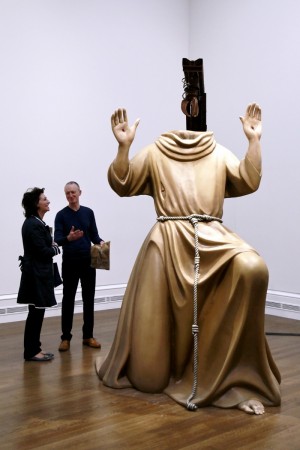
© Glenn Copus, Evening Standard 

Landy (seen above with the kinetic super-sized saints sculptures) is the chap who created Art Bin, inviting people to come and throw their unsuccessful pieces of art into a giant skip.  And then he was also the guy who, back in 2001, sat in the window of C&A in Oxford Street, catalogued all his possessions from his car to his birth certificate, and then systematically destroyed the lot in a performance piece called Break Down.  You do have to wonder how he gets along these days without his bank cards or driving licence.

Anyway, now he has is the eighth Rootstein Hopkins Asociate Artist, which means he gets a studio at the National Gallery and total access to the collection.  The only stipulation is that the resulting exhibition must refer to the collection, and inform and reinvigorate gallery visitors to that collection.

Landy set about drawing and collaging from the paintings that caught his imagination in the collection.  After a while, he was drawn to the many paintings of Saints, with their bizarre stories of self-punishment and denial, strange attributes, and plethora of creatively violent martyrdoms. He then handed over to model-making company MDM, who constructed huge kinetic sculptures of fibreglass and retro mechanical parts, overseen by Landy.

Here's Saint Apollonia, who greets you at the entrance to the exhibition.  

Michael Landy, Saint Apollonia, 2013
Michael Landy, courtesy of the Thomas Dane Gallery, London
© Michael Landy, courtesy of the Thomas Dane Gallery, London / Photo: The National Gallery, London

She's a big girl, and if you stand on a hydraulic footpedal, she smashes a set of pliers into her face with both hands, and wrenches out a tooth with a loud crash.  WHACK...YANK!

Here's Saint Francis of Assissi, famed for his life of poverty and self-denial.

Photo: Allie Suwanrumpha

St Francis is the guy who lived a life free of material objects, although he didn't shred everything in the window of C&A.  Now, I believe that a large grabbing claw, like those machines you get at the funfair, is meant to come along, reach down and grab something out of the neck of St Francis.  But St Francis wasn't working when I visited.  In fact, quite a few saints had broken down.  But in a way that was ok.  Mechanical breakdown.  Mental break down.  Break Down indeed.

Here's one that hadn't broken down - it's  Saint Thomas, whose disembodied finger jab-jab-jabs at the body of Christ, battering holes in the fibreglass. 


The body of Christ flails around violently on its spring, and people jump.  No wonder the gallery staff have earplugs.  It's noisy stuff.  

It's also pretty violent stuff, in a cartoon way.  Saint Jerome repeatedly batters himself with a rock to stop himself from having impure thoughts.  Saint Peter Martyr has an axe in his head.  Saint Lawrence has a large griddle that he was roasted alive on, and Saint Lucy's eyes whirl on a plate.  The flailing, crashing, battering, self-flagellating saints come across as a pretty weird bunch.  What was with all their obsessive self-destruction?  What kind of peculiar mind-set did they have?

Michael Landy, Multi Saint, 2013
© Michael Landy, courtesy of the Thomas Dane Gallery, London / Photo: The National Gallery, London

These are figures are built from many parts.  They are constructed from fragments of a variety of different paintings in the gallery, and are also built out of old defunct mechanical parts.  They are therefore all about Landy's obsession with destruction and fragmentation, about the things that you need, the things you can do without, the things that are defunct and no longer relevant in your life.  

So the question here is - are saints relevant?  Their myths are constructed from different parts, as their physical bodies are here.  Once revered, their stories known by everybody, these saints are literally no longer the figures they once were. Saint Catherine has even been chucked out of the saints calendar for not actually existing.  The minx!  

Landy comes over as a genial kind of guy, but equally he's obviously not the sort of guy who shies away from the big statement or the big gesture.  These are sculptures that are fun and interactive (when they work) but are also ones that pose questions.  

A piece of art is, inevitably, also about the artist who creates it.  So the questions of relevance, self-destruction and, indeed, mental state which Landy is posing about the saints, are also, by extension, ones which Landy is posing about himself. 

You've got to be a bit bonkers to be a saint.  But you've also got to be a bit bonkers to be an artist.

Wednesday, 18 September 2013

At the 20 21 British Art Fair

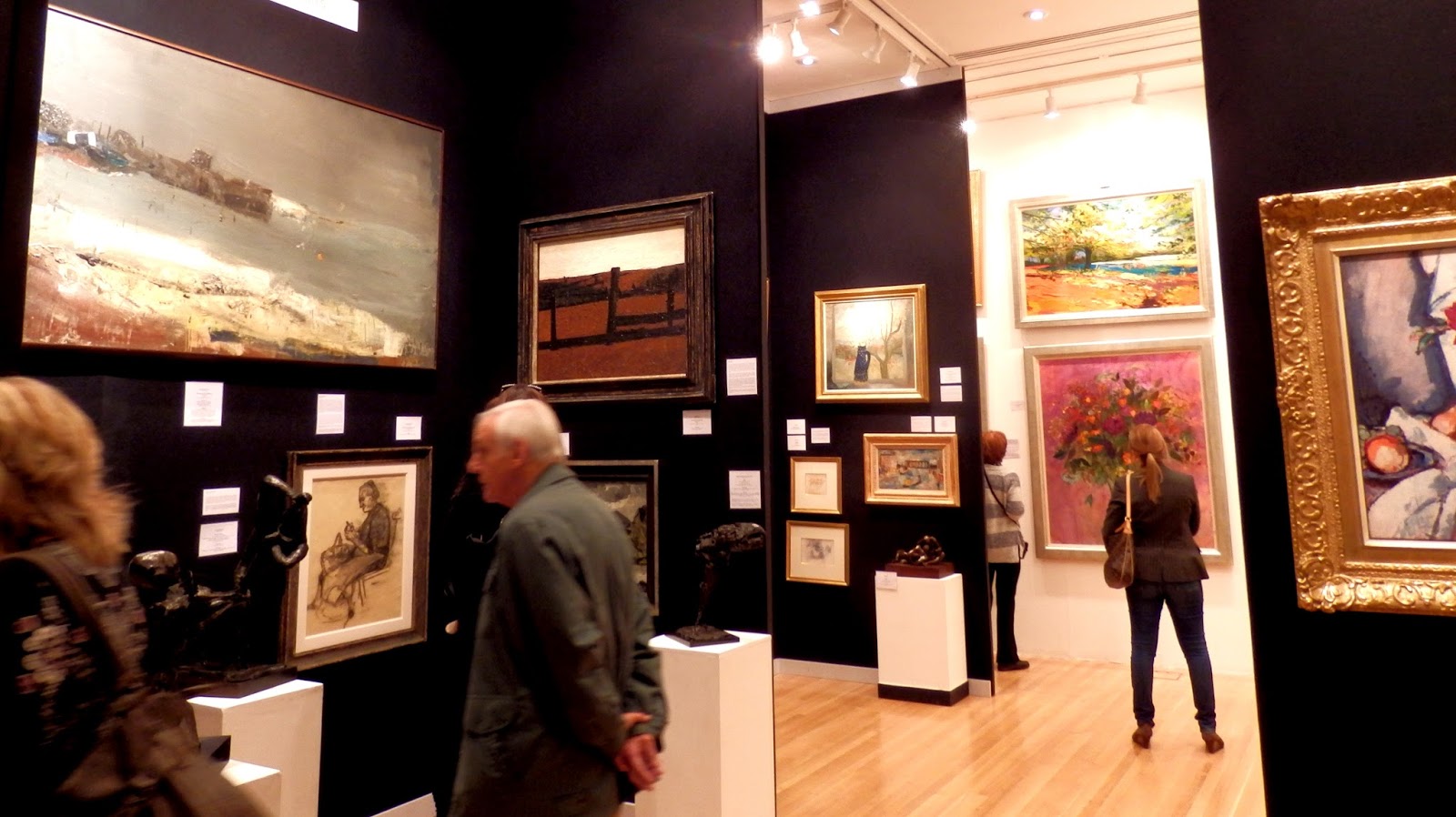
Here's some photos of one of my paintings,  Paths Meeting, Hampstead Heath (that's it up at the top of the photo) on the Duncan Miller Fine Arts stand at the 20 21 British Art Fair, which was held at the Royal College of Art in London this weekend.

As you can see, my painting is keeping good company!  Here it is with contemporary artists Ann Oram and John Kingsley.


Also on the stand were works by, amongst others, Joan Eardley and Scottish Colourist S J Peploe.

On the top left is a Joan Eardley Catterline Landscape and beneath it her 1950s conte drawing Old Woman Peeling Potatoes.  Also seen on the plinth nearby is one of Elisabeth Frink's bird figures.


Here's the very fine Peploe, Still Life with Roses and Fruit of 1928, looking wonderfully contemporary on its black background.

The Fair itself was a feast for the eye.  If I was able to stuff one of the pieces of work into my handbag, I'd either choose a Peter Lanyon Cornish landscape or the Boyle family piece, which was a small square of sand with a single seashell.  I'd never seen such a small piece by them before, and it was very beautiful.

There were also some very lovely figure drawings by Stanley Spencer, so as usual, it was a real treat.

Monday, 16 September 2013

A Midsummer Night's Dream at the Noel Coward Theatre

I was in London over the weekend to visit the 20/21st British Art Fair at the Royal College of Art (where I had paintings on exhibition), and took the opportunity to take in a play in the evening.

I've had tickets to see A Midsummer Night's Dream with David Walliams and Sheridan Smith for over a year now, so was really looking forward to it.


I was in the cheap seats right up in the balcony - not for those with vertigo as I found out, but still with a perfectly good view of the stage.

I'm sure you're all familiar with the play - it's all about the anarchic other-worldliness of the forest inverting the up-tight moral order of the court.  It becomes a magical place inhabited by fairies in moonlight, full of beautiful, bewitching imagery, mistaken identity and mischief. 

Sheridan Smith plays Titania, Queen of the Fairies, as a spliff-smoking hippy chick.  David Walliams is David Walliams (as usual) playing Bottom.  Oberon is played by some bloke with an Irish accent that sounds like Sean the voice of my sat nav, and his delivery was so lacking in depth and variation that I kept expecting him to tell the audience to Turn Right.  However, he had obviously been cast for his abdominal physique (which was impressive) rather than his delivery.

Meanwhile, the two pairs of lovers - Lysander, Demetrius, Hermia and Helena - ran about dropping their trousers round their ankles, undoing their dresses and straddling each other with so much six-pack slapstick business that the whole thing resembled a Brian Rix farce.  All it lacked was a Vicar walking in unexpectedly.

It's all very well having a play that's about comedy and fun (because it is a Shakespeare Comedy), but it lacked any emotional depth.  David Walliams was fine - he's been acting Shakespeare for years, after all - but I didn't think he was exactly electrifying.  (I saw David Tennant in Love's Labours Lost simply walk on stage, lie down, and put a hat over his face, and that was just about the most sizzling thing I've ever seen, even from the top row of the theatre.  Goodness knows how he did that.)  But Mr Walliams played Bottom like one of his Little Britain characters. Little Bottom.

Shakespeare's play is full of the most exquisite passages of lyrical poetry, which move through the text like wide glitttering swathes of scattered fairy dust, bejeweling the Dream and giving it form and emotional depth.  But in this production, it just kind of got swallowed up, and you didn't care about any of the lovers and their plight.  It was all just too, too insubstantial. I've seen plenty of productions of Dream, and honestly, you can do both magic and depth. 

For example, there's a difference between taking Puck's line "Lord, what fools these mortals be" as the keystone of the play, and then going further and interpreting the word 'fools' as 'idiots'. Fools are fallable, and you can forgive people for being foolish.  But idiots are just...idiots.  

Given additionally that the line is directed not only at the lovers in the play, but also to the audience in general (meaning that everyone involved in the play, the characters and those watching, are equally capable of being foolish in matters of love) it equates you with the trousers-round-the-ankles brigade on stage.  You're one of this bunch of plain idiots.  And that's just irritating, not illuminating. And it's a play about illumination - la luna, the moon.  Illumination of the human condition.

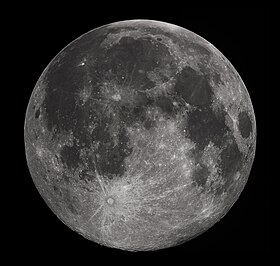
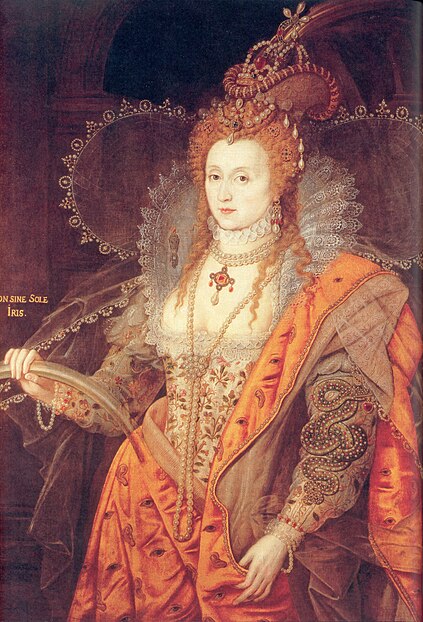
It's also a political play.  Written around 1590-96, it is an allegory referencing the waning years of the reign of Queen Elizabeth 1st.  Indeed, the huge feminine symbol of the moon dominates the set of this production.   

 The Rainbow Portrait of Elizabeth 1, c1600, Oil on canvas

A Midsummer Night's Dream is exactly contemporary with Edmund Spenser's allegorical (but incomplete) epic poetic masterpiece The Faerie Queene, one of the longest poems in the English language (believe me, I've read it...) which acts, on one level, to praise and glorify Elizabeth.  

Both The Faerie Queene and A Midsummer Night's Dream are also, however, making political points.  Elizabeth was, at this time, in her late 50s/early 60s, and childless, leading to problems regarding succession and a period of economic and political uncertainty. Therefore, in Shakespeare's play, as the virginally white old moon wanes, anarchy breaks out and society breaks down.  

How does Shakespeare get away with it?  By presenting these ideas as a dream.  "If we shadows have offended,/ Think but this, and all is mended," says Puck to the audience, playing the get-out-of-jail-free card, "That you have but slumber'd here / While these visions did appear."  Yes, it's all a dream.  So that's okay then.

So - were any of these themes touched upon in this production?  Any depths, resonances, complexities, universal truths? 

Nope - just drop the trousers.

Now, it wasn't just me being in the wrong mood for the play, or not entirely 'getting' it.  Quite a few people left after the interval - which was a pity, because the second half was stronger than the first.  

To sum up then - for all the energy and invention on the stage, the spliffy hippy analogy actually suited this Dream - because it was actually not nearly as funny or clever as it thought it was.  It was indeed, as insubstantial as a dream.

For more information about the play, cast, characters and tickets, please go to the A MIDSUMMER NIGHT'S DREAM WEBSITE.

Thursday, 12 September 2013

A Van Gogh in the Attic

It's a once in a lifetime event - a new full-sized Vincent Van Gogh canvas has been unveiled in the Netherlands.

Sunset at Montmajour was sold in 1901, and went off the radar until it turned up in the collection of a Norwegian industrialist - who had banished it to his attic as it was thought to be a fake.  Which begs the question, what did he pay for it, and under what circumstances was it sold to him as real?  

It all sounds a bit odd, but the Van Gogh Museum in Amsterdam says we're going to get more details of its discovery in the October edition of The Burlington Magazine.

Admittedly, it's not immediately Van Gogh-like.  It's a picture of some twisty little trees on a hillside, and is a bit sludgy looking.

 OLAF KRAAK/AFP/Getty Image

However,  secondary evidence of letters from Vincent to his brother Theo tie the painting down to a specific day (July 4th 1888) during his time at the Yellow House in Arles in the south of France, when he was painting his sunflowers, his bedroom, and other masterpieces.  

Paint analysis and other samples of materials (presumably the jute canvas) also build up a picture of authenticity.  You can imagine how excited the Van Gogh Museum in Amsterdam are about this.


Get up close on the brush strokes and you can think yes, well, that's a Van Gogh brushstroke, even if the effect when you stand back is a bit like a big green duvet.  The technical term (as described by the Van Gogh Museum) is a 'transitional work'.

Here's the actual location,with those wonky trees at Montmajour near Arles.  I guess it kind of does look like a big green duvet anyway.


A rediscovered Van Gogh masterpiece - what do you think?


Tuesday, 10 September 2013

Paintings at the 20/21 British Art Fair

I'm going to have some a whole selection of paintings on show down in London this weekend, at the 20/21 British Art Fair.  The Fair opens tomorrow, and goes on until Sunday 15th.

It's held in the Royal College of Art opposite the Royal Albert Hall, and my work is going to be on Stand 11 with Duncan Miller Fine Arts.  

Here's a look at a couple of them!

River in Early Autumn, Betwys y Coed (Oil on linen, 24 x 26)

Green Valley, Brecon Beacons (Oil on linen, 16 x 16)

Both of these paintings are Welsh scenes, one from Snowdonia in the north, and the other from the south of Wales. 

If you're in London, why not drop in?  They have lots of really exciting work from top British artists and sculptors of the 20th century including Henry Moore, Elisabeth Frink, Frances Bacon and Alison Watt.  Find out more information HERE.

If you'd like an invitation for free entry for two to the fair which you can print out yourself, then drop me an email at judith@jibridgland.com