Showing posts with label National Gallery London. Show all posts

Thursday, 19 September 2013

Michael Landy - Saints Alive

Whilst in London, I went along to the National Gallery to see the exhibition Saints Alive by Michael Landy.  Going during the evening on a Friday meant that there were no queues for the Sunley Room, as although the exhibition is free, numbers into the room are limited.

© Glenn Copus, Evening Standard 

Landy (seen above with the kinetic super-sized saints sculptures) is the chap who created Art Bin, inviting people to come and throw their unsuccessful pieces of art into a giant skip.  And then he was also the guy who, back in 2001, sat in the window of C&A in Oxford Street, catalogued all his possessions from his car to his birth certificate, and then systematically destroyed the lot in a performance piece called Break Down.  You do have to wonder how he gets along these days without his bank cards or driving licence.

Anyway, now he has is the eighth Rootstein Hopkins Asociate Artist, which means he gets a studio at the National Gallery and total access to the collection.  The only stipulation is that the resulting exhibition must refer to the collection, and inform and reinvigorate gallery visitors to that collection.

Landy set about drawing and collaging from the paintings that caught his imagination in the collection.  After a while, he was drawn to the many paintings of Saints, with their bizarre stories of self-punishment and denial, strange attributes, and plethora of creatively violent martyrdoms. He then handed over to model-making company MDM, who constructed huge kinetic sculptures of fibreglass and retro mechanical parts, overseen by Landy.

Here's Saint Apollonia, who greets you at the entrance to the exhibition.  

Michael Landy, Saint Apollonia, 2013
Michael Landy, courtesy of the Thomas Dane Gallery, London
© Michael Landy, courtesy of the Thomas Dane Gallery, London / Photo: The National Gallery, London

She's a big girl, and if you stand on a hydraulic footpedal, she smashes a set of pliers into her face with both hands, and wrenches out a tooth with a loud crash.  WHACK...YANK!

Here's Saint Francis of Assissi, famed for his life of poverty and self-denial.
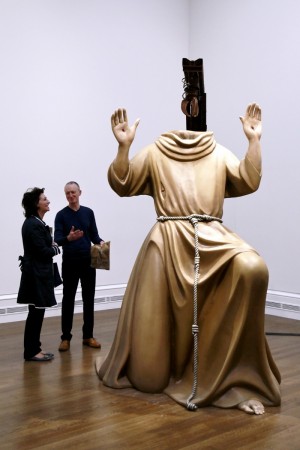
Photo: Allie Suwanrumpha

St Francis is the guy who lived a life free of material objects, although he didn't shred everything in the window of C&A.  Now, I believe that a large grabbing claw, like those machines you get at the funfair, is meant to come along, reach down and grab something out of the neck of St Francis.  But St Francis wasn't working when I visited.  In fact, quite a few saints had broken down.  But in a way that was ok.  Mechanical breakdown.  Mental break down.  Break Down indeed.

Here's one that hadn't broken down - it's  Saint Thomas, whose disembodied finger jab-jab-jabs at the body of Christ, battering holes in the fibreglass. 


The body of Christ flails around violently on its spring, and people jump.  No wonder the gallery staff have earplugs.  It's noisy stuff.  

It's also pretty violent stuff, in a cartoon way.  Saint Jerome repeatedly batters himself with a rock to stop himself from having impure thoughts.  Saint Peter Martyr has an axe in his head.  Saint Lawrence has a large griddle that he was roasted alive on, and Saint Lucy's eyes whirl on a plate.  The flailing, crashing, battering, self-flagellating saints come across as a pretty weird bunch.  What was with all their obsessive self-destruction?  What kind of peculiar mind-set did they have?

Michael Landy, Multi Saint, 2013
© Michael Landy, courtesy of the Thomas Dane Gallery, London / Photo: The National Gallery, London

These are figures are built from many parts.  They are constructed from fragments of a variety of different paintings in the gallery, and are also built out of old defunct mechanical parts.  They are therefore all about Landy's obsession with destruction and fragmentation, about the things that you need, the things you can do without, the things that are defunct and no longer relevant in your life.  

So the question here is - are saints relevant?  Their myths are constructed from different parts, as their physical bodies are here.  Once revered, their stories known by everybody, these saints are literally no longer the figures they once were. Saint Catherine has even been chucked out of the saints calendar for not actually existing.  The minx!  

Landy comes over as a genial kind of guy, but equally he's obviously not the sort of guy who shies away from the big statement or the big gesture.  These are sculptures that are fun and interactive (when they work) but are also ones that pose questions.  

A piece of art is, inevitably, also about the artist who creates it.  So the questions of relevance, self-destruction and, indeed, mental state which Landy is posing about the saints, are also, by extension, ones which Landy is posing about himself. 

You've got to be a bit bonkers to be a saint.  But you've also got to be a bit bonkers to be an artist.

Friday, 6 September 2013

Colour at the National Gallery, London

The curators of the National Gallery must have taken note of my list of favourite paintings, because Degas' La Coiffure is going to be appearing in a major new exhibition there next year.


The show is called Colour, and is going to be at the National Gallery in London from 18 June - 7 September 2014 in the Sainsbury Wing.

Here's what the website says about the show - sounds pretty exciting.

‘Colour’ will provide visitors with a unique and exceptional opportunity to journey through the history of colour, by exploring the wide range of materials that are used to create colour in paintings and other works of art. 

Woo-hoo!!  

‘Colour’ is the first exhibition of its kind in Britain.  

Boy, they must have been punching the air in delight when they brain-stormed that one as a USP.  "Think of the fridge magnets!!  It's a marketing goldmine...   

Each room will be dedicated to a particular colour from the spectrum, as well as a room devoted to gold and silver.  

Now, you'll note that they differentiate gold and silver from the actual colours of the spectrum.  This is, of course, as I've pointed out before, because gold is not a colour, it's a metallic element.  Thank you, National Gallery, and take that, Dr James Fox (see my blog HERE for what I'm ranting on about).  Anyway... 

‘Colour’ will draw on the expertise of the  National Gallery's scientific department and the spectacular range of paintings in the Collection.  The exhibition will help visitors to understand the history of the use of colour over a 700 year period – from the early Renaissance  to the Impressionist movement.  

Yum.  

Visitors will explore the origins and developments of the physical materials themselves, from natural and mineral products to manufactured pigments. The exhibition also examines the material problems faced by artists in achieving their painterly aims; the breakthroughs they struggled for and the technical challenges they faced.  

Yum yum.   

Several major national cultural institutions have loaned works for the display – which has painting at its heart but also includes minerals, textiles, ceramics and glass. These form a rich and diverse exhibition which illustrates the importance of colour in the way that creators of works of art experience and represent the world.  

Just my sort of show.  Looking forward to it already!  

Read more HERE.

Wednesday, 25 July 2012

imagine...Dancing with Titian

I caught a really interesting programme on television last night, 'imagine...Dancing with Titian'.  I'm not a great fan of dance, and thought I wouldn't like it, but it was really enthralling.

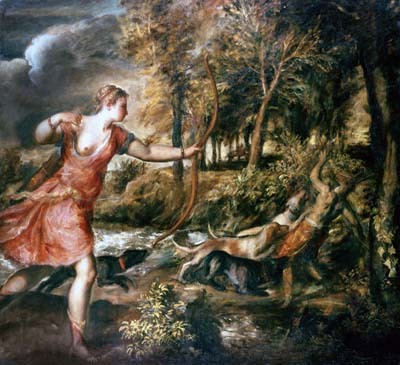
The programme, with Alan Yentob, documented new artworks and dances inspired by three Titian paintings gathered together at the National Gallery in London for the first time since the 1700s.  The paintings show scenes from Ovid's Metamorphoses based on the myth of Diana.  They are...
 
Titian, Diana and Acteon (Oil on canvas, 1556-9)

Titian, The Death of Acteon (Oil on canvas, 1559)

Titian, Diana and Callisto (Oil on canvas, 1559) (from the National Galleries of Scotland)

These pictures were painted by Titian when he was in his 80s, at a time when, as one of the curators pointed out, he may not have been at the height of his physical powers, but he was at the height of his imaginative powers.  

These are mysterious, sensual paintings, full of texture and layers of glazes and flickering licks of glowing paint.  The paint is applied in various ways, sometimes smudges, or brushed, or dabbed, or looking as if fingers have been used.  It must have seemed radically experimental at the time.

This is echoed by the present day artists in the rest of the National's exhibition.  ‘Metamorphosis: Titian 2012’ features new work by contemporary artists Chris Ofili, Conrad Shawcross and Mark Wallinger in a unique collaboration with The Royal Ballet.

It was the Royal Ballet work that was perhaps the most interesting.  There were three ballets; one inolved a huge industrial robot which represented Diana, and moved on stage in a presence that was both beautiful and menacing, creating a real tension between the human and the mechanical.  And because of the problems that they had with the technology, you literally didn't know what was going to happen, so there was a continual frisson of danger. 

The second ballet had giant mirrors, which reflected not only the dancers but the audience as well, playing with the ideas of voyeurism contained in the Diana story.  

But the last was perhaps visually the most striking, even though it was the simplest, telling the story of the death of Acteon, set upon and killed by the hounds of Diana.  The sets and costumes were designed by Chris Ofili, who is not, I have to say, my favourite artist.  However, here he played an absolute blinder.  

The sets were stunning, with a mysterious forest, like the other-wordliness of the magical forests in Shakespeare, and lit by a huge scarlet red moon.  The fluid costumes and details of the individually designed dogs heads reminded me of the costumes for Parade designed by Picasso in 1917 for the Ballet Russes (which I saw performed some years ago in Edinburgh as part of the Festival).  It was amazing watching the whole creative process, and all the parts coming together.

Fusing dance and painting: Federico Bonelli performs 
Diana & Actaeon against the background of Chris Ofili’s psychedelic set design (Picture: © Alastair Muir)

You can watch extracts of the ballets here.

Marianela Nunez and The Royal Ballet in Diana and Actaeon. Metamorphosis: Titian 2012. © ROH/Johan Persson, 2012.

Not all of the connections with the Titian paintings were immediately apparent, but the it was more about the sense of the paintings, the contrasts of sensuality and cruelty, the transformative process.  Chris Ofili's set designs and costumes certainly were the most successful in combining dance with the painterly sense of the Titians.

When Titian painted these Diana pictures in his 80s, at a time in history when life could be cut brutally short at any moment, he must always have felt 'Time's winged chariot hurrying near'.  The fact that Titian's own death and transformation from the mortal was on his mind has greatly informed the work.  This is especially apparent when you look at the paint surface closely, with its wispy, flickery, urgent insubstantial layers of substance conjuring up form, and is possibly most demonstrable in one of his last paintings, the grim Flaying of Marsyas.

Titian, The Flaying of Marsyas (Oil on canvas, 1570-76)

Again from Ovid (read more about it here), it is a truly shocking image, telling the story of the chirpy satyr Marsyas, whose only crime was to play the pipes better than Apollo.  For this, he is flayed alive.  

Again, the paint is flickery and urgent, but spares none of the detail of the horrific scene.  Upside-down, the grimace of the martyred Marsyas looks like a smile.  It looks like Titian is also expressing all the pain and humiliation and injustice of old age itself, with youth and innocence and happiness being pointlessly stripped away until nothing is left.  It's about the pain of being mortal and having a body, and of losing it.  A metamorphosis indeed.

Do have a look at the programme if you can - it's a treat - and the free exhibition is on until 23 September at The National Gallery in London.

See the programme on i-Player here.