Friday, 14 November 2014

A Couple of Norfolk Paintings

Back in the summer, I travelled round Norfolk to get material for my forthcoming solo show in London (which I'm thinking of calling Journeys Through Landscape - always good to have a title in mind when preparing the show).  You can take a look at some of the photographs in my blog HERE.

Now here are a couple of the paintings which I've produced as a result of that trip - thought you might like to have a look. 

Cattle by Windmill, Norfolk (Oil on linen, 16 x 16)

Windmill at Cley Next the Sea (Oil on linen, 24 x 26)


Wednesday, 12 November 2014

Version #1

Earlier this week, this watercolour of mine went under the hammer at McTears Auction House in Glasgow.

Today I came, quite by chance, across the first version of this.  It was done the during the same class, with the same model in the same pose...


Tuesday, 11 November 2014

Mr Turner

I was at the Showroom Cinema in Sheffield on Saturday, to see the new Mike Leigh film Mr Turner.  It's had fantastic reviews, so I was really looking forward to it.  It stars Timothy Spall as legendary artist Joseph Mallord William Turner.

Here's the man himself.
JMW Turner, Self Portrait (Oil on canvas, 1799)

and here's Timothy Spall as JMW.

The audience at this showing were all 'couples of a certain age', and during the two and a half hours of the film, the husbands fidgeted and rustled interminable quantities of toffees before falling into Werther-induced slumbers.

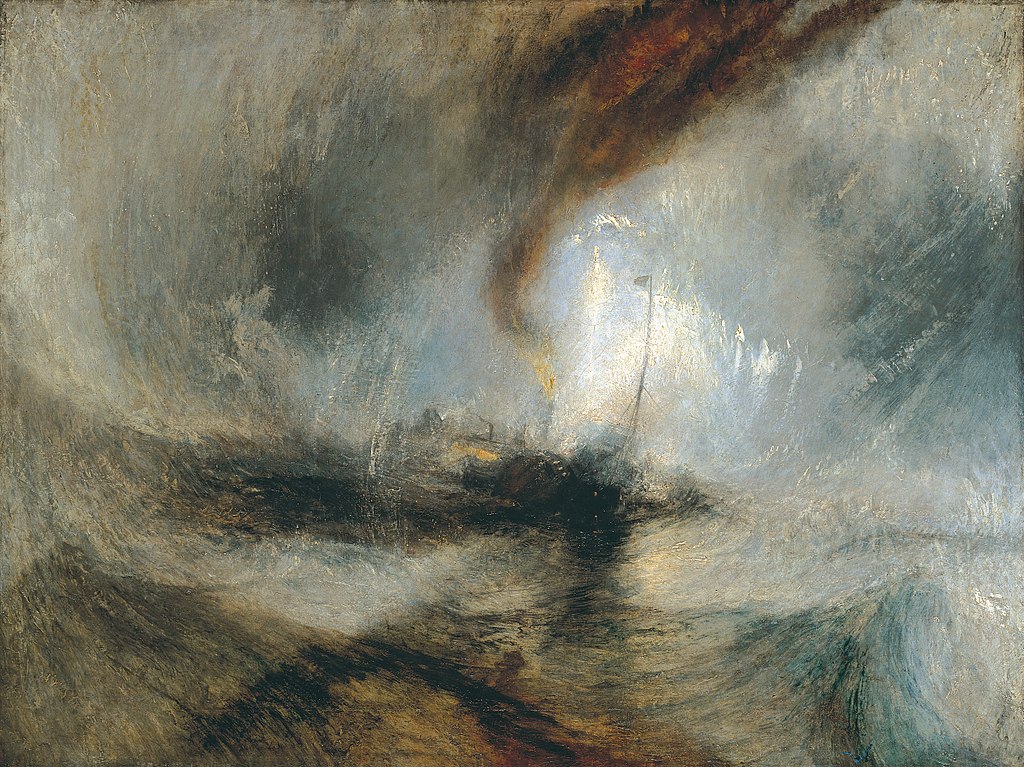
Now, Turner was famous for wild, impressionistic avant-garde forces-of-nature-painted-by-a-force-of-nature pictures such as these

 JMW Turner, Snow Storm - Steam Boat Off a Harbour's Mouth

He is shown striding through a sun-soaked landscape, sketching en plein air, or tied to the mast of a ship in a possessed manner, and spitting upon, rubbing, smudging, and throwing paint onto canvas in paroxysms of creativity.  He is also, early on, shown scrubbing yellow paint into his watercolour paper - which made me sit up in my seat, as I thought that Turner in fact dipped his papers into buckets of various pigments in order to dye the sheets and work on several at once (on his death, he left over 20,000 drawings and watercolours to the nation).  This surprised me, considering that there was such incredible minute attention to the detail of the film (dead bluebottles were hand-made, a pigs head had the bristles painstakingly replaced, as you can't buy pigs heads from butchers with the bristles any more - this was for a scene where the pig was shaved to take the bristles off again for brushes...).  

It's quite an odd film, the antithesis of a Hollywood special effects blockbuster (in fact, it was budgetary constraints which meant that two of the films key scenes in Turner's artistic life could not be filmed - the burning of the Houses of Parliament and his trip to Venice).  

It's a film which dares to take its time in order to tell a tale of duality and multiplicity.  Even Turner himself goes by a number of different names depending on who he's with and what version of the story he is telling about himself.  

It's a film about one of the world's most extraordinary genius's (one who is simultaneously lionised and ridiculed by society), but it's also about grindingly ordinary people.  It's about the problem of making external the internal, both in terms of art and life. There's no plot.  Stuff just happens.  Nothing is overtly explained.  Things are hinted at.  Emotions are withheld, or explode.  It's like the paintings themselves, where objects are indistinct, the sense of the piece is suggested by a swirling fury of mark-making or suffused in a calm glow.  Nothing in either film or painting is spelt out, but it's there to be found.  Perhaps. 

Timothy Spall's is a totally convincing performance, as gravy-boat faced harrumphing sex-pest genius, selfishly at the centre of his own drama, stomping through the film refusing to be conventional or to compromise, painting eternity on the brink of modernity, and leaving an everyday trail of women washed up in his wake, like so many Fighting Temeraires being dragged to their last berth to be broken up. 

His housemaid, whom he sexually exploits and takes for granted, ends up a lonely spinster entombed in a crumbling house and a broken body, having devoted her life to him;

his shrewish wife is abandoned, his daughters are ignored (although there is a brilliant scene when he is told of the death of his daughter, and the only signal of his internal conflict is shown by Spall's hands).  

He lives at a secret address with widow Mrs Booth, a surrogate mother figure, but it is all cloak and dagger.  
It's difficult to see the attractiveness of a man so emotionally juvenile, retentive and selfish in his relationships, but who pours all his heightened inner perceptions into his work.  He communicates through paint rather than words.  

Spall convinces totally as the painter, but I'd have liked to have seen more of the work, more of his relationship with the prudish Constable, and perhaps more of just how exactly he came to be such so convention-defying. What was the catalyst for his anti-authoritarian mould-breaking attitude?  Just sheer bloody-mindedness?

And what are his final words as he lies on his deathbed with the ever-attentive Mrs Booth?  I love you?  Nope.  "The Sun is God!" he shrieks. Which sort of sums it up.  In Turner's world the heirarchy is Sun, Interpretor of Sun (Turner), then everyone else.

In many ways, it's a stunning film.  Everyone is totally convincing and spot-on.  It sums up a stifling society of a certain class at a certain era, full of dirt and dust and ennui and trivial inconsequential conversation.  It's a brave film which doesn't spoon-feed the audience.  But it's also a film which is, ultimately,  curiously unengaging and indistinct.  

Although as Turner himself famously said , 'Indistinctness is my forte'.

Friday, 7 November 2014

Blood Swept Lands and Seas of Red

Whilst in London, I went to see Blood Red Lands and Seas of Red at the Tower of London.
The Tower was absolutely jammed with people, who had travelled from all over to visit. It was like a pilgrimage or haj, with people shuffling in lines around the moat.


Each hand-made ceramic poppy represents a life lost.


Thursday, 6 November 2014

Anarchy and Beauty

I was down in London at the weekend, and took the opportunity to go to the National Portrait to see the exhibition about the legacy of William Morris, called Anarchy and Beauty.
It sounded pretty exciiting - Morris textiles, Pre-Raphaelite paintings and designs, all the way through to Bernard Leach pottery, Eric Gill sculpture and Lucienne Day textiles.  Wow!  There's a tempting mixture.  

I couldn't wait.... so I paid my £14 and in I went.  £14!! Never mind, it was bound to be worth it.

It's a teeny tiny exhibition, full of people.  People crowded round the jam-packed exhibits in cases with their explanatory labels,  so it's difficult to get in to read them.  But the gist is that visionary Victorian artist, writer and designer Morris was down with the people, and that his group of like-minded chums were all socialists/bohemians/Marxists/Communists/rebels./radicals  Because artists do tend to be, on the whole, socialists/bohemians/Marxists/Communists/rebels/radicals.  

Anyway, whilst it was quite a narrow exhibition space, it was strangely difficult to get close to the exhibits to actually see them, and to be honest, I got tired of queueing to try and get close to read them.

There was a Bernard Leach pot, and a little 2-minute video about him, which was moderately entertaining in a general between-programmes potters-wheel way.  But it didn't say anything particularly about Leach's specific technique or style.  You certainly got no inkling of his whole Japanese vibe.
I've seen a far better and more informative film at his studio in St Ives (which was manned, incidentally, by a very rude young besom, who threw my Scottish money back at me at the door, snapping "It ain't got the Queen's 'ead on it.").

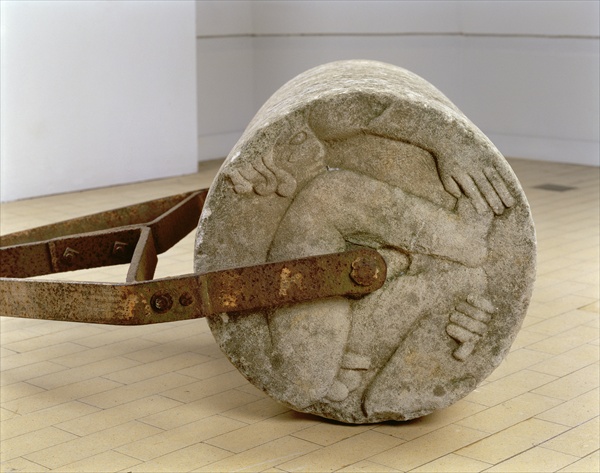
To the left of the Leach exhibit is the highlight of the show.  Eric Gill's garden roller.  Yes, really.  


Eric Gill, Adam and Eve Garden Roller (1933, Portland stone and iron)

Sans-serif sculpting sex-pest, Gill invented the Gill font (unsuprisingly), sculpted the art deco figures on the Midland Hotel and Broadcasting House

Eric Gill, Ariel between Wisdom and Gaiety

and generally set about forcing himself on anyone, and anything, that ventured in his priapic path.  Not even the family dog was safe.  However, no worries!  Because he's now cast as 'eccentric bohemian' rather than 'Savile-like monster'.

Anyway, this is all summed up in the garden roller of Portland stone that he used on his tennis court (there's a socialist in action for you).  The ends of the roller are decorated with a typically flambouyant figure of the naked Adam, ready for a bit of roll-on-the-hay action. Presumably an exhausted and fed-up Eve is on the other side, but I couldn't see that, nor was there a photo, or even a mirror so you could see it.  

As I said, this is a small exhibition, which all feels a bit crammed in, so when I came to the exciting stuff - the Leach and the Gill - there was only one example, so nothing really to get your teeth into.  

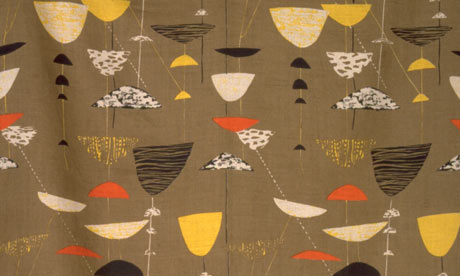
Similarly, right along from the roller was Lucienne Day.  Lucienne Day! Designer of some of the most fab 50s textiles ever created!!  Here was a length of Calyx - but a reprinted length, by the Glasgow School of Art Advanced Textiles Department, rather than an original piece.  
Now, when the textile department started the reprinting project, I went up to see an exhibition in the Art School Museum of the fabrics and Day's original artwork for designs such as Spectators and Magnetic.

It was utterly fascinating.  They were created out of cut pieces of paper, stuck on to large boards.  You could see the hands-on rawness of the designs, the mind in action, thinking out, and indeed cutting out,  these hugely influential, Festival-of-Britain zeitgeist pieces of design.  They were like little teeny tiny Matisse cut-outs, which were of course being produced at the same time (1950s).

Any of that Lucienne contextual preparatory work here?  Nope.  Just half a curtain.

And...well, that was basically it.

Now there was a lot in there.  A lot in a small space,  But, conversely, not much at all.  It was like a sandwich tin of amuse-bouche, but no substance.  And not worth  £14.  After seeing the exhibition I have no idea how, in terms of the argument and context of this show,  Eric Gill related to William Morris or Lucienne Day or Bernard Leech.  

It was like a blunderbuss filled with marshmallows and fired against a wall.  Sorry...
 Any & Beauty Exhibition Supporters Group.
Take a look at the National Portrait website exhibition link to Anarchy and Beauty .


Tuesday, 4 November 2014

Painting Up For Auction

This watercolour of mine from nearly 25 years ago, is coming up for auction at McTears in Glasgow on Sunday.  Quite a few of these sort of early pieces are now coming out of cupboards and on to the market!

It's a watercolour and pencil piece on A0 cartridge paper.

Although catalogued by McTears as 'Seated Model', it was originally called 'The Stand In'.  The reason for this was that it was done during a life-drawing class at Glasgow School of Art, on an occasion when the usual model didn't turn up so a clothed model had to stand in for the session.

Bafflingly, I have no record of selling the piece myself, so I have to admit it's a mystery as to how it's come up for auction!

It has a reserve of £150-250.  To go to the McTears Scottish Contemporary Art Auction page and to view Lot 1988, just click HERE.

Monday, 3 November 2014

More Paintings on My Easel...

Here's a work in progress.


It's not finished yet, but it's a painting of the view from Queens Park over the autumn trees and the rooftops of Glasgow towards the Campsies and the north.  The spire is Queens Park Baptist Church.

Here it is again, along with another of paths running through the park.


Another autumn painting of trees on the right, and one of the beach at North Berwick on the left.

These paintings will all be going down to London just before Christmas.