Tuesday, 1 May 2012

Painting for Sale on Ebay

A watercolour of mine painted 22 years ago has turned up for sale on Ebay here.

 Judith I Bridgland, Glasgow City Chambers (Watercolour, 1990)

The Ebay description says "Commissioned piece from Glasgow city council for there Glasgow smiles better campaign (sic)"

Not the case!

Back in 1990, Glasgow was European City of Culture, and I was working as a typist whilst trying to start out as an artist.   I exhibited paintings with Art Exposure Gallery, who supported artists like myself who were trying to get a toe on the ladder.

The then Lord Provost of Glasgow, Susan Baird, was (as far as I remember) coming to look round the building where the Art Exposure Gallery was based.  The gallery owner suggested that it would be a great idea if I presented the Provost with a painting during her visit - good publicity both for me and the gallery.

Now, this was a big thing for me - I only took home £10 a day with my typing, so I was probably giving away the best part of a weeks wages, as well as the time involved in making it. 

On the big day, the Lord Provost smiled politely when I gave her the painting, and went away with it tucked under her arm.  I couldn't guauge how it had actually gone down. 

I can't say that I got any publicity, payment, or indeed anything else out of it, and I always wondered what happened to the picture.  Did the Provost like it?  Did it hang in her office?  Was it somewhere in the City Chambers?  Or did it just go in the nearest bin?

Twenty two years passed....and I heard no more about it until this week, when it popped up on Ebay! 

So just where has the picture been all these years?   Isn't life funny....

Monday, 30 April 2012

Thank you!

Thank you so much to everyone who came along to Bristol on Saturday for the preview of the Great Welsh Journey at the Lime Tree Gallery.  

It was really wonderful to meet and talk to so many lovely people.  I'd like to thank everyone very much indeed for making the effort to be there, as I know some folk had travelled a long distance to attend.


Given the biblically wet weather on Friday and Sunday, it was a miracle that there was a break in the clouds on Saturday that allowed so many people to come along!

It was a great to chance to enjoy a glass of champagne and some beautifully made Welsh-themed food (served on slate - nice touch!).  Whilst it was the first time for some visitors to see my work, a lot of people already owned one, two or even several of my paintings, so it was good to hear what happens to my pictures when they go to their new homes!

I think everyone enjoyed not only the fun idea of going on the 'journey' along with the guidebooks, but also the little 'postcards from the paintings'.  

Each of the oil paintings has a postcard attached, showing where the picture was painted, and on the other side I've written a little message to tell you about a bit about the scene itself.  

 Flowers by the Shore near Swansea (Oil on linen, 20 x 20)

(It was my son's idea, so I'll let my 12-year-old take all the credit!)

So if you're going along to the show, which runs until 16th May, then do take a few minutes to have a look at them.

Thursday, 26 April 2012

Off to Bristol!

It's off to Bristol for the opening of the Great Welsh Journey.

I'll be in the gallery here on Saturday between 11am and 4pm.

If you're able to come along, see you there!

Wednesday, 25 April 2012

Mondrian / Nicholson: In Parallel

There's a rather nice little exhibition on at the moment at the Courthauld Gallery in London, showcasing the abstract work during the 1930s of Ben Nicholson and Piet Mondrian.

 Mondrian I Nicholson In Parallel Catalogue

Nicholson and Mondrian first met in Monrian's studio in Paris in 1934.  The studio was painted white and had different-sized squares of primary colours stuck over the walls.  Nicholson was astonished, and it struck such a chord with him and his own work that he invited Mondrian (20 years his senior) to come and live near him and his artistic circle in Hampstead, London.  Mondrian did so in 1938.

Piet Mondrian, Composition C (No III) with Red, Yellow and Blue 
(Oil on canvas, Private collection on loan to Tate ©)

Nicholson was already exploring abstraction before he met Mondrian, but he was inspired by the calmness and spirituality of Mondrian's work, and went on to produce some of his greatest abstract paintings.  In turn, Nicholson offered Mondrain encouragement and support, and exhibition opportunities. 

Ben Nicholson, 1937 (Oil on canvas, The Courtauld Gallery, London)

His first wife, Winifred Nicholson, was the first buyer of Mondrians' work in England, in a pre-war climate when art sales were thin on the ground.  Winifred even accompanied Mondrian on the trip from Paris in 1938, recalling that on the train journey to Calais, Mondrian was transfixed by the passing countryside. She realised he was actually mesmerised by the telegraph poles: “Look how they pass, they pass, they pass, cutting the horizon here, and here, and here” he said.  

Mondrian was of course Dutch, and it becomes obvious when you go to Holland, with its flat landscapes of low horizons, that any upright vertical - a church spire, a tree, a telegraph pole - attains an incredible importance.  Thus you are always very aware of the horizontals  pierced by the verticals.  

Here is a 1909 painting by Mondrian of his native Holland, which is all about horizontals.  You can see how any vertical on the scene is going to be pretty mind-blowing stuff.

Piet Mondrian, View from the Dunes with Beach and Piers, Domburg 
(Oil and pencil on cardboard 1909, Museum of Modern Art, New York)

Once in London, Mondrian was welcomed into an international community of avant-garde artists and writers - Henry Moore, Naum Gabo, Herbert Read, John Cecil Stephenson and Nicholson’s future wife, Barbara Hepworth - and also into city life.  He enjoyed jazz clubs and cinema (his favourite film being Snow White and the Seven Dwarfs).  

But along came the war, and Mondrian left for New York - could there be a more appropriate city for a painter of grid-patterns? -  whilst Nicholson and his entourage went to Cornwall.

For more information on the exhibition, which continues until May 20th, click here.

Tuesday, 24 April 2012

Beautiful Tulips

The tulips and cherry blossom in my garden are out!


Whenever I'm in Amsterdam, I make sure I buy lots of tulip bulbs, all with exotic pictures on the front and promises of unusual show-stopping blooms in exciting colour combinations.  This includes the thrillingly named 'Queen of the Night', a black tulip.  I've lost count of the number of 'Queen of the Night' bulbs I've tucked under the soil in my garden over the years.  And every spring, I wait for them to come up.

So....spot any black tulips...?


Still, my plain old red and yellow tulips are proving to be willing and co-operative models as usual, and this week I'll be painting some more canvasses like this...

Tulips and Cherry Blossom (Oil on linen, 12 x 12)

Monday, 23 April 2012

Favourite Paintings - Cezanne

I suppose there can be no real appreciation of the history of art without an appreciation of the work of Paul Cezanne.  Fortunately, he's an artist who also happens to produce very very beautiful paintings.

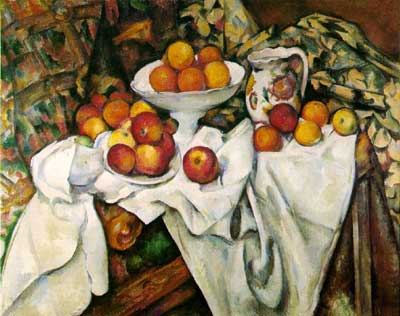
This is Still Life with Apples and Oranges.

Paul Cezanne, Still Life with Apples and Oranges (c. 1895—1900, Oil on canvas, 74 x 93 cm Musée d'Orsay, Paris).

Even if you've seen this painting a million times before, have a really good look at it now.  Just take a look at the whole painting.  

How does it strike you?  How would you describe the picture?  What do you see?  How does it make you feel?  Does it make you happy?  

The fruit seems scattered in quite a jolly, random way, the jug seems pretty and familiar; it's a pleasant, unthreatening domestic scene.

Take a closer look.  Obviously, this being a reproduction, you can't see the canvas and the brushstrokes and the way that the paint is applied - if the real painting were in front of you, you'd look at all of these things - but have a look at the space.  The nice fullsome round fruit, the jug and the bowl - are they really as round and full of volume as they seem?  

The central apple is very real and round, but the fruit at the top left at the back - they seem almost flat.  And the bowl seems tipped up and squint.  What exactly is the whole arrangement sitting on?  Is there a chair underneath?  A table?  It's unclear as to how it all works, which on further reflection, is a little unsettling.  There seem to be a number of different answers to the questions, all of which are largely unresolved.

If you look at how the composition works, what appears at first quite random is in fact carefully orchestrated in a series of dynamic geometric shapes which underpin the whole painting. 

If you join the corners of the painting by drawing a giant imaginary 'X' across the picture, then slap bang in the middle is the apple, like the fulcrum of a wheel.  

Once you notice this, the whole composition turns with a forward motion like the spokes of a wheel (you can see something similar at wortk in Caravaggio's Crucifixtion of St Peter.)

 Caravaggio Crucifixtion of St Peter (Oil, c1600)

If you divide the painting in half horizontally, then all the fruit is sitting above the line in the top half.  All the fruit forms a rough pyramid shape, and there are pyramids of fruit within that shape that echo the pyramids of the folds of cloth.

The bowl is tipped up so that it appears more flattened than it should.  The plate of apples is also tipped up.  There is also an ambiguous area on the left hand of the stem of the bowl, where there is a shape that might be a piece of fruit in front of it, or the darkness of the fabric behind.  

 Cezanne Still Life with Apples and Oranges (detail)

It floats between being positive and negative space, in front or behind.

The cloth in the top right, with its shape, colouring and pattern, also look strangely reminiscent of one of Cezannes other favourite motifs....

Cezanne Still Life with Apples and Oranges (detail)

 Cezanne, Mont St Victoire (Oil, 1890-94, National Gallery of Scotland, Edinburgh)

So is it a cloth or a mountain?   Fabric or earth?  Or just paint and pattern?  Lines and colour on a two dimensional surface?

Paul Cezanne (1839-1906) was contemporary with the Impressionists, but paved the way for Picasso and Cubism, and all that is 'modern' art.  He painted over 200 still lifes, with the aim of 'conquering Paris with an apple'.  These still lifes were very carefully considered over a long time - so long that he would even use wax fruit as props, with wooden blocks to prop up plates to stage-set the arrangements.  

These weren't just paintings about fruit - these were essays in the essential pattern of geometry that he perceived as underpinning nature itself  - the “cylinder, sphere and the cone”.  Hence referencing a mountain in a piece of cloth - the same principles govern the shapes of both.

He saw the pattern in forms and the rhythms of nature, and in the flattening of objects and his playing with perspectives he showed that the experience of looking is about the assimilation not just of one viewpoint - for no-one observes from only one fixed point - but from the experience of looking and of piecing together in your head many, many viewpoints.  

Which of course leads to this...

  Pablo Picasso Les Demoiselles d'Avignon (Oil, 1907)

...but that's a story for another day.

Friday, 20 April 2012

Painting in Neath, the Valleys and Powys

Final day of my trip to Wales, and last part of the Great Welsh Journey!

Another day of sunshine and showers, heading out from the city of Swansea towards Neath and on to the Black Mountains.  

Small  villages dotted a patchwork of fields, and bales of hay lay in autumn fields with all the colours of the harvest.  The sun brought out the contrast of the acidic greens of the late summer leaves and grasses.

Harvest, Brecon Beacons (Oil on board, 10 x 10)

At Merthyr Tydfil, I took the road up to Brecon.  The road wound through gentle sloping hills whose sides were all greens with the purple of heathers, and accented by the occasional waterfall.

Road to Brecon (Acrylic, 5 x 7)

Lunch at Brecon gave the chance to reflect on all the places I'd seen, and I started to make notes about how I wanted to arrange the exhibition and articulate all the material that I'd collected.


It had been quite a trip, and there was so much information to deal with.  However I was clear that I wanted the visitor to the show to come on the journey as well, and to feel as if they were involved in following the route and the adventure round Wales. 

At the core of the show were to be 20 oil paintings, with the key things that I'd seen, and then acrylic sketches and drawings, along with the note-taking postcards, which would inform and add to those core paintings.  Other artists involved in the show would provide different perspectives on Wales and the whole Welsh experience, including landscapes and still lifes.

I also wanted to have a 'Guidebook' to the exhibition - something which would help you get your bearings on the journey, something a little bit different.

Seven months after the trip, the next part of the journey starts with the opening of the show in Bristol next week...

If you'd like to see the fruits of my travels, you can view the paintings online here and the all the postcards here.

If you'd like a Guidebook and an invite to the show, please contact the Lime Tree Gallery here.