Showing posts with label photography. Show all posts

Wednesday, 30 May 2018

The Photography of John Turner

There's a wonderful article on the BBC website about the finding of an old suitcase full of photographs, which prove to be a glimpse of the past and an insight into a person.

Read the article here.
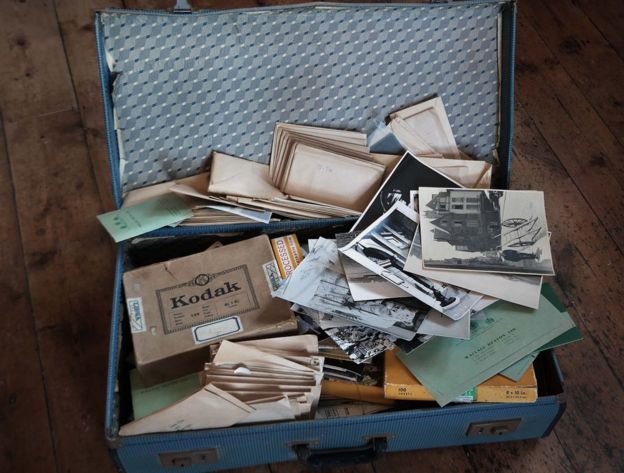

The photos are the work of John Turner, a property manager who died in 1987, and who loved taking photos, but never made a big thing of it to his family.  It was only when he died that his talent was discovered, with images of London from the 1930s to the 50s, and the ordinary people and places of Soho and the street markets.

John seems to have had a need to have a creative outlet - there was a catalogue from the first surrealist exhibition in the 1920s in London in his possessions when he died.  did he long to be a bohemian artist?  Take a look at both the Surrealist overtones and the humour of this shop window scene.
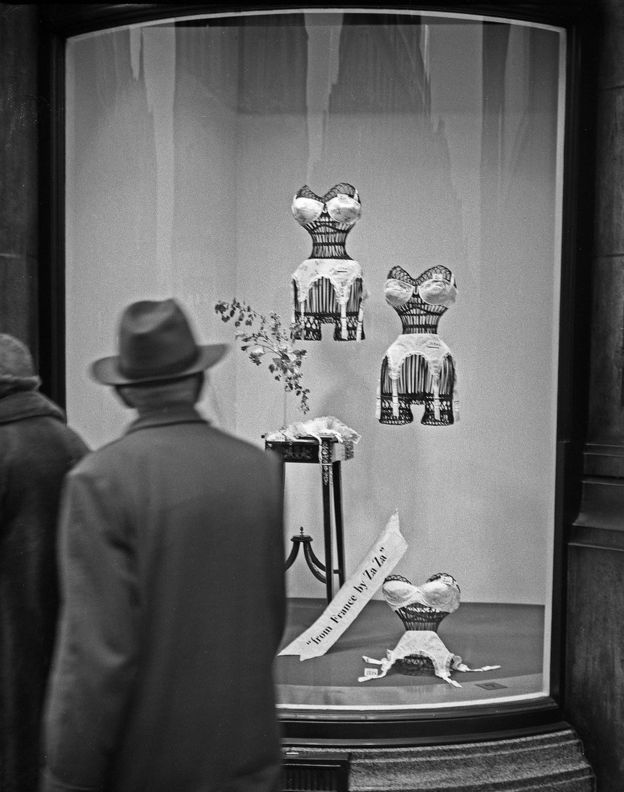
 Bond Street, London, 1960 - John Turner

He certainly has an eye for the quirky and the spontaneuous, getting close to his subjects with his camera, in a way that suggests he was easy-going and non-confrontational, making them feel at ease and allowing them to be natural.  It reminds me very much of the work of ordinary nanny-by-day, photographer-on-her-time-off, Vivian Maier.  
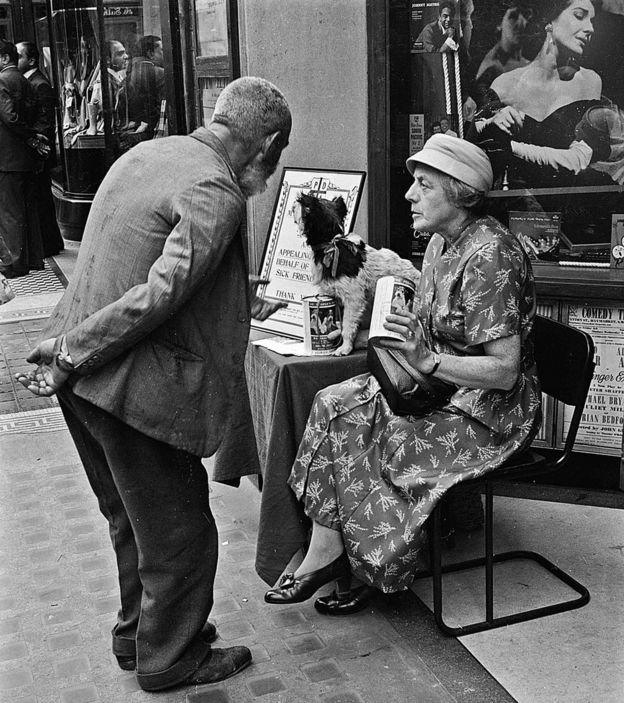
 A woman collecting for the PDSA charity, Regent Street, London, 1955 - John Turner

Apparently he only took one exposure of each subject, so he waited to compose the scene and get it just right, or pressed the trigger at the right moment.  (Maier similarly went out with only one roll of film on each photo expedition, observing and taking one exposure of each subject to tell the story of her journey, until the film was completed, then returning home.)  

Look at how he's managed that capture of the perfect moment here.  Not easy with a cumbersome old camera.
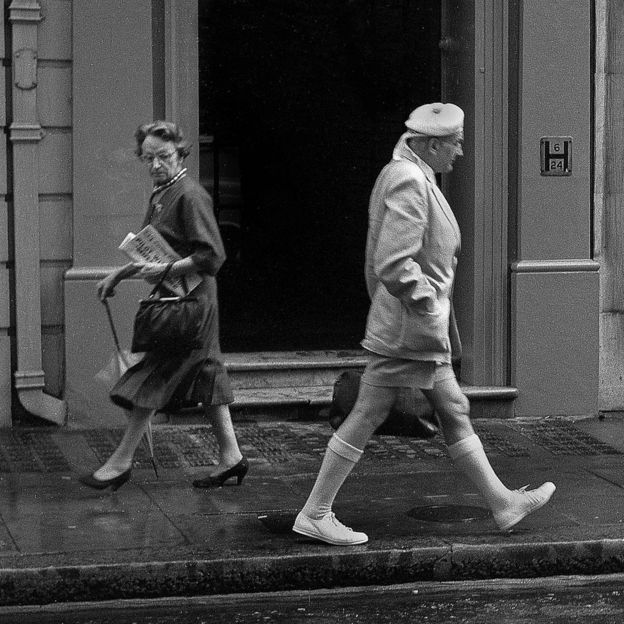

 Passing in the street, London, 1956 - John Turner

Similarly, some of Turner's photos have a certain detatched feel, a voyeur or an observer, although his are more playful than Maiers'. 
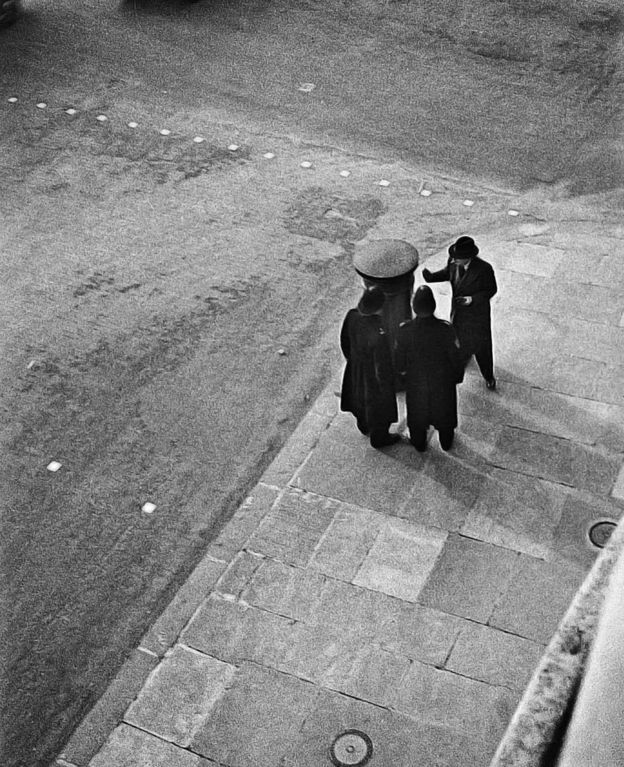
 Policemen seen from above on Charlotte Street, London, 1934 - John Turner

Hers have a certain sadness at the heart of them, his are playful. Hers are, I feel, like a very controlled cry, saying 'I matter, I am here.'  

Both are a way of saying 'there is more to us than people normally see'.

Neither collections were designed to be exhibited.  They were purely private.  A lot of the photos of both Vivian and John were never developed in their lifetime.  There was just a deep personal need to document and create.

Tuesday, 31 January 2012

Degas and the Ballet: Picturing Movement

I thought I'd mention a really excellent show which I saw recently at the Royal College of Art in London - I don't know if anyone else managed to see it.  (It's unfortunately finished now, but I hadn't started the blog last year, so that's why it's only just getting a mention!)  

I'm sure you're all familiar with the work of Degas and his Impressionist paintings of young, ballet dancers, women bathing and frisky horses.  Certainly, the image used on the poster would lead you to believe that this was going to be a very sickly sweet show all about pastel-coloured young girls in tutus, ending with a nice line in fridge magnets in the gift shop.


However, what this exhibition managed to clearly document (and all kudos to the curators for putting together such a well thought-out and thought-provoking show) was the development of Degas' lifelong obsession with the figure in movement.  

Degas was working at a time in the 19th century when there were great technical advances in photography and early film, which were embraced by the artist in the same way that David Hockney is embracing the i-Pad as a tool to make art in his new show at the Royal Academy.  

Degas' compositions were pieced together from various studies made from various sources, so that a group of ballet dancers could come from a variety of different studies of individuals or small groups, made in a number of media.  The information from all the sources was then jigsawed together to make the final picture, giviing an informed sense of a place and an event, rather than an actual documentation of one specific event - almost like one of his early history paintings.

The pose of the figures would often have a casual, fleeting sense to them, as figures can when caught off-guard by the camera, giving a feeling of capturing a moment in time and a fleeting glimpse of something temporal. 

The really exciting thing in the exhibition was the inclusion of his little-seen photographs and their relationship to other work.  Here's one of his photos...


Degas, Dancer Adjusting Her Shoulder Strap (Modern gelatin silver print, 1895)

And a pastel and gouache based on the pose - note all the changes made whilst working out the composition, almost as if the figure is blurred in movement, or as if several viewpoints of the same figure were amalgamated into one - which of course, is what Picasso was doing later in 1907 at the birth of cubism.


Another photograph (the intense colour is due to a chemical reaction during development of the plates)...

Degas, Dancer, Arm Outstretched (Collodion on glass, 1895)

And a related pastel with the figure from the photo at the left hand side


So far from being a chocolate-box artist, Degas was instead a modern, radical artist who thought profoundly about visual problems and was fully attuned to the technological developments of his time.  

Born in 1834, largely self-taught, this free-thinking and experimental approach paved the way for others in the modern age - look at his incorporation of real objects into his bronze sculpture of the little dancer aged 14, with its ribbon in the hair and tutu made of actual material.  That's something everyone from Picasso to Rauschenberg has done.
 
 
Again, giving her age of 14 in the title emphasises the temporal movement, and the quick passing of youth.   

Increasing blindness forced Degas to give up working in 1912, and for the last 5 years, he was a sad figure shuffling around Montmartre.   

One of the most touching things in the exhibition was a short piece of film taken of Degas walking on a street in Paris with his niece.  It is strikingly ordinary, with chattering shop-girls on a break at lunchtime walking sassily down the street and playing to the camera.  But Degas doesn't notice he's being filmed.  It's both ordinary and extraordinary, in that those few seconds capture a fleeting glimpse of one of the true great of art history, just for a moment, not doing anything special, but preserved on a short loop of time.  It's strangely appropriate, rather profound, and very touching.  It's a work of art in itself.