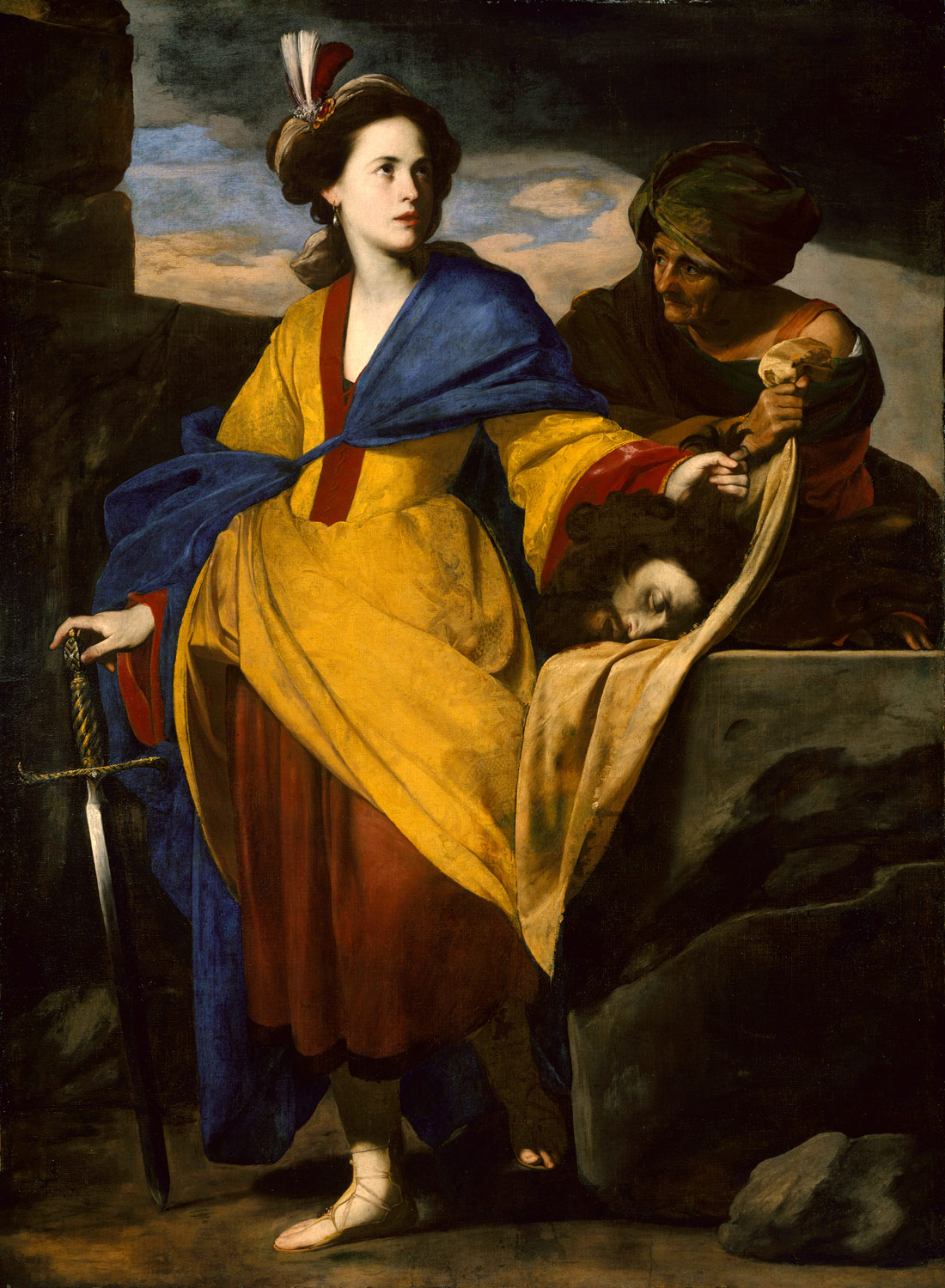
Whenever I'm lucky enough to be in the Metropolitan Museum in New York, I'm always struck by this painting.
Massimo Stanzione, Judith with the Head of Holofernes (Oil on canvas, 1640)
It's a big painting that you have to look up at, and it's set against the dark red background of the museum wall.
It's by Neopolitan painter Massimo Stanzione - not exactly a household name - and the subject is the story from the Apocrypha of Jewish heroine Judith beheading Holofernes. As it explains in the card beside the painting
I suppose I have a thing about paintings of my namesake. It's a subject explored by a number of painters throughout art history, from the another-day-in-the-office version by Lucas Cranach the Elder in 1530
to Gustav Klimt's opulent Secessionist sensuality in 1901
Stanzione was a 17th century Italian painter, often called a 'Caravaggisti' (painting in the dramatic chiaroscuro (literally meaning 'light dark') style of Caravaggio).
In fact. Caravaggio painted his own version of Judith half a century earlier.
Caravaggio, Judith Beheading Holofernes (Oil, 1598)
Whilst Stanzione's painting obviously is influenced by the dramatic lighting effects of Caravaggio, Caravaggio's style was somewhat more visceral and earthy. In his depiction, the deed is actually taking place, and we are spared none of the detail of the blood, the pain, the effort and the pragmatic stoicism.
Stanzione is more classical and lyrical. His version of Judith shows the calm after the storm. Judith steps forward in Apollo Belvedere pose (the classical statue often referenced by artists).
The head of Holofernes lies with an expression almost of sleep. A divine light catches Judith's face, confirming the righteousness of her deed.
I suppose what I like about this picture, and what's so eye-catching, are the colours and the big, beautiful rhythms of the composition. It jumps off the wall at you and captivates you.
Judith's dress is composed of big triangles of red, blue and yellow ochre, and the directions and movement of this drapery sweeps your eye around the painting. The line of her right leg is on the golden section, and this line is carried up to the top of the painting through the red line of her bodice, and then is carried further up by the feather in her headdress, before it just twitches round to the right, and carries the eye down to the curve of the line of the edge of cloth in which the head is being held.
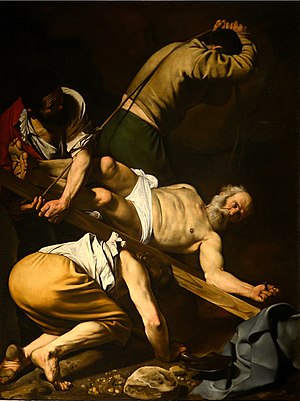
It's a lovely cartwheel composition with a really dynamic sense of movement. Caravaggio did the same thing in his composition of the Martyrdom of St Peter.
Crucifixion of St. Peter (1600-01) by Caravaggio in the Cerasi Chapel, S Maria del Popolo, Rome
Now, Stanzione, whilst not a particularly well-known artist, was a very interesting one. Born in Naples in 1586, Massimo decided to become an artist at 18. He studied in Rome, influenced by Caravaggio, and then moved back to Naples in 1630 with feminist pin-up girl Artemisia Gentileschi. Here she is.
Artemisia Gentileschi, Self Portrait as the Allegory of Painting (Oil, 1630)
She is the artist that Germaine Greer called 'the magnificent exception' - the woman who made it as a respected artist in a world and a profession that was totally the domain of men.
Her father was the Caravaggisti artist Orazio Gentileschi, and he hired a painter called Agostino Tassi to tutor his daughter in 1611. Tassi raped Artemisia, and a trial followed when her father pressed charges, during which Artemisia was tortured using thumbscrews. Tassi was given a year in prison but never served the sentence.
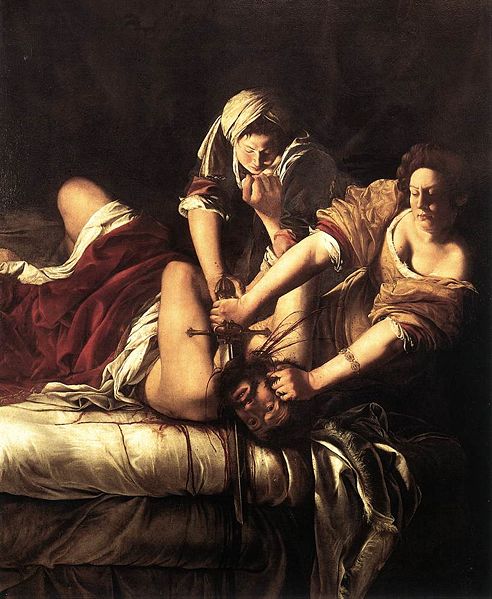
No wonder, then, that over 90% of Artemisia's art contains impassioned depictions of heroines and strong female protagonists, including Judith, and no wonder that the head of Holofernes is being hacked off with such blood-splattering vigour.
Artemisia Gentileschi, Judith Beheading Holofernes (Oil, 1614)
However, Stanzione must have greatly respected Artemisia's reputation as an artist, for apparently their relationship when they moved to Naples in 1630 was that of an informal apprenticeship, with each artist influencing the other. Stanzione's work was enriched with greater light effects, and Artemisia's became more classical, less angry. They even collaborated together on The Birth of St John the Baptist.
Both Artemisia Gentileschi and Massimo Stanzione died of plague in 1656, which swept through Naples in that year and virtually wiped out an entire generation of Neapolitan artists.