Monday, 19 August 2013

Caravaggio at the Edinburgh Festival Fringe

I was through at the Edinburgh Festival on Saturday to take in some of the Fringe action.

First up it was an early morning dip into the murky depths of the dark world of the painter Caravaggio, in Castration on a Tennis Court at the Symposium Hall.  This was a tale full to bursting with pimps, priests, prostitutes and painting, presented in an engagingly effortless, chatty and endlessly knowledgeable style by TV art historian and cerebral hottie Andrew Graham-Dixon.


He's the chap was on BBC4 recently, riding a bicycle whilst doing a piece to camera about the Dutch Golden Age.  What a guy.  Here's his oddly radioactive picture from his website, as he illuminates every corner of our cultural darkness.
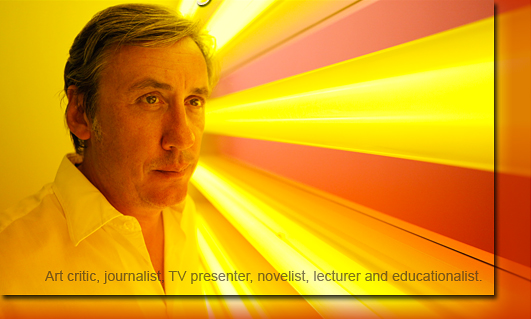

(Apparently, according to his website, you can actually hire him, for your own private tour.  You can even take him abroad.  Or get him to give you advice in order to make the 'right aesthetic and financial choices'. I wonder how much he costs...?)

And now here was AGD in Edinburgh, the real thing, straight from the late-night recesses of our television screens, hopping onto the stage armed merely with his book and a cup of coffee, and nary a lecture note or a lecturn in sight (nor any strange radioactive rays). 

He launched into a story about the reaction of Keith Richards (of the Rolling Stones) on seeing Ottavio Leoni's drawing of the 25 year old Caravaggio.  Here it is.

"He looks like a bad boy!" rasps AGD, doing Keef, "If he were alive now, he'd be a Rolling Stone!"  He likes doing an impersonation or two, does AGD.

Now, one of the key people who helped AGD's research for his book Caravaggio: A Life Sacred and Profane was none other than the Papal Devil's Advocate (for there is such a job description), a chap called Sandro. He's the guy who dishes the dirt on any prospective saints by trawling for trash in the Vatican Archives.  For the last 32 years, he has spent his lunch hours going through several million records in the Archives on his own personal quest, in the hope of finding rubies in the dust - namely papers which mention Caravaggio.  

So far, he's found a couple of hundred, which must mean a hit rate of about one new document coming to light every six weeks.  Just enough to keep you searching.  The things which have come to light include an inventory made by Caravaggio's landlady in Rome, detailing the contents of his room - his swords and daggers, his chamber pot, his 12 books - but not the titles of the 12 books.  Chinks of light in the darkness, and the eternal frustration of the ommissions.  She also noted that he'd messed up the room by knocking a hole in the ceiling - the possible secret of the dramatic lighting effects of Caravaggio's chiaroscuro...?

AGD has effortless fluid command of the myriads of names, dates and details, and the skill and energy to tell a tale.  This story is one of darkness, passions, violence, danger, and the rule of the street.  Life as a painter on the cusp of the 16th and 17th centuries in Rome was survival of the fittest in the gutters, gritty, brutal and tough.  And yet a painter's job was to communicate the vision of the light of heaven from the very midst of all this profane darkness, to bring religion to the masses by picturing the divine.  No wonder Caravaggio's work was full of darkness and light, and the chiaroscuro of contrasts and contradictions; death and life, opulence and poverty, the sacred and the profane.

The brutality and brevity of life hit Caravaggio from a very young age.  When Bubonic plague swept through Milan in 1576, his family lost nearly every male member.  Father, uncle, grandfather - all were gone in days. Before Caravaggio was six years old, all his male role models were wiped out, and the dead were piled up in the streets.  

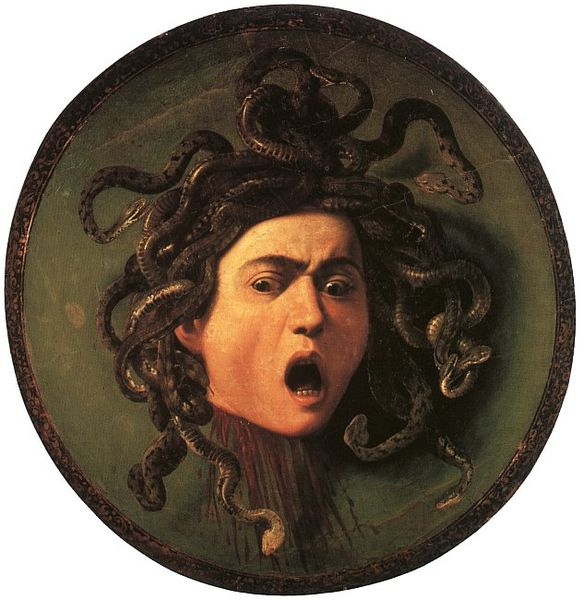
No wonder when he painted a self-portrait, it was like this.


Caravaggio, Medusa (Oil on wood) 1590, Uffizi
Here he is portayed as the Medusa, painted onto a curved shield, which has a handle across the back so you can hold it.  AGD acted out the scene.  In the legend, Perseus is going to slay the snake-headed monster Medusa.   If he looks at her, he will be turned to stone, so he has the shiny round shield on his arm and can see the Medusa's image reflected in it.   He reverses into the fray, sword flailing, and cuts off her head.  As it flies through the air leaving streams of blood,  in the last 12 seconds of consciousness Medusa can see her own death reflected in the polished surface of the shield. 
It wasn't the last time Caravaggio would paint himself beheaded.  By the time he was painting these sort of images, he had already seen much more brutal horrors right on the streets. Plague.  Fights.  Executions.

No wonder Caravaggio's art was all about 'making it real'.  Real people.  Real poverty.  Real dirt.  Real miracles.  Miracles that are there for those who can see, not heralded by flights of angels. He used prostitutes as models (and was probably a pimp himself).  In fact, here his model for the Virgin Mary was a drowned prostitute pulled from the Tiber.

Caravaggio, Death of the Virgin (1606, Louvre)


The swollen body of the Madonna proved to be such a stumbling block for the church of Santa Maria della Scala who commissioned The Death of the Virgin, that it was rejected.  Thus it eventually ended up hung in an appallingly lit long corridor in the Louvre.

Caravaggio's colours were the colours of earth, made from actual earths and clays, not the expensive colours of church-controlled lapis lazuli. Thus he painted the Madonna in a red dress, not a blue one, as was the tradition. 

His paintings are like film sets, like modern installations, using the real light flowing through the three dimensional space of the architecture of the churches in which the paintings were sited to become the divine light in the two dimensional paintings.  The space within the paintings references the space in which we stand when we are looking at them (which is why it is so important to see the work in situ). Filmmaker Martin Scorcese compared 16th century Rome to Hollywood, with winning of a commission for an altarpiece being like getting the rights to make a movie.  

In Caravaggio's blockbusters, which had the common masses of pilgrims buzzing round them like flies, he creates characters that people can actually identify with, that they might meet on the street. Thus, dirty-footed Saint Matthew is fallable and semi-literate, 
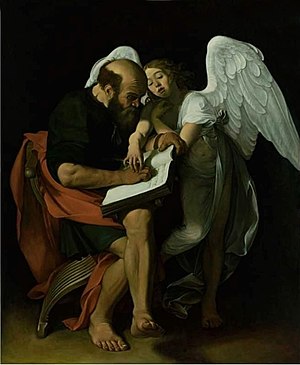
Caravaggio, St Matthew and the Angel (1602, destroyed)

Saint Peter takes a huge amount of human effort to kill, 

Caravaggio, Martyrdom of Saint Peter (Santa Maria del Popolo 1600)

Saul becomes like a newborn baby lying in the manger as he falls from his horse, 


and the Virgin Mary's ascension into heaven is suggested not by cherubs, but by a void, filled with an impersceptible breath, a heat, the wave of a curtain in the back room of a house, leaving behind her heavy, swollen body sagging on the bed. People looking at the painting would recognise death when they saw it, as they would have seen it as a matter of course in their lives, and they would certainly recognise it here.  This is mortal death, plain to see.  

But the spiritual, the miracle, is there if you look carefully enough.  Because, says Caravaggio,  that's how it is in real life.  The divine isn't about cherubs and gold and the trappings of religion.  It's right down in the grime, it's real, it's happening all around, you're breathing it in, it's something real and alive and vital and everyday.

Similarly, there are signs of the miracle of the risen Christ in the Supper at Emmaus - but only if you can see them.


Caravaggio, Supper at Emmaus (1602, National Gallery London)

It's all in the shadows.  The shadow behind Christ forms a halo, the fruit basked teetering on the edge of the table (between life and death) casts not the shape of the fruit, but the tail of a fish - the ixthus.

And the arguments!  You wouldn't want to have been a waiter in Caravaggio's Rome - one waiter was assaulted by an artist for daring to serve a meringue that was too crunchy.  Or was it not crunchy enough?  And Caravaggio got into trouble for smashing a plate into the face of a waiter who brought him a dish of buttered artichokes rather than ones dressed with olive oil.

The fact that Caravaggio got into a fight over a buttered artichoke was no arty-joke.  Sorry...

However, as AGD explained, there was a logic to Caravaggio's anger (and he was a man full of energy and anger and passion). In this case,  the waiter was actually making a racial slur by insinuating that fine Roman olive oil was not worth wasting on butter-sloshing northerners like Caravaggio (Lombardians being famous for their love of lashings of butter and cheese).  So Caravaggio smacked him in the face, gashing it open and knocking out teeth.  You don't like my face?  Well, no-ones going to like yours much once I've finished with it.

And now onto the subject of the whole talk - namely that castration on a tennis court.  Caravaggio was never, it seems, beaten when it came to one-on-one fighting with a sword.  And in this case, he killed man, on a tennis court -  Ranuccio Tomassoni.  Not that they were actually playing tennis, as AGD acted out for us, sweeping back his floppily unruly fringe once again in a gesture that annoyed my follically-challenged lecture companion.  No, you could be put to death for holding a duel.  Instead, this was a smokescreen - hold a game of tennis and pretend that a fight broke out, that it was a crime of passion.  Oh, those hot-headed Italians.  We squeaked in our comedy squeaky seats in excitement.

Caravaggio, it seems, was aiming for Tomassoni's groin, with the aim to castrate him, in an act of revenge appropriate to the nature of their dispute.  However, in the split second that it took for the sword to pierce Tomassoni's groin, the course of Caravaggio's life was changed forever, and its downward spiral had begun.  For the blade pierced the femoral artery, and the man bled out in seconds.  According to accounts, the tennis court was awash with blood, fountains of it all over the place in shocking torrents, covering the onlookers; he was dead in moments.

By this time, we'd been going for an hour and twenty minutes, and the janitor was getting agitated about the next show coming on - so there we pretty much stopped.  Not that there isn't about another 30 years worth of material (probably) which could seemlessly issue like unstoppable streams of silk from the lips of the prodigiously elephantine-memoried Mr Graham-Dixon.


Here he is afterwards, signing my copy of A Life Sacred and Profane whilst I burbled some complete and utter total nonsense. 

Hey ho - never meet your idols, eh?

Later the same day, I met Rick Wakeman, and did pretty much the same thing.

Wednesday, 14 August 2013

Edinburgh Paintings Online

If you'd like to see the paintings that are currently on display for the Edinburgh Festival at the Morningside Gallery, then click HERE to see them all.

Title: Fenced Fields by Farm, Fife
Artist: Judith Bridgland
Medium: Oil on Linen
ImageSize: 24" x 26"


The images show the paintings in their frames.  As you can see here, the frames are bespoke hand-made and hand-gilded, with cream-coloured slips and glass.  I prefer to glaze the paintings, as this is better for conservation purposes, preserving both the surface and the colour of the paint.

Monday, 12 August 2013

Good Stuff

Last month I wrote about Goddess Debbie Harry of Blondie here, who's still rocking it out at 68.

Well, tonight it was another Third Age Wonder, the red-haired vision of space-punk cosmic kookiness that is Kate Pierson of the B-52s.


This woman is 65!  65!!!  Cosmic thing indeed.

Yes, they may be older since I last saw them in the 90s at the Barrowland Ballroom - but then, aren't we all older?  Although some of use aren't quite so bendy or indeed so fundmentally groovy.  That's one inspirational woman.

Still singing about the girl from Ipanema going to Greenland, there was plenty of cosmic crustacea, robots, meteor showers, volcanoes, and of course lots of banging on the doors of love shacks from mini-skirted micro-beehived Kate, a strangely permanently-amused Cindy, and sprechgesang Fred.


Shake those maracas and party on!

Thursday, 8 August 2013

Charleston Farmhouse - Bloomsbury Group Masterpiece

Whilst I was on my photo-taking trip round the south coast of England, I paid a visit to Charleston Farmhouse in Sussex with my cousin.  I've visited it before, but I was dying to see it again as it's so inspirational.

Charleston Farmhouse was, from World War 1 onwards, the home and country meeting place for the writers, painters and intellectuals who made up the Bloomsbury Group, including Vanessa Bell and Scots-born Duncan Grant (he of the Omega workshop). There was quite a lot of goings-on, artistic, intellectual and otherwise.

Here's Vanessa, circa 1910
                                                                                                      Getty Images

and here's Duncan, who was apparently absolutely irrisistable to all and sundry.

(c) George Eastman House

What do you think...?

Now...it was a lively household, with many guests coming and going who were big names in the literary and artistic circles of the time, such as E M Forster and Roger Fry (with whom Vanessa had a relationship in 1911).

Vanessa Bell was married to Clive Bell.  Duncan Grant was gay, with a series of partners/models, including his cousin Lytton Strachey, politician Arthur Hobhouse, economist Maynard Keynes, and David Garnett. 

Vanessa had a baby in Christmas 1918, who was born at Charleston and weighed using the kitchen scales.  Upon seeing her there, David Garnett (Grant's lover) declared 'I'm going to marry her!"  In a rather creepy way.

The child, called Angelica, grew up believing Clive Bell was her father, but discovered at 17 that her father was in fact Duncan Grant (much to her distress).  

Duncan Grant with Angelica Bell (c) The Tate Archive

And yes, Angelica then went on to marry David Garnett.  Blimey!!  Unbelievable.  (And it's actually far, far more complicated than that - for more details read the article here.)

Despite Duncan's homosexuality, he and Vanessa were devoted to each other, and lived together until she died, in 1961, in the upstairs bedroom, looking out at the garden.

(The beds are surprisingly small and narrow....all things considered.)

So the household was a seething mass of love triangles, suicides and Communism.
 
Although the farmhouse was only rented, the group went to work decorating, embroidering, and printing pretty much every available part of the interior, as well as designing the garden, in a frenzy of creative outpouring.  Plates, furnishings, textiles, ceramics, rugs, lampshades like collanders which cast a sparkly light, - you name it, they made it.   Walls are stencilled.  Fireplaces and doors are painted on.   It's an eclectic, electric whirl of 60 years of creative energy.  Although mentioning electrics, the wiring looks decidedly dodgy (although I was assured it's all been, er, checked...).

Here's the dining room, where Queen Bee Vanessa insisted on being mummy and sitting at the head of the table serving everyone at the strictly-timed evening meal.  She liked to be the alpha female of the group.

I'm sure there were many heated debates between them all.


Can you imagine what on earth it must have been like to be invited there as a houseguest?  You'd have to be on your toes not only to keep up with all the intellectualising, but also just wondering what exactly what was going on between everyone, and was there a lock on your bedroom door.

Here's the drawing room.  It has lovely views into the garden, as if nature is coming into the room.  In fact, a lot of the rooms are double aspect, and have a wonderful feeling of light about them, even though some of them have very dark grey painted walls.


Vanessa painted a lot of murals using circles as a motif.  It's a very feminine symbol, like a full moon, or the circle of life.

This is Duncan Grant's studio.  I have to say, as achingly desirable as it would be to have as a studio, is does have the feel of somewhere to sit and act the part of being an artist, rather than the sense of an active working studio.  It's not exactly Frances Bacon's workplace.

Here's a detail of the lock on one of the doors.


The colours are pastel and chalky, like the soil of east Sussex itself.  The paints were formed from ground pigment mixed with rabbit size glue in order to adhere to the surfaces on which they were applied.

This is the bathroom - even that's decorated.

 (c) The Charleston Trust

The general bohemian feel of the household with all its complex intertwined relationship entanglements is probably summed up in this Charleston textile, an embroidered silk hanky.

University of Brighton

If you're ever near Eastbourne, then I do urge you to go.  Check opening times first, and be aware that you have to go round in a small group as part of a guided tour.  However, this is wonderful.

The whole place is inspirational, as it just has such a huge sense of energy about it.  It makes you want to go off and paint all over your entire house!!

Tuesday, 6 August 2013

On Show in Edinburgh

Here's a couple of the paintings that are going to go on display in the Edinburgh Festival show at the Morningside Gallery on Saturday 10th August


Curve of White Sand, Morar (Oil, 17 x 17)


This is of the famous white sands of Morar (which are also rather pink in colour in places), which look out over the western isles.  On a clear day, the view is amazing, and the sea is the colour of something you might find in the Mediterranean.

Gentle Waves, Camusdarach (Oil, 10 x 10)

Another little painting of the sands near Morar.


Distant Yachts from the Edge of the Water, Morar (Oil on linen, 20 x 20)


Peaceful Boats (Oil on linen, 24 x 26)


Fenced Fields by Farm, Fife (Oil on linen, 24 x 26)


This is of a beautiful early spring day in Fife, with a very clear blue sky over patterns of pastel fields.  The fields are near Auchetermuchty on the way to Cupar.

If you'd like to go along to the gallery to see these and other paintings of mine, then you'd be very welcome to come along and enjoy the champagne reception.  The gallery is open from 11am on Saturday 10th August, and you'll find it at  

94 Morningside Road, Edinburgh EH10 4BY.  

All welcome!


Sunday, 4 August 2013

Peter Capaldi - the New Doctor Who

So it's finally been announced - Peter Capaldi is the 12th incarnation of the Doctor.


Which reminds me of a night in June in the early 1990s.  

I was at the Glasgow School of Art Degree Show, which in those days, was attended by all and sundry - you didn't need a ticket to get in.  All the arty people in Glasgow, it seemed, turned out and surged through the corridors of the Charles Rennie Mackintosh building in an attempt to take in the work of the latest graduates and hopefully find the latest new big name.  The place was packed.

I was going through a set of the big heavy swing doors in one of the corridors, when who should be coming the other way but the Future Time Lord himself (although I didn't know that then), and ex-Glasgow School of Art student, Peter Capaldi.  

As it was a heavy swing door, I politely held it open for him.  He was looking back, talking to his companion, his arm held out in front of him to push the door and not looking where he was going.  Consequently, as he proceeded forward, his outstretched hand came into contact not with the door, but instead took a hold of my left breast.

He looked round.  He looked at his hand.   I looked down at his hand.  We looked up at each other.  He removed his hand.

"Sorry - I thought it was a door knob." he said.

Which I've always thought an odd thing to say.  Because the doors of Mackintosh's masterpiece don't have any door knobs.  Or door handles....

Taisie Design

However, getting back to the subject in hand (so to speak), what will the casting of Capaldi mean for the role of Doctor Who?

The Matt Smith era has been, I would say, somewhat of a disappointment.  After the rebooting of the series in 2004 with and angry, brooding, leather-jacketed Christopher Eccleston ("every planet has a north") as the Ninth Doctor, 
and then the iconic casting of David Tennant as the Tenth, 


BBC

Matt Smith's youthful Steven-Moffat-era Doctor descended into a morass of labyrinthine
plottage. It's not Smith's fault - he did his best, but ended up with a persona consisting of cut-and-paste wildly-convulsing physical tics as a replacement for insightful character.  Physical semaphore.

The thing is that Who became ALL about the writing, and not about the characters. Plot obfuscating character.

It became Moffat (or Gatiss) going "look, remember that upturned crate with writing on it 3 episodes ago that was onscreen for a split second and you could only see if you paused your television and stood on your head? Well, it was actually a really meaningful clue to the story arc! Or maybe not!! Ha Ha! Wow, we're so clever now we're in charge."

Rather than the episodes being driven by the actions and decisions of believable, fully fleshed-out characters finding themselves in certain situations, you always felt the heavy, self-congratulatory, solopsistic hand of the writer manipulating the action. And that made for dull, clunky, unsatisfying viewing.

Like being satisfyingly drawn into any good drama, watching the adventures of a madman in a box is about the willing suspension of disbelief. But plot lines of such mind-bending convolutedness, where every detail is meaningful, went beyond being challenging and interfered with the basic aforementioned willing suspension of disbelief. You wanted to be drawn into it all and care about it and think, for a while, that it was real. But it became so contrived it was blatently obviously not real, and that strikes at the basic heart of good drama, because you can't connect with it. The hand of the maker had become too obvious.

Which is why people were turning off.  You neither enjoyed the fun of the adventure, nor were gripped by the characters, and therefore weren't scared by the monsters because there was no genuine sense of peril.  You no longer cared.  And my son thought it was boring.  He's a child. He should know.

So now we have Capaldi, a decision that 90% of Whovians are ecstatic about.  (When did that last happen?)  

In the 50th anniversary year of the show, Capaldi is seen as a return to 'old values'.  For a start he's not some young whippersnapper - at 55, he's the same age as original Doctor, William Hartnell.  There he is on the left.


BBC
(Blimey, people looked a whole lot older back in 1963, didn't they?)

He even made a fan-boy nod to Hartnell when he came on stage at his BBC announcement.


(That's precision thumbage there, honed in the mirror, me-thinks.)

So Capaldi brings a certain frisson of the original grandfatherly gravitas back, whilst not looking like an actual grandfather.  (In fact, he's still not half bad looking...)


Now, he's probably not going to be running around quite as much.  But hey, stories that don't always resort to the line "Run!" and the lazy plot standby of the get-out-of-any-situation sonic screwdriver might not be a bad thing.  It might lead to a bit of practical creativity to get out of situations of peril.  And a return to the driving force of the character at the heart of the action.  

Yes!  Character.  And action!!  Not overblown special effects, not overdone plot.  Just stuff you really feel (and please, without Murray Gold's volume-at-11 music telling you exactly how you should be feeling - remember Murray, in space, no-one can hear your score).  Maybe even 'story' rather than 'plot'!*  Now there's a luxury.

If you look at Capaldi's back catalogue, it's got a lot of the Doctor ingredients - the gentle comedy of Local Hero and Soft Top, Hard Shoulder 
(crikey, he wasn't half bad looking, was he?), the quirkiness of Franz Kafka's It's a Wonderful Life,

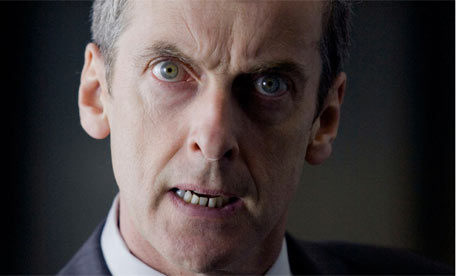
(yes, that's half-man, half-cockroach), and the vein-in-forehead-pulsing pent-up anger (if not the sweariness) of The Thick of It.  

The Guardian

The Doctor has all of those things, plus you've got to believe that he also has the authority, the wit, the intelligence, the darkness, the depth, and the humanity (yes, even though he's an alien) to take on the whole of space and time, plus the inhumanity and the fragility to fail.

And Mr Capaldi's a fan.  You've got to 'get' it to be in it.

The thing that concerns my son is, though - where does that leave the Doctor's companion?

 
Clara is going to start the Christmas episode (which we might all actually be looking forward to now with genuine excitement for the first time since The Christmas Invasion) with a 20-something Doctor, and end up with an old bloke.  Awks.  If not just plain Ewwww.

Yes, it's going to be a whole new New Doctor.... a Doctor that is, of course, a reflection of the times in which we live, a mirror to ourselves.  Older, sadder, wiser, battered but still resilient, and still rather magnificent.  

Let's just hope he plays it with his own Scottish accent.

* Story = the King died then the Queen died.  Stuff just happens - like life.
Plot = the King died then the Queen died of grief.  Causal relationship between events, as beloved of scriptwriters, most notably Steven Moffat,  because it links events and creates dramatic tension.

Painting with Pixels

Here's a picture by David Hockney, whose work I've talked about I've talked about before in my blog here.


David Hockney, The Arrival of Spring

This is a work which the 76 year-old artist created using an i-Pad, and then has been blown up to a vast size. Pixels are used like paint.  An old dog learns new technological tricks in order to create.

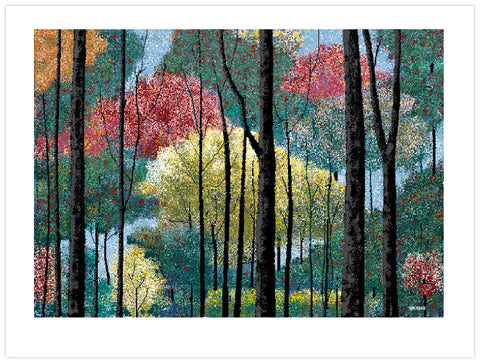
Here's a picture by American artist Hal Lasko.

Looking Up, Hal Lasko

Making Mr Hockney look like a spring chicken, 98-year-old Mr Lasko, who is registered blind with wet macular degeneration,  made this using Microsoft Paint.  

Trained as a graphic designer, he took up creating with the computer in recent years when his sight began to go, and now works up to ten hours a day on pieces.

I'd like to see his work blown up to fifty feet long and put in the Royal Academy.

 Hal Lasko, Woods in Avon

Read more about Hal Lasko HERE.